


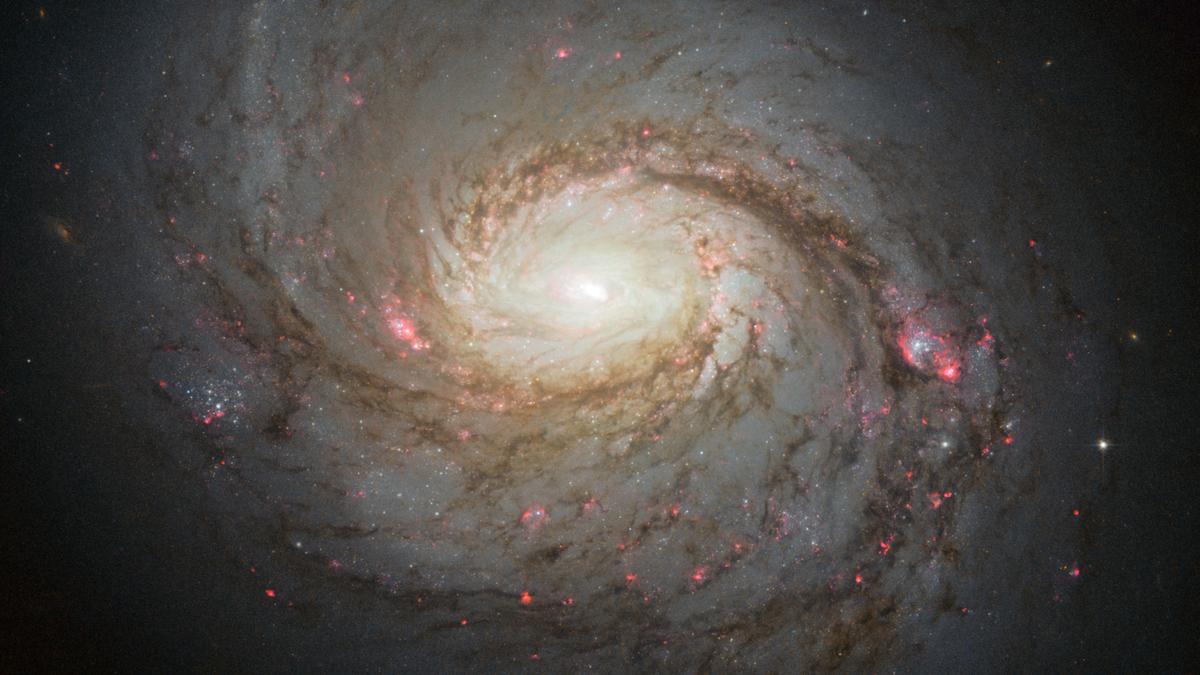
A new study has revealed more spiral galaxies in the universe’s youth than astronomers had expected.
The universe is about 13.8 billion years old and is home to different kinds of galaxies, from spiral to elliptical and those with or without bulges. Astronomers previously believed spiral galaxies formed about 6 billion years ago, but a new study by a group of astronomers from the University of Missouri in the U.S. has called this belief into question. It was published on June 11 in the Astrophysical Journal Letters.
While the universe’s younger galaxies have tended to be spiral, the older ones have a variety of shapes. Astronomers study them to understand how they formed and evolved. But studying the older galaxies is more difficult because the light from them is fainter.
Not just hot air
An important idea in astronomy is that as the universe cooled down from a dense plasma state, it contained more and more hot gas. They formed clumps of matter that eventually gravitated to become galaxies. These early galaxies had irregular shapes and lacked disks. But as they cooled as well, they formed hot, thick disks that later became thinner and finally spiral ‘arms’ — a process that took billions of years.
This theory is now suspect. “Our work shows that this cooling down and spiral formation occur around the same cosmic time,” said Vicki Kuhn, a graduate student at the University of Missouri and a member of the study.
Astronomers routinely see stars forming in real-time but since all the galaxies have already formed, they use a sort of astronomical archaeology to study them. “We don’t see proto-galaxies,” said Girish Kulkarni of the Tata Institute of Fundamental Research, Mumbai, who was not involved in the study. “What we do then is study how the galaxies evolve. The spiral galaxy fraction is one way to do this biography.”
Seeing further into the past
The first step is to use light of the infrared and optical wavelengths to detect galaxies in the early universe. Since older galaxies are harder to detect, we need powerful telescopes. Ideally, astronomers would like to observe light emitted when the universe was around 500 million years old, when the galaxies were thought to be forming.
NASA’s James Webb Space Telescope, launched in 2021, has helped astronomers gaze much deeper into the universe’s past than before. The University of Missouri team used the telescope to study a cohort of 873 galaxies individually and identified at least 216 spiral galaxies. Some of them dated to 1.5 billion years after the universe’s birth.
For the study, all six authors went through each image to classify it as spiral or non-spiral. Prerana Biswas, a postdoctoral researcher at the Indian Institute of Astrophysics, Bengaluru, who wasn’t involved in the study, said the method is crude but shows the result is free of human bias. Abhijeet Borkar, a research scientist at the Astronomical Institute of the Czech Academy of Sciences in Prague, agreed. He wasn’t involved in the study either.
But while Dr. Biswas said future studies should use automatic algorithms to spot spiral galaxies, Dr. Borkar said there are few alternatives to this sort of verification. “Even for invoking machine learning or neural networks, this is the first step. The only way to improve is to have a larger number of astronomers” going through the data.
An underestimate comes to light
The researchers then compared the number of spiral galaxies to the total number of galaxies. They found that between 3 billion and 7 billion years after the Big Bang, the fraction of galaxies with spiral shapes increased from about 8% to 48%. Previous observations had indicated an increase from 5% to 30% instead. “It’s much greater than what was known before,” Dr. Kulkarni said.

Dr. Borkar was in fact taken aback by the fact that spiral-armed galaxies were fully formed so early.
The new observation shows the number of spiral galaxies is high as well as that they increased in number as the universe evolved.
Dr. Kulkarni explained how astronomers study the formation of galaxies. They develop mathematical models on powerful computers and let them evolve with time. While dark matter and gravity exert dominant influences on the universe’s evolution, they aren’t enough to produce galaxies. So astrophysicists include hot, dense gases in the simulation. These simulations have thus far matched what astronomers have observed.
As the universe ages, the gases cool and clump together, and stars form. As the stars evolve, they give rise to supernovae, which create most of the elements we have on the earth today. Some black holes are formed, too, and a few of them sit at the centres of galaxies and exert their own influences.
From simplistic to complicated
Given the uncertainty in many of these models’ parameters, astrophysicists also use observations to refine them — and such refinements are often crucial.
The Hubble Space Telescope is famed for its clear images of distant celestial objects and astrophysicists have used it to refine many models. But then some studies found signs that the early universe had many galaxies with disks. Astronomers think such galaxies were actively forming new stars.
The authors of the present study didn’t compare their observations with the simulations, however, which has puzzled Dr. Kulkarni.
He also said the link between these sophisticated simulations and the present-data may not be easy to decipher. All experts agreed astronomers must carefully reexamine the existing framework of observational data and theoretical studies.
“The earlier scenario was more simple,” Dr. Borkar said. Now “the theories need to be made more complicated.” He added that it’s possible that while stars are formed in some regions of galaxies, hot gases could be present simultaneously in other regions.
‘No one knows’
The new findings could also affect what astronomers understand about the rate of the formation of stars in the universe. For earth-like planets to form around stars, spiral galaxies should host a sufficient amount of elements heavier than iron in their spiral arms. When heavier stars die and blow up as supernovae, they throw out these elements into the arms. But if something else gets in the way of star formation — such as the influence of black holes — then not enough stars will form in the first place.

As the universe aged, spiral galaxies became more populous even around the time star formation peaked. Over time, spiral gases have less and less gas in their spiral arms, slowing the formation of more stars. But collisions between galaxies, like the one predicted to occur between our Milky Way and its neighbouring Andromeda in about 5 billion years, could restart this process into a second life while also creating an elliptical galaxy.
Overall, our view of the universe’s cycle of forming galaxies, stars, and earth-like planets seems to be getting more complicated. What does it imply for our understanding of galaxy formation? Dr. Biswas said, “I can safely say that no one knows.”
Debdutta Paul is a science writer at the International Centre for Theoretical Sciences, Bengaluru, and a freelance science journalist.