





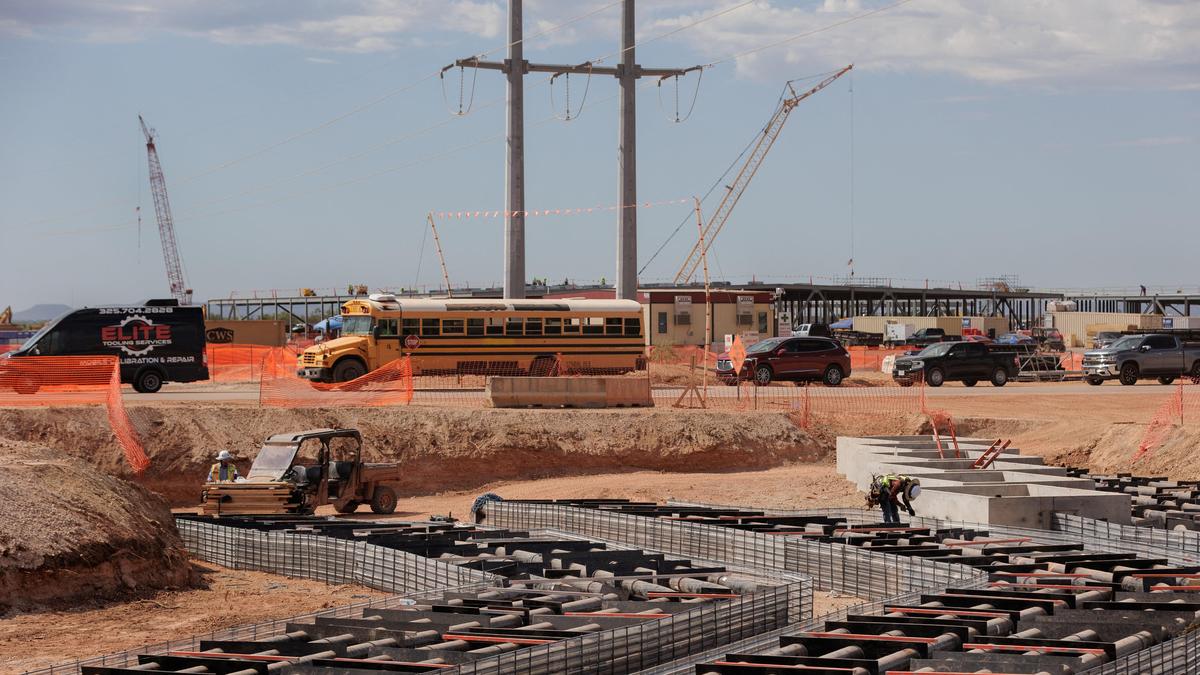
Many think the idea of ‘dumping’ in global trade is a red herring. The reason is obvious: if country A is able to dump certain goods in country B, it’s not because A has smuggled them in. It’s because someone in country B was interested in receiving those goods, and B’s laws allowed for them to be imported.
This said, it’s possible to argue that dumping is a legitimate concern, and not a red herring, if a country’s government and its people are at odds on a policy yet the government enforces it to pander to a few commercial interests — a situation not unheard of in modern democracies. India in particular has seen this often with its national and international commitments as well as its domestic priorities, ranging from including commercial plantations in forest surveys to pad afforestation numbers to importing oil for cultivating itself as a growth market for global fossil fuel producers forced to move away from richer countries that are decarbonising.
Good versus bad data centres
Today, data is the new oil, and it’s possible the country is at similar risk of being ‘dumped’ with poorly designed data centres making inefficient use of energy, guzzling large quantities of water, and polluting the environment. To be sure, data centres are not implicitly bad and can be run efficiently, and in the larger scheme of things be a net benefit for the national economy.
But ensuring they have precisely that effect requires every data centre to be located in a place where power supply is reliable as well as where the project pays for required grid upgrades. The centre should also be designed for high utilisation, meaning the servers should not be idle; this requires properly estimating the capacity and scheduling workloads. Second, the centre must incorporate efficient cooling as a core component rather than as an afterthought, including in the form of efficient airflow management and allowing higher inlet temperatures within the established thermal envelopes and reducing the demand for mechanical cooling. In fact, where it’s feasible, centres should also use naturally cool ambient air or water and, for intensive AI workloads, use liquid cooling. At the same time, they should minimise their dependence on potable water and use recycled water where available, and minimise the use of backup power. Finally, the data centre should measure every relevant parameter that it’s expected to optimise over time.
Conversely, a bad data centre is often one that’s efficient on paper but inefficient on the ground because it’s been installed in the wrong place and/or with the wrong design. For instance, it could be located in a water-stressed area and be designed to use evaporative cooling, which requires a lot of water. Or it could be running older cooling setups without basic airflow controls, thus increasing the energy overhead.
Google’s proposed Cerrillos data centre in Santiago, Chile, offers a real-world example. Local opposition to the project focused on the project’s consequences on an increasingly water-stressed region. A Chilean environmental court subsequently required Google to account for the effects of climate change on the aquifer and to consider alternative cooling methods, causing the Big Tech company to switch to an air-cooled design.
Brooking resistance
India is widely cited as a market with great potential to host these facilities. While the U.S. is far ahead of India, it has also started to show outward signs of popular resistance to these facilities. India can learn from this to avoid taking on a bad proposition itself, especially when local governments are prepared to cut corners and developers try to hide behind opaque contracts.
Of late, a surge in proposals for data centres in the U.S. has met with organised local resistance, with municipal boards having to decide whether energy- and water-intensive facilities fit their zoning rules and residents anxious that the projects will endanger property values and local water supply. In North Carolina, a mayor signalling that a proposal for a data centre would fail unanimously, prompted developers to rescind it even after it promised environmentally friendly features. In another town in Minnesota, a proposal for a large data centre was put on hold after residents complained about the inadequacy of the environmental review. They said local officials and utilities had known about the proposal for nearly a year before disclosing it, with the secrecy intensifying the conflict.
Industry groups and consultants have said that such pushback is increasingly becoming the norm but that it has also been pushing developers to rethink how early and how transparently they need to engage communities.
Given these issues, it’s salient that countries in the Global South have poor zoning in practice, a less than satisfactory record of governments involving community members in planning construction projects, lacklustre enforcement of environmental regulations, and aspirations of growth in the IT sector. When the capital for data centre projects faces sustained, organised resistance and local approval processes that are more participatory, it can be more tempting to look for jurisdictions where land is cheaper and political friction is lower. Data centres can’t be dumped anywhere — they still need reliable power, network connections, minimally uncertain land titles, and geopolitical predictability — but it’s possible the most resource-intensive and least locally beneficial ones could disproportionately target places where the costs can be more easily externalised. Many governments are in fact explicitly courting data centres as a part of their AI or IT industrialisation strategy through land and power concessions and expedited clearances. In India itself, multiple State policies offer sizable fiscal and infrastructure incentives and promise streamlined approvals.
Latin America like the U.S. has already had multiple disputes where communities have argued that governments advanced projects without proper environmental review, particularly in water-stressed areas. Many cases in Chile have been particularly emblematic, leading to vehemently contested litigation and protests. It hasn’t helped that while data centres are capital-intensive, they’re also relatively low on permanent jobs, leaving governments without one of their favourite bargaining chips.
Signs to watch for
India itself is a reasonably high-risk candidate for ‘data dumping’. The country is actively positioning itself as a major data-centre hub and multiple independent forecasts have projected rapid capacity growth in this decade. JLL projected it would expand by around 77%, reaching 1.8 GW by 2028. Ratings agency CRISIL said it would increase to 2.3-2.5 GW by the end of the 2028 fiscal. Colliers has predicted that capacity is likely to surpass 4.5 GW by 2030. The policy environment is also swimming in incentives at present. Together with relative geopolitical stability and a large domestic market, India seems like a more credible market for global firms than many other alternatives.
Compounding the ‘dumping’ risk is the fact that the chief externalities are also unusually pronounced. Many basins and cities in the country are already highly water-stressed. The consequences of the power system are similarly non-trivial, with large, clustered loads requiring grid upgrades and clearer rules about which consumer type will pay what rate. And as for environmental regulation: the Comptroller and Auditor General, the Supreme Court, and the National Green Tribunal have all recorded several lacunae in institutional mechanisms, post-clearance monitoring, and in enforcing mitigation measures.
This doesn’t mean India will inevitably become a dumping ground, however, for three reasons. First, hyperscale data centres still demand substantial grid capacity, substations, fibre-optic routes, etc. so they can’t be set up to the exclusion or ignorance of what the existing system can handle, which in turn could force public sector coordination even in areas with weak zoning. Second, India has relatively strong judicial and tribunal pathways compared to many peer states. Even if they’re imperfect and often slow, they’ve been known to create credible deterrence pressure.
Third, India has strong and vocal civil society organisations. Given that the answer is not to ban data centres but for developers to engage with local governments and communities at a very early stage of the project, here are some signs of potentially bad governance that civilians can watch for:
(i) Incentives that race to the bottom: this includes large land and power subsidies, accelerated permits, exemptions from routine building and environmental processes, and loose sustainability requirements. Zoning rules must designate data centres as heavy infrastructure and must come with buffer areas and noise limits.
(ii) When a jurisdiction adds large power loads quickly without clear rules about costs, data centres can avoid paying for upgrades to the grid and instead push that expense to households. Data centres must disclose the expected peak load, their water sources, method of cooling, and times of day when they use backup generators. There must also be rules to keep households from cross-subsidising.
(iii) Situating facilities in arid or seasonally stressed areas can significantly worsen the stress if each facility doesn’t also have a binding water budget and contingency plans in the public domain. Each data centre should have a water use ceiling that’s derived from the conditions of the local basin, including for non-potable or waterless cooling requirements.
(iv) Finally, beware non-disclosure agreements involving public utilities, disclosure windows, shell entities or environmental filings that are hard to access. There must be a public registry that records audits and incidents.