


Skip to content
  • Facebook
  • X
  • Linkedin
  • WhatsApp
  • Associate Journalism
  • About Us
  • Privacy Policy
  • 033-46046046
  • editor@artifex.news
Artifex.News

Artifex.News

Stay Connected. Stay Informed.

  • Breaking News
  • World
  • Nation
  • Sports
  • Business
  • Science
  • Entertainment
  • Lifestyle
  • Toggle search form
  • Pune Porsche car crash | As fake video of teen goes viral, mother appeals to cops to protect him
    Pune Porsche car crash | As fake video of teen goes viral, mother appeals to cops to protect him Nation
  • Watch: Who is Harini Amarasuriya, Sri Lanka’s new Prime Minister?
    Watch: Who is Harini Amarasuriya, Sri Lanka’s new Prime Minister? World
  • Rupee rises 5 paise to 88.10 against U.S. dollar in early trade
    Rupee rises 5 paise to 88.10 against U.S. dollar in early trade Business
  • Eknath Shinde’s Swipe At Uddhav Thackeray
    Eknath Shinde’s Swipe At Uddhav Thackeray Nation
  • Hamas’ Armed Wing Releases New Video Of Gaza Hostage
    Hamas’ Armed Wing Releases New Video Of Gaza Hostage World
  • There Are Reports That Arvind Kejriwal Will Be Arrested On Nov 2: AAP Leader Atishi
    There Are Reports That Arvind Kejriwal Will Be Arrested On Nov 2: AAP Leader Atishi Nation
  • “Very Slim Chances”: Ex-Pakistan Board Chief’s Blunt Admission On India Travelling For Champions Trophy
    “Very Slim Chances”: Ex-Pakistan Board Chief’s Blunt Admission On India Travelling For Champions Trophy Sports
  • Access Denied Sports
New way to study surfaces brings ‘real world’ pressure to the lab

New way to study surfaces brings ‘real world’ pressure to the lab

Posted on January 7, 2026 By admin


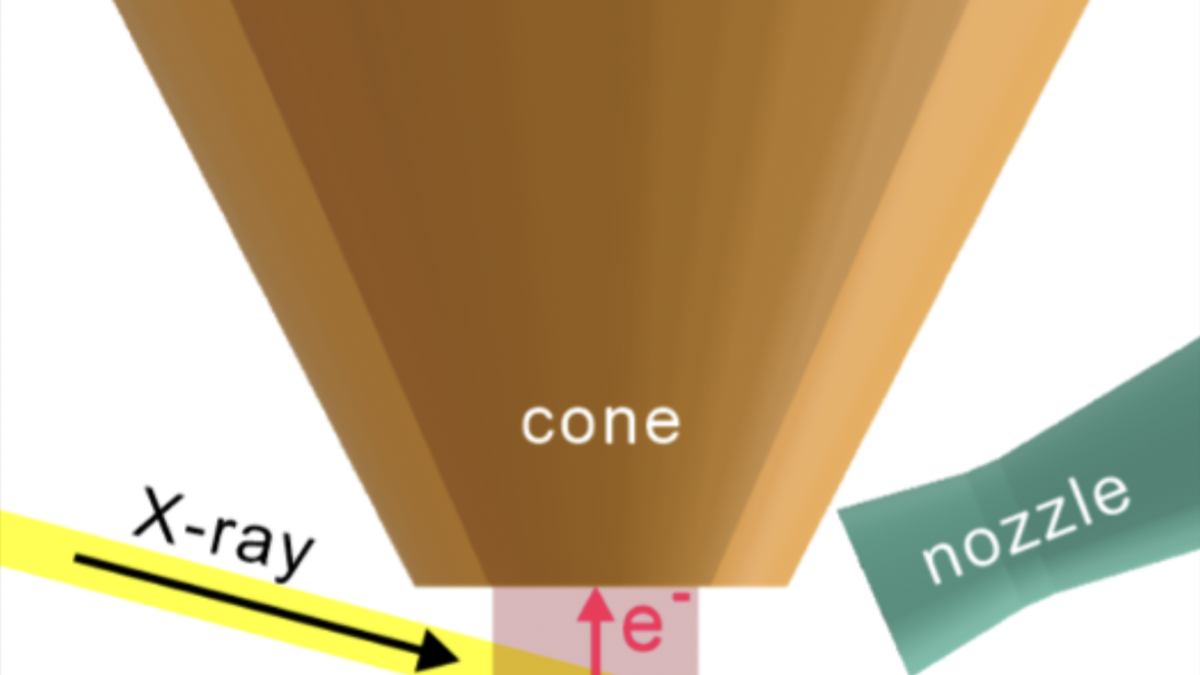
A schematic illustration of the experimental technique.
| Photo Credit: Cai et al., Photo Science, 2025

To understand how materials work, whether a metal in a car’s catalytic converter or the substances in a battery, scientists need to look at their surfaces at the atomic level.

One of the best tools for this is X-ray photoelectron spectroscopy (XPS). A device shoots X-rays at a material and measures the properties of electrons that bounce off, revealing to researchers exactly what elements are present and how they’re bonding.

The problem is that there’s a major catch. XPS usually requires a vacuum (a space with no air). If there are gas molecules around, they block the electrons before they reach the detector. This creates a problem called the ‘pressure gap’.

While XPS works great in a vacuum, real-world chemical reactions usually happen under atmospheric pressure, about 1 atm. Studying a catalyst in a vacuum is a bit like trying to study how a fish swims by looking at it on dry land: you aren’t seeing its natural behaviour.

Currently, to bridge this gap, scientists often have to travel to large, stadium-sized facilities called synchrotrons.

Now, a team of researchers from ShanghaiTech University and other institutions has published a paper in Photon Science proposing a solution that could fit in a standard laboratory.

The researchers modified a standard laboratory XPS machine to handle high pressures. Their innovation was a piece of engineering usually associated with rocket engines: a de Laval nozzle.

A de Laval nozzle is a tube that pinches in the middle and flares out at the end. This shape accelerates gas flowing through it to supersonic speeds. In the study, the researchers used the nozzle to shoot a focused jet of gas directly at the sample surface.

According to the paper, the localised pressure creates a small zone up to 1 am right on the sample’s surface. Because the gas is moving so fast and is focused, the pressure drops off rapidly just a few millimeters away, keeping the rest of the machine in a vacuum, sparing the detectors.

The team used computer simulations and a custom pressure sensor to verify the pressure at the sample surface actually reached 1 atm.

To test the system, the researchers examined a sample of platinum while spraying it with nitrogen gas.

In a standard XPS machine, filling the chamber with this much gas would make it impossible to see the sample. But the researchers reported their gas jet created a layer of high pressure only about 20 µm thick, thin enough to also allow the electrons from the platinum to still reach the detector.

Per the study, the team successfully detected signals from both the nitrogen gas and the platinum surface at pressures up to 1 atm. They also found that as the pressure increased, the signal from the surface got fainter.

If the technology proves reliable, scientists could study surface chemistry at realistic pressures in their own labs, rather than applying for time at synchrotron facilities. They could also better understand how catalysts break down pollutants or how rust forms in real time, potentially leading to more efficient industrial processes.

Published – January 07, 2026 06:00 am IST



Source link

Science

Post navigation

Previous Post: Access Denied
Next Post: Trump says Venezuela will ‘turn over’ 30 to 50 million barrels of oil to U.S.

Related Posts

  • Does evolution of adaptation always take hundreds of years?
    Does evolution of adaptation always take hundreds of years? Science
  • Google claims first ‘verifiable’ quantum advantage for Willow chip
    Google claims first ‘verifiable’ quantum advantage for Willow chip Science
  • Space startup Agnikul raises ₹150 crore to fund reusable rockets
    Space startup Agnikul raises ₹150 crore to fund reusable rockets Science
  • Chamarajanagar varsity to host Kannada Science Congress
    Chamarajanagar varsity to host Kannada Science Congress Science
  • Saltwater flooding a serious fire threat for electric vehicles
    Saltwater flooding a serious fire threat for electric vehicles Science
  • When for-profit companies fund research, how is science affected?
    When for-profit companies fund research, how is science affected? Science

More Related Articles

Indian scientists build breakthrough gene-editor, aim for patent Indian scientists build breakthrough gene-editor, aim for patent Science
Using science to address India’s dog crisis Using science to address India’s dog crisis Science
Science This Week | 2023 Nobel Prize winners announced, ISRO to begin unmanned flight tests for Gaganyaan and more Science This Week | 2023 Nobel Prize winners announced, ISRO to begin unmanned flight tests for Gaganyaan and more Science
New science research board ‘takes effect’, Science Minister New science research board ‘takes effect’, Science Minister Science
China plans to cut CO2 emission by about 130 mln metric tons in key areas in 2024, 2025 China plans to cut CO2 emission by about 130 mln metric tons in key areas in 2024, 2025 Science
Agni-Prime Missile: New generation ballistic missile Agni-Prime successfully flight-tested Agni-Prime Missile: New generation ballistic missile Agni-Prime successfully flight-tested Science
SiteLock

Archives

  • January 2026
  • December 2025
  • November 2025
  • October 2025
  • September 2025
  • August 2025
  • July 2025
  • June 2025
  • May 2025
  • April 2025
  • March 2025
  • February 2025
  • January 2025
  • December 2024
  • November 2024
  • October 2024
  • September 2024
  • August 2024
  • July 2024
  • June 2024
  • May 2024
  • April 2024
  • March 2024
  • February 2024
  • January 2024
  • December 2023
  • November 2023
  • October 2023
  • September 2023
  • August 2023
  • July 2023
  • June 2023
  • May 2023
  • April 2023
  • March 2023
  • February 2023
  • January 2023
  • December 2022
  • November 2022
  • October 2022
  • September 2022
  • August 2022
  • July 2022
  • June 2022
  • May 2022

Categories

  • Business
  • Nation
  • Science
  • Sports
  • World

Recent Posts

  • Access Denied
  • Access Denied
  • Access Denied
  • U.S. nearly triples list of countries whose citizens must post bonds up to $15,000 to apply for visas
  • Access Denied

Recent Comments

  1. Ramonisofs on UP Teacher Who Asked Students To Slap Muslim Classmate
  2. JamesSnult on UP Teacher Who Asked Students To Slap Muslim Classmate
  3. JamesSnult on UP Teacher Who Asked Students To Slap Muslim Classmate
  4. Bennyfen on UP Teacher Who Asked Students To Slap Muslim Classmate
  5. JeffreyGroof on UP Teacher Who Asked Students To Slap Muslim Classmate
  • Michael Clarke inducted into Australian Cricket Hall of Fame
    Michael Clarke inducted into Australian Cricket Hall of Fame Sports
  • Putin Vows To “Respond” If Ukraine Hits Russia With Long-Range Weapons
    Putin Vows To “Respond” If Ukraine Hits Russia With Long-Range Weapons World
  • Shruti Kotwal Eyes 2026 Winter Olympics Qualification, Wishes Skaters Ahead Of KIWG 2025
    Shruti Kotwal Eyes 2026 Winter Olympics Qualification, Wishes Skaters Ahead Of KIWG 2025 Sports
  • Will Quit Politics If Attempts Are Made To Disturb Reservation: Praful Patel
    Will Quit Politics If Attempts Are Made To Disturb Reservation: Praful Patel Nation
  • Adani Group Firm Kutch Copper Joins International Copper Association
    Adani Group Firm Kutch Copper Joins International Copper Association Nation
  • Access Denied
    Access Denied Nation
  • JSW MG Motor names Anurag Mehrotra as Managing Director
    JSW MG Motor names Anurag Mehrotra as Managing Director Business
  • Watch: Two men seen dangerously close to erupting Kilauea volcano lava
    Watch: Two men seen dangerously close to erupting Kilauea volcano lava World

Editor-in-Chief:
Mohammad Ariff,
MSW, MAJMC, BSW, DTL, CTS, CNM, CCR, CAL, RSL, ASOC.
editor@artifex.news

Associate Editors:
1. Zenellis R. Tuba,
zenelis@artifex.news
2. Haris Daniyel
daniyel@artifex.news

Photograher:
Rohan Das
rohan@artifex.news

Artifex.News offers Online Paid Internships to college students from India and Abroad. Interns will get a PRESS CARD and other online offers.
Send your CV (Subjectline: Paid Internship) to internship@artifex.news

Links:
Associate Journalism
About Us
Privacy Policy

News Links:
Breaking News
World
Nation
Sports
Business
Entertainment
Lifestyle

Registered Office:
72/A, Elliot Road, Kolkata - 700016
Tel: 033-22277777, 033-22172217
Email: office@artifex.news

Editorial Office / News Desk:
No. 13, Mezzanine Floor, Esplanade Metro Rail Station,
12 J. L. Nehru Road, Kolkata - 700069.
(Entry from Gate No. 5)
Tel: 033-46011099, 033-46046046
Email: editor@artifex.news

Copyright © 2023 Artifex.News Newsportal designed by Artifex Infotech.