
Skip to content
  • Facebook
  • X
  • Linkedin
  • WhatsApp
  • YouTube
  • Associate Journalism
  • About Us
  • Privacy Policy
  • 033-46046046
  • editor@artifex.news
Artifex.News

Artifex.News

Stay Connected. Stay Informed.

  • Breaking News
  • World
  • Nation
  • Sports
  • Business
  • Science
  • Entertainment
  • Lifestyle
  • Toggle search form
  • Access Denied
    Access Denied Nation
  • “Helicopter Ghuma Na”: Rohit Sharma’s Funny Suggestion As Axar Patel Fails To Imitate MS Dhoni
    “Helicopter Ghuma Na”: Rohit Sharma’s Funny Suggestion As Axar Patel Fails To Imitate MS Dhoni Sports
  • Access Denied Sports
  • Powerful quake and aftershocks rock Indonesia’s Bali and Java islands; no casualties reported
    Powerful quake and aftershocks rock Indonesia’s Bali and Java islands; no casualties reported World
  • Josef Mengele, The Infamous Doctor At Nazi Concentration Camps
    Josef Mengele, The Infamous Doctor At Nazi Concentration Camps World
  • Bangladesh interim government sets trail in killings during students’ movement
    Bangladesh interim government sets trail in killings during students’ movement World
  • In rare interview, Joe Biden says he could have defeated Donald Trump
    In rare interview, Joe Biden says he could have defeated Donald Trump World
  • Access Denied Business
New way to study surfaces brings ‘real world’ pressure to the lab

New way to study surfaces brings ‘real world’ pressure to the lab

Posted on January 7, 2026 By admin


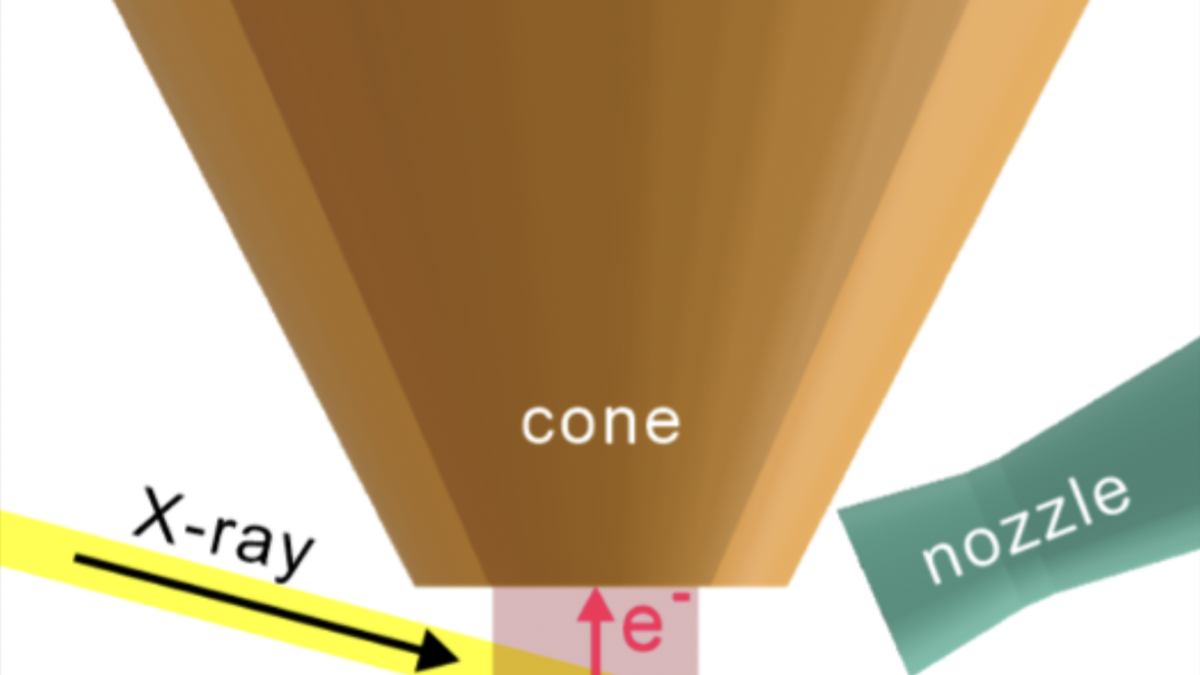
A schematic illustration of the experimental technique.
| Photo Credit: Cai et al., Photo Science, 2025

To understand how materials work, whether a metal in a car’s catalytic converter or the substances in a battery, scientists need to look at their surfaces at the atomic level.

One of the best tools for this is X-ray photoelectron spectroscopy (XPS). A device shoots X-rays at a material and measures the properties of electrons that bounce off, revealing to researchers exactly what elements are present and how they’re bonding.

The problem is that there’s a major catch. XPS usually requires a vacuum (a space with no air). If there are gas molecules around, they block the electrons before they reach the detector. This creates a problem called the ‘pressure gap’.

While XPS works great in a vacuum, real-world chemical reactions usually happen under atmospheric pressure, about 1 atm. Studying a catalyst in a vacuum is a bit like trying to study how a fish swims by looking at it on dry land: you aren’t seeing its natural behaviour.

Currently, to bridge this gap, scientists often have to travel to large, stadium-sized facilities called synchrotrons.

Now, a team of researchers from ShanghaiTech University and other institutions has published a paper in Photon Science proposing a solution that could fit in a standard laboratory.

The researchers modified a standard laboratory XPS machine to handle high pressures. Their innovation was a piece of engineering usually associated with rocket engines: a de Laval nozzle.

A de Laval nozzle is a tube that pinches in the middle and flares out at the end. This shape accelerates gas flowing through it to supersonic speeds. In the study, the researchers used the nozzle to shoot a focused jet of gas directly at the sample surface.

According to the paper, the localised pressure creates a small zone up to 1 am right on the sample’s surface. Because the gas is moving so fast and is focused, the pressure drops off rapidly just a few millimeters away, keeping the rest of the machine in a vacuum, sparing the detectors.

The team used computer simulations and a custom pressure sensor to verify the pressure at the sample surface actually reached 1 atm.

To test the system, the researchers examined a sample of platinum while spraying it with nitrogen gas.

In a standard XPS machine, filling the chamber with this much gas would make it impossible to see the sample. But the researchers reported their gas jet created a layer of high pressure only about 20 µm thick, thin enough to also allow the electrons from the platinum to still reach the detector.

Per the study, the team successfully detected signals from both the nitrogen gas and the platinum surface at pressures up to 1 atm. They also found that as the pressure increased, the signal from the surface got fainter.

If the technology proves reliable, scientists could study surface chemistry at realistic pressures in their own labs, rather than applying for time at synchrotron facilities. They could also better understand how catalysts break down pollutants or how rust forms in real time, potentially leading to more efficient industrial processes.

Published – January 07, 2026 06:00 am IST


Source link

Science

Post navigation

Previous Post: Access Denied
Next Post: Trump says Venezuela will ‘turn over’ 30 to 50 million barrels of oil to U.S.

Related Posts

  • ISRO ties up with European Space Agency for Gaganyaan missions
    ISRO ties up with European Space Agency for Gaganyaan missions Science
  • Companies’ appetite for cheap carbon offsets stokes fears of greenwashing
    Companies’ appetite for cheap carbon offsets stokes fears of greenwashing Science
  • What was the tussle over Covaxin IPR? | Explained
    What was the tussle over Covaxin IPR? | Explained Science
  • Other than the red pigment, what material was used in the red paint by people of Peru’s Sicán culture?
    Other than the red pigment, what material was used in the red paint by people of Peru’s Sicán culture? Science
  • Mandyam Srinivasan of bee studies fame faces misconduct allegations
    Mandyam Srinivasan of bee studies fame faces misconduct allegations Science
  • Musk’s xAI is raising  billion from Sequoia and others
    Musk’s xAI is raising $6 billion from Sequoia and others Science

More Related Articles

Surprising ‘dark oxygen’ discovery could ensnarl deep-sea mining | Explained Surprising ‘dark oxygen’ discovery could ensnarl deep-sea mining | Explained Science
Science quiz: Scientific terms that are palindromes Science quiz: Scientific terms that are palindromes Science
The Science Quiz | Ice creams The Science Quiz | Ice creams Science
Katalin Kariko, scientific maverick who paved way for mRNA vaccines Katalin Kariko, scientific maverick who paved way for mRNA vaccines Science
How do lightning rods prevent lightning strikes from reaching people? How do lightning rods prevent lightning strikes from reaching people? Science
Naturally occurring bile acid can blunt statin-induced diabetes Naturally occurring bile acid can blunt statin-induced diabetes Science
SiteLock

Archives

  • May 2026
  • April 2026
  • March 2026
  • February 2026
  • January 2026
  • December 2025
  • November 2025
  • October 2025
  • September 2025
  • August 2025
  • July 2025
  • June 2025
  • May 2025
  • April 2025
  • March 2025
  • February 2025
  • January 2025
  • December 2024
  • November 2024
  • October 2024
  • September 2024
  • August 2024
  • July 2024
  • June 2024
  • May 2024
  • April 2024
  • March 2024
  • February 2024
  • January 2024
  • December 2023
  • November 2023
  • October 2023
  • September 2023
  • August 2023
  • July 2023
  • June 2023
  • May 2023
  • April 2023
  • March 2023
  • February 2023
  • January 2023
  • December 2022
  • November 2022
  • October 2022
  • September 2022
  • August 2022
  • July 2022
  • June 2022
  • May 2022

Categories

  • Business
  • Nation
  • Science
  • Sports
  • World

Recent Posts

  • BEST conductor dies in accident involving four buses in Mumbai
  • Nayar reckons KKR got a par total, rues missed chances
  • Pope Leo decries European military spending as ‘betrayal’ of diplomacy
  • Scent Of Rain, Shutterfly, Stud Poker and Starzella please
  • New factional battle lines emerge in Congress hours after nomination of Kerala CM

Recent Comments

  1. JamesHeR on UP Teacher Who Asked Students To Slap Muslim Classmate
  2. RafaelNar on UP Teacher Who Asked Students To Slap Muslim Classmate
  3. CarlosExorb on UP Teacher Who Asked Students To Slap Muslim Classmate
  4. Robertfloup on UP Teacher Who Asked Students To Slap Muslim Classmate
  5. Davidcag on UP Teacher Who Asked Students To Slap Muslim Classmate
  • America is in a losing position in the Gulf, but Israel is winning: University of Oklahoma Professor Joshua Landis
    America is in a losing position in the Gulf, but Israel is winning: University of Oklahoma Professor Joshua Landis World
  • Starc’s availability depends on NOC from CA: Badani
    Starc’s availability depends on NOC from CA: Badani Sports
  • Ex-India Star Reveals Shakib Al Hasan Playing Chennai Test With Multiple Injuries
    Ex-India Star Reveals Shakib Al Hasan Playing Chennai Test With Multiple Injuries Sports
  • Goods exports dipped 2.6% in September, but a  billion upgrade to August tally lifts outlook
    Goods exports dipped 2.6% in September, but a $4 billion upgrade to August tally lifts outlook Business
  • Indian Financial Systems Remain Largely Unaffected From Microsoft Outage
    Indian Financial Systems Remain Largely Unaffected From Microsoft Outage Nation
  • ‘Relaxed But Also Felt Very Bad’: R Ashwin’s Father On His International Retirement
    ‘Relaxed But Also Felt Very Bad’: R Ashwin’s Father On His International Retirement Sports
  • PM Says Reservation Key Issue Of 2024
    PM Says Reservation Key Issue Of 2024 Nation
  • Tired of political turmoil, Bulgarians give ex-President a convincing mandate for change
    Tired of political turmoil, Bulgarians give ex-President a convincing mandate for change World

Editor-in-Chief:
Mohammad Ariff,
MSW, MAJMC, BSW, DTL, CTS, CNM, CCR, CAL, RSL, ASOC.
editor@artifex.news

Associate Editors:
1. Zenellis R. Tuba,
zenelis@artifex.news
2. Haris Daniyel
daniyel@artifex.news

Photograher:
Rohan Das
rohan@artifex.news

Artifex.News offers Online Paid Internships to college students from India and Abroad. Interns will get a PRESS CARD and other online offers.
Send your CV (Subjectline: Paid Internship) to internship@artifex.news

Links:
Associate Journalism
About Us
Privacy Policy

News Links:
Breaking News
World
Nation
Sports
Business
Entertainment
Lifestyle

Registered Office:
72/A, Elliot Road, Kolkata - 700016
Tel: 033-22277777, 033-22172217
Email: office@artifex.news

Editorial Office / News Desk:
No. 13, Mezzanine Floor, Esplanade Metro Rail Station,
12 J. L. Nehru Road, Kolkata - 700069.
(Entry from Gate No. 5)
Tel: 033-46011099, 033-46046046
Email: editor@artifex.news

Copyright © 2023 Artifex.News Newsportal designed by Artifex Infotech.