


Skip to content
  • Facebook
  • X
  • Linkedin
  • WhatsApp
  • YouTube
  • Associate Journalism
  • About Us
  • Privacy Policy
  • 033-46046046
  • editor@artifex.news
Artifex.News

Artifex.News

Stay Connected. Stay Informed.

  • Breaking News
  • World
  • Nation
  • Sports
  • Business
  • Science
  • Entertainment
  • Lifestyle
  • Toggle search form
  • Access Denied World
  • China taxes condoms, contraceptive drugs in bid to spur birth rate
    China taxes condoms, contraceptive drugs in bid to spur birth rate World
  • Access Denied World
  • Access Denied Sports
  • Sensex, Nifty soar in early trade on impressive GDP data, foreign fund inflows
    Sensex, Nifty soar in early trade on impressive GDP data, foreign fund inflows Business
  • Access Denied
    Access Denied Nation
  • Vodafone exits Indus Towers; sells shares worth ₹2,800 crore; clears ₹890 crore dues
    Vodafone exits Indus Towers; sells shares worth ₹2,800 crore; clears ₹890 crore dues Business
  • Access Denied
    Access Denied Nation
How the moon kicked Chandrayaan-3 propulsion module into a new orbit

How the moon kicked Chandrayaan-3 propulsion module into a new orbit

Posted on December 30, 2025 By admin


On December 30, astronomer Jonathan McDowell posted on X.com: “The abandoned Chandrayaan-3 propulsion module, left in a 125000 x 305000 km orbit in 2024, had a bit of a tussle with the Moon in November and has now been found in a 365000 x 983000 km x 22 deg orbit”.

Dr. McDowell is well-known for, among other things, publishing Jonathan’s Space Report, “an irregular newsletter which attempts to provide a detailed and pedantic historical record of the space age” and for maintaining the ‘General Catalog of Artificial Space Objects’.

Objects in Moon-orbit-crossing trajectories tend to be chaotic; the abandoned Chandrayaan-3 propulsion module, left in a 125000 x 305000 km orbit in 2024, had a bit of a tussle with the Moon in November and has now been found in a 365000 x 983000 km x 22 deg orbit

— Jonathan McDowell (@planet4589) December 30, 2025

Tug of war

His post describes a common problem in spaceflight: once you leave a spacecraft in a very large and lopsided orbit around the earth that comes anywhere near the moon’s path, the moon’s gravity can keep nudging it in ways that are hard to predict far in advance.

“Moon-orbit-crossing” in his post means the object’s orbit around the earth reaches out to distances comparable to the moon’s distance. As a result at some points the object and the moon can pass relatively close to each other. When that happens, the moon’s gravity matters a lot.

In low-earth orbit, i.e. 150-2,000 km above sea level, the earth’s gravity dominates and the motion of satellites here is fairly regular. But when you get closer to the moon, you’re effectively in a three-body situation: the earth pulls, the moon pulls, and an object in between that’s affected by both their pulls moves quickly through regions where the balance of those pulls changes.

In these systems, small differences in timing or position can lead to big differences later. That is what Dr. McDowell meant by “chaotic”. The orbit is still governed by the laws of physics but the underlying equations are very difficult to solve.

This was also the premise of the science fiction book and later Netflix show ‘3 Body Problem’. An alien species inhabited a world in a system with three suns orbiting each other, repeatedly leading to periods of climate chaos. The three-body problem asks how three masses move when each attracts the others by gravity. In classical mechanics, this problem doesn’t have a general closed-form solution, meaning there’s no single formula with which you can predict how the system will evolve for all possible starting positions, speeds, and masses.

A looping path

The Chandrayaan-2 mission ended in partial failure when its lunar lander crashed on the moon’s surface in 2019. But since it had successfully launched an orbital module, which continued to orbit the moon, the Chandrayaan-3 mission only consisted of a propulsion module, a lander, and a rover.

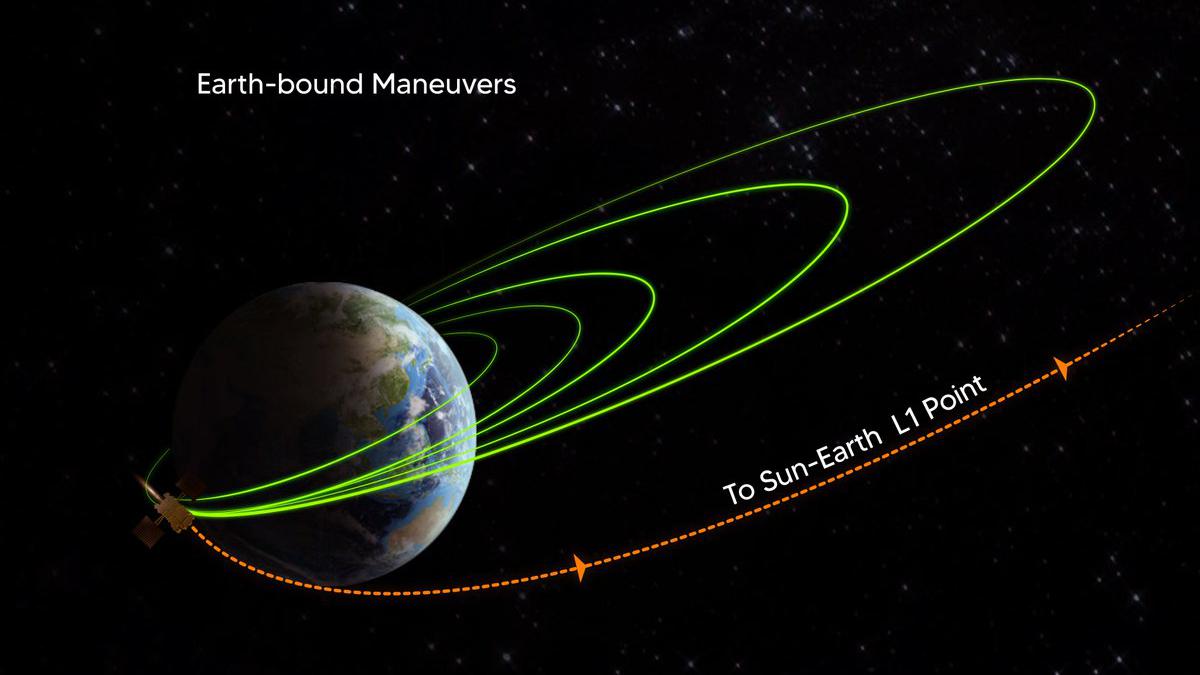
After the lander and rover descended on the moon in August 2023, the Indian Space Research Organisation (ISRO) moved the propulsion module to a 125,000 x 305,000 km orbit around the earth in October. These two numbers are the distances from the earth at the closest point (perigee) and farthest point (apogee) of the orbit.

So the propulsion module was looping around the earth on a highly elliptical path: it came as close as about 125,000 km, then swung out to about 305,000 km, approaching the moon’s average distance (~384,000 km). That means it spent some of its time in the moon’s gravitational neighbourhood.

The moon’s kick

When Dr. McDowell says it had “a tussle with the moon in November”, he means the propulsion module had a relatively close pass by the moon. During a close pass, the moon’s gravity can kick, or suddenly change, the object’s speed and direction relative to the earth. This is not like friction or a collision but a purely gravitational interaction. Depending on the geometry, the kick can raise the orbit, lower it, tilt it or change its shape.

According to an ISRO statement in November, the propulsion module entered the moon’s “sphere of influence” on November 4 and exited it on November 14. The organisation said it tracked the ‘event’ using the Indian Deep Space Network (IDSN), a collection of antennae near Bengaluru that, together with data received by similar ground stations operated by NASA and other space agencies, monitors Indian assets in space.

While it was in the moon’s sphere of influence, the propulsion module flew by the moon twice: on November 6 it came within 3,740 km of the lunar surface and on November 11 within 4,537 km.

After this encounter, the orbit of the propulsion module changed in three ways. First, it became much larger overall. According to ISRO the apogee jumped to 727,000 km; Dr. McDowell wrote in his post on December 30 that it was 983,000 km high. Either number is well beyond the moon’s distance and a sign that the moon’s pull added (or rearranged) orbital energy in the earth’s frame.

Second, the new orbit has a different shape and orientation. ISRO concluded the perigee to be 409,000 km and Dr. McDowell, 365,000 km. That is, the propulsion module no longer comes back anywhere near 125,000 km; it stays high almost all the time. And third, the orbit became noticeably tilted, by 22º, relative to the earth’s equator. This happened because the moon’s gravity pulled the module in a direction that wasn’t perfectly aligned with its current motion and orbital plane. As a result the module’s angular momentum vector changed.

Very different orbit

Per the statement, ISRO took “special care … to monitor its trajectory” and its proximity to other space objects. “The overall satellite performance was normal during the flyby and no close approach was experienced with the other lunar orbiters. This event garnered valuable insights and experience from mission planning, operations, flight dynamics perspectives, and especially enhanced the understanding of disturbance torque effects.”

In sum, ISRO left the Chandrayaan-3 propulsion module in a wide earth orbit that grazed the moon’s neighbourhood. In November 2025, the timing lined up such that the moon passed close enough to strongly tug on the propulsion module. This reshaped its orbit, pushing it into a higher, more tilted, and more extreme ellipse. As a result, tracking teams now found it with a very different set of orbital parameters.

In his post, Dr. McDowell credited amateur astronomer Sam Deen, astronomer Luca Buzzi, and Bill Gray, who developed notable software to track near-earth objects, “for figuring out that the suspected asteroid CE1M9G2 … was actually Chandrayaan-3”.

Published – December 30, 2025 08:37 am IST


Source link

Science

Post navigation

Previous Post: China’s live fire drills around Taiwan resume for a second day, aimed at warning ‘external forces’
Next Post: Access Denied

Related Posts

  • Mobile phones not linked to brain cancer, major review of 28 years of research finds
    Mobile phones not linked to brain cancer, major review of 28 years of research finds Science
  • Science Quiz: On the immune system
    Science Quiz: On the immune system Science
  • Erich von Daeniken, Swiss author who popularised ancient‑alien theories, dies at 90
    Erich von Daeniken, Swiss author who popularised ancient‑alien theories, dies at 90 Science
  • Something changed about cyclone formation in the 1990s | Explained
    Something changed about cyclone formation in the 1990s | Explained Science
  • UN report finds countries’ emission reductions short of Paris goal
    UN report finds countries’ emission reductions short of Paris goal Science
  • How do some cancer cells survive chemotherapy? Scientists find one way
    How do some cancer cells survive chemotherapy? Scientists find one way Science

More Related Articles

Shorebird from Australia spotted over 7,400 km away on island in Andamans: Expert Shorebird from Australia spotted over 7,400 km away on island in Andamans: Expert Science
Sci-Five | The Hindu Science Quiz: On the world’s smallest cat Sci-Five | The Hindu Science Quiz: On the world’s smallest cat Science
Witness the lunar eclipse 2025 through telescopes at a guided session in Coimbatore Witness the lunar eclipse 2025 through telescopes at a guided session in Coimbatore Science
What is xenobiology? – The Hindu What is xenobiology? – The Hindu Science
A Konkan secret, the sada needs more light A Konkan secret, the sada needs more light Science
Pollen in pee: fossilised urine from a small African mammal helps us understand past environments Pollen in pee: fossilised urine from a small African mammal helps us understand past environments Science
SiteLock

Archives

  • May 2026
  • April 2026
  • March 2026
  • February 2026
  • January 2026
  • December 2025
  • November 2025
  • October 2025
  • September 2025
  • August 2025
  • July 2025
  • June 2025
  • May 2025
  • April 2025
  • March 2025
  • February 2025
  • January 2025
  • December 2024
  • November 2024
  • October 2024
  • September 2024
  • August 2024
  • July 2024
  • June 2024
  • May 2024
  • April 2024
  • March 2024
  • February 2024
  • January 2024
  • December 2023
  • November 2023
  • October 2023
  • September 2023
  • August 2023
  • July 2023
  • June 2023
  • May 2023
  • April 2023
  • March 2023
  • February 2023
  • January 2023
  • December 2022
  • November 2022
  • October 2022
  • September 2022
  • August 2022
  • July 2022
  • June 2022
  • May 2022

Categories

  • Business
  • Nation
  • Science
  • Sports
  • World

Recent Posts

  • New factional battle lines emerge in Congress hours after nomination of Kerala CM
  • Trump invites Chinese President Xi Jinping for September 24 visit at White House
  • Chennai Metro Rail to procure additional tunnel boring machines due to delays in Phase II network
  • PM Modi’s ‘warning’ on economy | What it means | Talking Politics
  • Trump-Xi meeting was ‘good’, says White House

Recent Comments

  1. JamesHeR on UP Teacher Who Asked Students To Slap Muslim Classmate
  2. RafaelNar on UP Teacher Who Asked Students To Slap Muslim Classmate
  3. CarlosExorb on UP Teacher Who Asked Students To Slap Muslim Classmate
  4. Robertfloup on UP Teacher Who Asked Students To Slap Muslim Classmate
  5. Davidcag on UP Teacher Who Asked Students To Slap Muslim Classmate
  • ATF price hiked by 5.4%, commercial LPG rates cut
    ATF price hiked by 5.4%, commercial LPG rates cut Business
  • “Aag Thandi Ho…”: Ex-Pakistan Star Asks Shoaib Akhtar To Fire Up Pakistan In Cricket World Cup 2023
    “Aag Thandi Ho…”: Ex-Pakistan Star Asks Shoaib Akhtar To Fire Up Pakistan In Cricket World Cup 2023 Sports
  • Israel demands release of all hostages after Hamas backs new truce offer
    Israel demands release of all hostages after Hamas backs new truce offer World
  • Northern Waves completes hat-trick by winning the Brave Dancer Plate
    Northern Waves completes hat-trick by winning the Brave Dancer Plate Sports
  • Markets trade firm on buying in IT stocks
    Markets trade firm on buying in IT stocks Business
  • Science for all newsletter scientists find a new tile shape
    Science for all newsletter scientists find a new tile shape Science
  • Spouses Of G20 Leaders Treated to Special Lunch, Street Food
    Spouses Of G20 Leaders Treated to Special Lunch, Street Food Nation
  • Did not want to blow up India ties: Canadian Prime Minister Justin Trudeau
    Did not want to blow up India ties: Canadian Prime Minister Justin Trudeau World

Editor-in-Chief:
Mohammad Ariff,
MSW, MAJMC, BSW, DTL, CTS, CNM, CCR, CAL, RSL, ASOC.
editor@artifex.news

Associate Editors:
1. Zenellis R. Tuba,
zenelis@artifex.news
2. Haris Daniyel
daniyel@artifex.news

Photograher:
Rohan Das
rohan@artifex.news

Artifex.News offers Online Paid Internships to college students from India and Abroad. Interns will get a PRESS CARD and other online offers.
Send your CV (Subjectline: Paid Internship) to internship@artifex.news

Links:
Associate Journalism
About Us
Privacy Policy

News Links:
Breaking News
World
Nation
Sports
Business
Entertainment
Lifestyle

Registered Office:
72/A, Elliot Road, Kolkata - 700016
Tel: 033-22277777, 033-22172217
Email: office@artifex.news

Editorial Office / News Desk:
No. 13, Mezzanine Floor, Esplanade Metro Rail Station,
12 J. L. Nehru Road, Kolkata - 700069.
(Entry from Gate No. 5)
Tel: 033-46011099, 033-46046046
Email: editor@artifex.news

Copyright © 2023 Artifex.News Newsportal designed by Artifex Infotech.