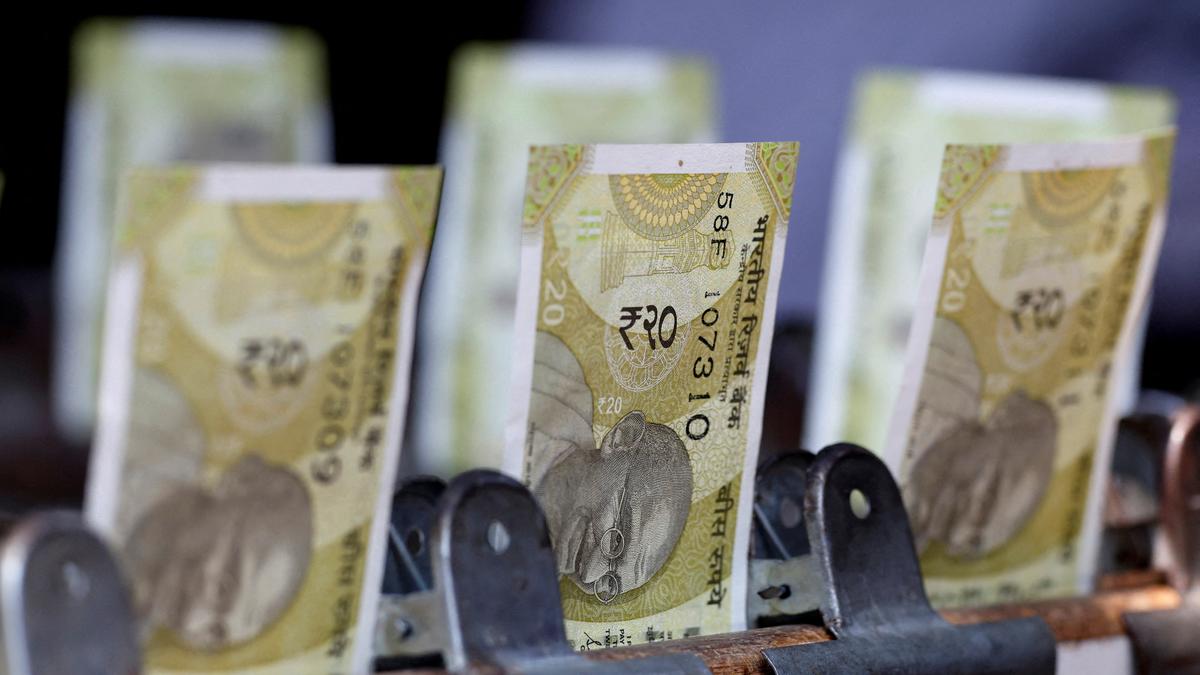




Over the last few days, the rupee exchange rate has fallen below ₹90 a dollar and has largely stayed at that level. Now, with Parliament running, a lot of the discourse on this has been political. However, from a policy level, it is critical to understand the economics behind the fall. Why is the rupee falling? Is it falling worse than other currencies? Does the fall hurt or help the Indian economy? And finally, is this a cause for alarm? Madan Sabnavis and Ranen Banerjee answer these in a conversation moderated by T.C.A. Sharad Raghavan.
Why is the rupee falling?
 Madan Sabnavis: It is falling for a variety of reasons. The first is that the fundamentals are definitely negative. When I talk of fundamentals, I am talking in terms of a higher trade deficit, possibly a higher current account deficit, and the movement of FPIs (foreign portfolio investments), which have tended to be negative rather than positive. These are the fundamental factors and these also get reflected in terms of our forex reserves coming down.
But I think the factor which has been driving the rupee down is more on the tariff front, where there were expectations that there would be a deal between India and the United States. That seems to be on the anvil, but still has not quite taken place. I think that is the reason why the sentiment has turned in the other direction.
In this entire business of the rupee depreciating, a critical factor which sort of moderates the level of fall of the rupee has been the intervention of the RBI (Reserve Bank of India). Now, we have seen that the intervention of the RBI in the forex market has tended to be limited. It does look like the fall of the rupee is within the acceptable limits of the RBI, though we should say upfront that the RBI maintains it is not defending any rate, but is out there to check any excess volatility in the market. These are the reasons why we have seen the rupee crossing from ₹87 to ₹88 to ₹89 and now ₹90.
Ranen Banerjee: The rupee is falling for two or three reasons. The primary one is ongoing portfolio outflows, which are increasing the demand for dollars. Second, our import growth has been higher than the export growth. And that also boosts the demand for the dollar. The current account deficit has been higher. So I think it’s the demand and supply of dollars and how much the RBI releases from its reserves to meet the demand. The uncertainty on the tariff agreement creates a forward-looking challenge. And it may impact the economy also. So that may influence some sentiment of the portfolio investors, who may be withdrawing from the Indian market. But I don’t think that is the key reason why portfolio investors are withdrawing. I think the key view that the investors are taking is that the valuations are higher and that they could have a higher return in other economies by deploying that capital in the immediate term. So, that is influencing portfolio flows. And of course, the uncertainty on the trade front adds to that sentiment.

Does a falling rupee indicate a weakness in the economy?
Madan Sabnavis: Definitely not. Because if you are looking at the overall state of the economy, if you go by the performance on the GDP front, it has been fairly remarkable, the kind of growth rates we have seen in the first half of the year. So, I don’t think it has anything to do with the real economy. The balance of payments is fairly robust. The RBI Governor had also pointed out that affordance reserves are covering 11 months of imports. So, I don’t see any problem out there. It is more of the sentiment that has been driving the rupee downwards. RB: I don’t think that there has been any structural change in the economy that is influencing the rupee. The fundamentals are very strong. We are having robust growth. Inflation is benign. The monetary policy is quite accommodative. The rate cuts have been done. The fiscal consolidation is in place. Capital expenditure is going on. The government is adhering to the fiscal roadmap that it had laid down. So I don’t think structurally anything major has changed. It is my belief that it is more transient factors that are impacting this (fall of the rupee), rather than structural factors.
Do you feel that there is any benefit to India from a falling rupee?
Madan Sabnavis: The only benefit which we would be getting on account of the falling rupee is more theoretical in nature. When I say theoretical, economic theory says that when the rupee depreciates, your exports gain a competitive advantage over the other countries. From the point of view of exports, if other currencies are not depreciating, but the rupee is depreciating, maybe around 4-5%, which we have seen in the current calendar year, this is an advantage for our exporters. The higher tariffs that have been imposed by the U.S. could be negated to a certain extent by the price competitiveness that we get on account of the rupee depreciation. Imports will become more expensive. Every commodity which we are importing is going to become more expensive by 4-5%. But purely from the point of view of inflation, if you look at the components of the CPI (Consumer Price Index) and what really gets affected on account of imports, our calculation shows that 5% depreciation on a sustained basis could push up inflation by something like 0.3-0.4%, which is not really very high. And given the fact that inflation is at an all-time low in India, this should not be a major worry for us.
Ranen Banerjee: The exporters may be happy that they are having a better realisation. And also, they may be happy that given some of the tariff headwinds, our products may become a little bit more competitive. If you look at, say, services, services exports is a very large segment of our economy and it has been doing very well, growing very fast. So companies that are exporting services are going to have better bottom lines in rupee terms. Who knows, they may be willing to share some of those benefits with their employees as higher bonuses. And then that may lead to further support for consumption. So, there are various channels through which benefits could come.
But then there are downsides also. We are a large importer. And therefore, during any rupee weakness, we have to shell out more rupees. And there could be some additional expenses that need to be done by companies that are importing. And if the demand holds, then to a very small extent, there could be some bit of imported inflation too, but it may not be very large. So we can’t really say whether it is benefiting India or not because different segments of the economy get impacted differently.
Is the falling rupee alarming and should the RBI step in or let it fall?
Madan Sabnavis: Every time the rupee reaches a new low, there is a tendency for a certain amount of alarm. And if the rupee is going down and there is little interference from the RBI, there would be a natural tendency for this to become self-fulfilling and the rupee will fall further. But in terms of internal dynamics, the currency should not be a major worry. From the point of view of exports, no alarm. From the point of view of inflation, no alarm.
But I think what is a worry is that when we have such a volatile currency, it becomes a bit difficult for both exporters and importers to do business, because normally we expect the rupee to be stable. The rupee should actually be appreciating, given the fact that the dollar is weakening. So, to that extent, I think it is definitely a disruption for us, especially for those who are in the business of importing inputs. But it is not going to rock the overall economic performance of the economy.
There may also be some pressure on the fiscal balance, but we will have to wait for the revised budget figures to understand the extent of the impact. There would definitely be some problem even in terms of fertilizer imports. But we don’t expect that to actually upset the fiscal arithmetic too much.
Ranen Banerjee: I don’t think we are in a situation where we need to be alarmed. We are the worst performing currency in the last three months, maybe. But if we take a two-year horizon, then I think other than the Korean currency, all other emerging market currencies have possibly depreciated against the dollar much more than the rupee. So, we must not forget that we almost had a flat exchange rate for over 12 months prior to the last six months. So I don’t think that there is need for alarm.
Listen to the conversation
Madan Sabnavis, Chief Economist at the Bank of Baroda; Ranen Banerjee, Partner and Economic Advisory Leader at PwC India