


Skip to content
  • Facebook
  • X
  • Linkedin
  • WhatsApp
  • YouTube
  • Associate Journalism
  • About Us
  • Privacy Policy
  • 033-46046046
  • editor@artifex.news
Artifex.News

Artifex.News

Stay Connected. Stay Informed.

  • Breaking News
  • World
  • Nation
  • Sports
  • Business
  • Science
  • Entertainment
  • Lifestyle
  • Toggle search form
  • Rupee falls 15 paise to close at 88.31 against U.S. dollar
    Rupee falls 15 paise to close at 88.31 against U.S. dollar Business
  • Access Denied Sports
  • “Don’t Play Reverse Shot”: Suryakumar Yadav’s Coach Gives Strange Advice Ahead Of India-Australia
    “Don’t Play Reverse Shot”: Suryakumar Yadav’s Coach Gives Strange Advice Ahead Of India-Australia Sports
  • Access Denied Sports
  • SBI reckons poverty levels between 4%-5%; inflation to ease if core inflation is declining vis-a-vis food price rise
    SBI reckons poverty levels between 4%-5%; inflation to ease if core inflation is declining vis-a-vis food price rise Business
  • Sarfaraz Khan Achieves Historic First In Indian Cricket. Not Even Sachin Tendulkar Or Sunil Gavaskar Attained It
    Sarfaraz Khan Achieves Historic First In Indian Cricket. Not Even Sachin Tendulkar Or Sunil Gavaskar Attained It Sports
  • Access Denied Sports
  • The Science Quiz | 100 years ago, science found the colossal squid…
    The Science Quiz | 100 years ago, science found the colossal squid… Science
Lessons from recent transport crises | Explained

Lessons from recent transport crises | Explained

Posted on December 10, 2025 By admin


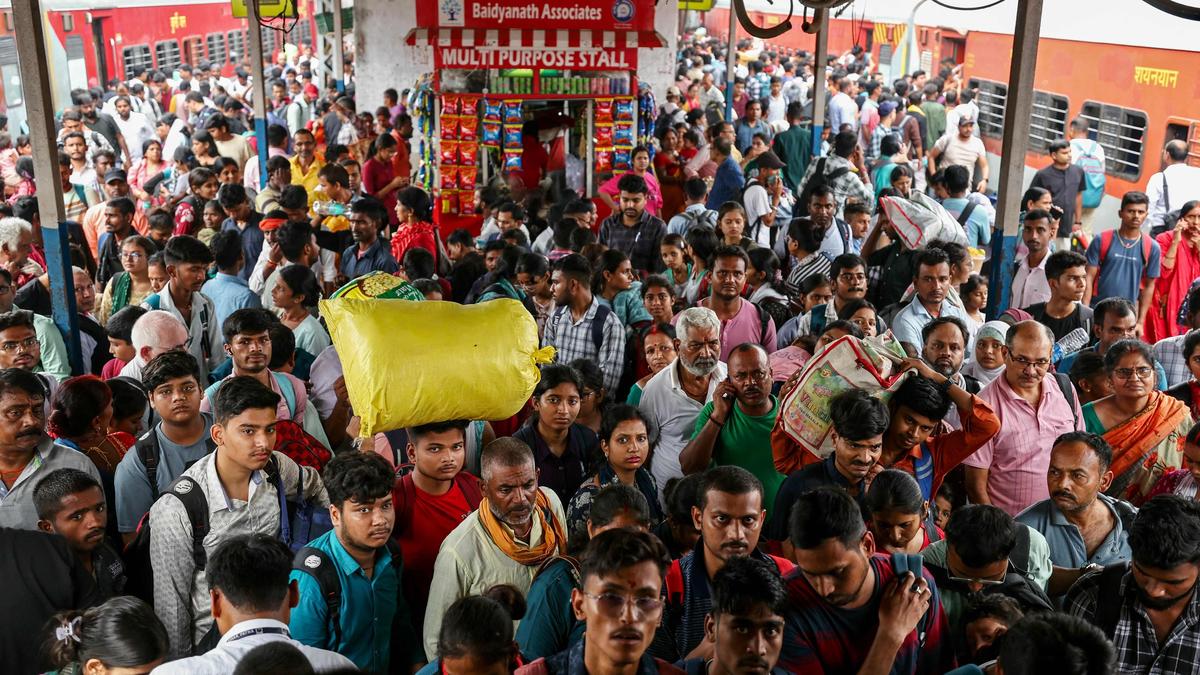
Passengers crowd at the platform as they arrive to board a train to their hometown a day after the Chhath Puja festival at a railway station in Patna on October 29.
| Photo Credit: AFP

In the past couple of months, India has witnessed its transport infrastructure come under massive strain. In October and November, trains to Bihar experienced immense rush, owing to migrants travelling home for Chhath Puja and the Bihar elections. Travellers were forced to travel in cramped and inhospitable conditions in unreserved compartments due to the paucity of trains. In December, the mass cancellation of Indigo flights owing to regulatory non-compliance led to stranded passengers and inflated prices.

Both events can be used to explain the reaction of prices and the responses of government and private players to demand and supply shocks. But the divergent behaviour of prices — and its effects — in these cases indicate the constraints imposed on welfare in a neo-liberal economy. Low prices of government services do not increase welfare unless accompanied by significant government investment, while deregulated prices only reduce welfare in the presence of monopolies.

Demand shock and Indian Railways

The sudden increase in demand for Bihar-bound trains in October is a classic indication of a demand shock. In the face of a given supply, such an increase in demand would lead to higher prices. If prices remain fixed due to government intervention, it would lead to an increase in the number of travellers far beyond the capacity of the trains. This led to overcrowded trains and hazardous travelling conditions. Standard economic theory would state that prices need to rise such that demand and supply are in equilibrium. While this would lead to the inability to travel for many, economic efficiency would be achieved. 

Critics point to this as the fundamental issue with government services, where keeping prices low due to social compulsions leads to excess demand of services and rampant inefficiency. But this criticism misses a fundamental problem. It is true that low prices lead to overcrowding, but the answer lies not in raising prices, but ensuring an increase in supply. Prices for certain services like health, education and train travel must be kept affordable for welfare, but at the same time, there must be significant investment by the state to expand access.

This is difficult to do in a neo-liberal economy, which places strict constraints on government intervention in the economy. Limits are placed on the size of the fiscal deficit, limiting government investment. A route that increases government spending while maintaining the deficit is through raising resources by wealth and income taxation of the top 1%. As shown by Thomas Piketty and his team, modest taxation of the top 1% would be enough to raise a considerable amount to strengthen the Indian welfare state. This, however, would not be acceptable to domestic and global capital. 

Monopolies and grounded flights

The solution, as advanced by many, is deregulation, and the entry of private capital into the provision of services. The logic goes that focusing on the profit motive ensures an efficient match of demand and supply, and investment in search of profit will ensure the expansion of services to all. However, the recent crisis surrounding Indigo has shown the shortcomings of this model.

The Indigo crisis is an example of a supply shock. The withdrawal of flights in the face of normal demand leads to price increases, amplified by the near-monopoly enjoyed by Indigo in Indian markets. The reduction in such a large amount of supply meant huge price increases for other flights and significant consumer loss. Supply restrictions for one firm in a market would not lead to such massive market-wide disruptions if the market was genuinely competitive. 

Non-competitive pricing power was highlighted as a key factor leading to the rapid increase in inflation during former U.S. President Joe Biden’s term, which played a role in bringing Donald Trump to power. The massive supply disruptions brought about by lockdowns increased costs, but were translated into a cost-of-living crisis due to the presence of significant monopolies. The argument for flexible prices implicitly assumes a competitive economy, which requires government intervention to prevent the rise of monopolies.

On the liberal economy

The two outcomes are not distinct but are the consequences of a neo-liberal economy that places restrictions on the actions of the state but pushes for deregulation of private activities. The inability of the state to raise taxes and increase spending leaves them with no option but to keep prices low for essential services and struggle with the increased demand and the fallout from overcrowding. The withdrawal of regulation leads to the concentration of capital and the rise of monopolies, a feature of Indian markets today. Far from ensuring consumer welfare, unregulated private markets can lead to rising monopolies which lower welfare and lead to high prices, as seen in the case of Indigo and the U.S. The two travel disruptions may seem dissimilar, yet they are both logical outcomes of an economic model that prizes the private, and downplays the importance of the public. These massive disruptions will emerge once more, if the underlying tendencies towards monopolies and the degradation of public services are not arrested.

Rahul Menon is associate professor at O.P. Jindal Global University.

Published – December 10, 2025 08:30 am IST


Source link

Business

Post navigation

Previous Post: Access Denied
Next Post: Access Denied

Related Posts

  • Rupee rises 6 paise to 83.30 against U.S. dollar in early trade
    Rupee rises 6 paise to 83.30 against U.S. dollar in early trade Business
  • New law is choking us, online gaming firms tell Supreme Court
    New law is choking us, online gaming firms tell Supreme Court Business
  • Rupee falls 10 paise to close at all-time low of 83.14 against U.S. dollar
    Rupee falls 10 paise to close at all-time low of 83.14 against U.S. dollar Business
  • Access Denied Business
  • Access Denied Business
  • Access Denied Business

More Related Articles

Access Denied Business
Markets decline in early trade dragged by bank stocks, weak Asian peers Markets decline in early trade dragged by bank stocks, weak Asian peers Business
Access Denied Business
Sanlam group hikes stake in Shriram Insurance firms Sanlam group hikes stake in Shriram Insurance firms Business
Delhi-San Francisco flight delay: Air India apologises, offers 0 travel voucher to passengers Delhi-San Francisco flight delay: Air India apologises, offers $350 travel voucher to passengers Business
Toyota to build three assembly plants in Maharashtra: report Toyota to build three assembly plants in Maharashtra: report Business
SiteLock

Archives

  • May 2026
  • April 2026
  • March 2026
  • February 2026
  • January 2026
  • December 2025
  • November 2025
  • October 2025
  • September 2025
  • August 2025
  • July 2025
  • June 2025
  • May 2025
  • April 2025
  • March 2025
  • February 2025
  • January 2025
  • December 2024
  • November 2024
  • October 2024
  • September 2024
  • August 2024
  • July 2024
  • June 2024
  • May 2024
  • April 2024
  • March 2024
  • February 2024
  • January 2024
  • December 2023
  • November 2023
  • October 2023
  • September 2023
  • August 2023
  • July 2023
  • June 2023
  • May 2023
  • April 2023
  • March 2023
  • February 2023
  • January 2023
  • December 2022
  • November 2022
  • October 2022
  • September 2022
  • August 2022
  • July 2022
  • June 2022
  • May 2022

Categories

  • Business
  • Nation
  • Science
  • Sports
  • World

Recent Posts

  • SC to hear appeals to extend deadline for GBA polls till Sept. 30
  • European countries in talks with Tehran for Hormuz transit: Report
  • East Bengal, Mohun Bagan set for derby with ISL crown at stake
  • ‘Online education has made learning flexible, inclusive’
  • IPL 2026 | Will PBKS overcome its hoodoo against RCB?

Recent Comments

  1. Josephpargy on UP Teacher Who Asked Students To Slap Muslim Classmate
  2. WilliamMip on UP Teacher Who Asked Students To Slap Muslim Classmate
  3. MichaelAssus on UP Teacher Who Asked Students To Slap Muslim Classmate
  4. DanielWep on UP Teacher Who Asked Students To Slap Muslim Classmate
  5. Thomastuh on UP Teacher Who Asked Students To Slap Muslim Classmate
  • Pacific Islands wait for Trump, wary of climate and China stance
    Pacific Islands wait for Trump, wary of climate and China stance Science
  • Trump loyalist Kash Patel is confirmed as FBI director by the Senate despite deep Democratic doubts
    Trump loyalist Kash Patel is confirmed as FBI director by the Senate despite deep Democratic doubts World
  • Forgotten India Pacer Umran Malik Handed Duleep Trophy Lifeline After Dengue Scare
    Forgotten India Pacer Umran Malik Handed Duleep Trophy Lifeline After Dengue Scare Sports
  • 2 Bangladesh Diplomats In India Suspended By Muhammad Yunus Government
    2 Bangladesh Diplomats In India Suspended By Muhammad Yunus Government Nation
  • Ind vs Pak: Clinical India Romp To 7-Wicket Win Over Pakistan In Women’s Asia Cup T20
    Ind vs Pak: Clinical India Romp To 7-Wicket Win Over Pakistan In Women’s Asia Cup T20 Sports
  • White House Fights Anxiety Over Joe Biden’s Health
    White House Fights Anxiety Over Joe Biden’s Health World
  • Five Batters To Watch Out For At The 2025 Champions Trophy 2025
    Five Batters To Watch Out For At The 2025 Champions Trophy 2025 Sports
  • Access Denied Business

Editor-in-Chief:
Mohammad Ariff,
MSW, MAJMC, BSW, DTL, CTS, CNM, CCR, CAL, RSL, ASOC.
editor@artifex.news

Associate Editors:
1. Zenellis R. Tuba,
zenelis@artifex.news
2. Haris Daniyel
daniyel@artifex.news

Photograher:
Rohan Das
rohan@artifex.news

Artifex.News offers Online Paid Internships to college students from India and Abroad. Interns will get a PRESS CARD and other online offers.
Send your CV (Subjectline: Paid Internship) to internship@artifex.news

Links:
Associate Journalism
About Us
Privacy Policy

News Links:
Breaking News
World
Nation
Sports
Business
Entertainment
Lifestyle

Registered Office:
72/A, Elliot Road, Kolkata - 700016
Tel: 033-22277777, 033-22172217
Email: office@artifex.news

Editorial Office / News Desk:
No. 13, Mezzanine Floor, Esplanade Metro Rail Station,
12 J. L. Nehru Road, Kolkata - 700069.
(Entry from Gate No. 5)
Tel: 033-46011099, 033-46046046
Email: editor@artifex.news

Copyright © 2023 Artifex.News Newsportal designed by Artifex Infotech.