





The rare earth hypothesis was proposed in a 2000 book by palaeontologist Peter Ward and astronomer Donald Brownlee. It argues that while simple, microbial life may be common in the universe, complex, multicellular life is likely uncommon. The idea is rooted in a particular place in the universe meeting a chain of successive conditions.
While we often talk about life as ranging from simple (e.g. bacteria and yeast) to complex (e.g. humans and octopuses), life itself is a complex phenomenon and the product of many factors falling in place. Studying these factors on the earth itself has been an arduous and even now an unfinished task; and looking for them on planets located several light years away remains extraordinarily fraught. Scientists studying the possibility of life on other planets have busied themselves with particular aspects over time. Some focus on planetary ingredients such as a rocky world with surface water in the habitable zone of the host star. Other scientists have been concerned with system-level architectures such as giant planets in particular places in the universe. Still others have been looking into long-term climate regulation and a persistent atmosphere. And so on.
Since 2000, we have accumulated significantly more data about exoplanets and planetary science. And the big picture that has emerged is mixed: several conditions required for life look less restrictive than scientists once feared whereas many others look harder to meet than scientists had hoped.
Understanding a planet
Let’s consider how often potentially habitable earth-sized planets occur. Studies based on early data from the NASA Kepler telescope (2009-2018) suggested that a significant fraction of sun-like stars in the Milky Way galaxy hosts small planets receiving starlight comparable to what the earth receives. One study even found that roughly a fifth of sun-like stars may harbour earth-sized planets in their habitable zones, although the data had many uncertainties.
More recent work has concluded, based on Kepler data, that there’s a non-negligible rate at which rocky planets occur in the habitable zones of stars called GK dwarfs. These and similar findings have concluded that worlds of roughly the right size at roughly the right distance from a suitable star are not rare, thus weakening the most sweeping claim in the hypothesis. The question has thus shifted from ‘where a planet is’ to ‘what a planet is like’. In the solar system, Mercury is too close to the sun to host earth-like life whereas Pluto is too far away. But while both the earth and Venus are in the sun’s habitable zone, Venus’s atmosphere renders it deadly for earth-like life.
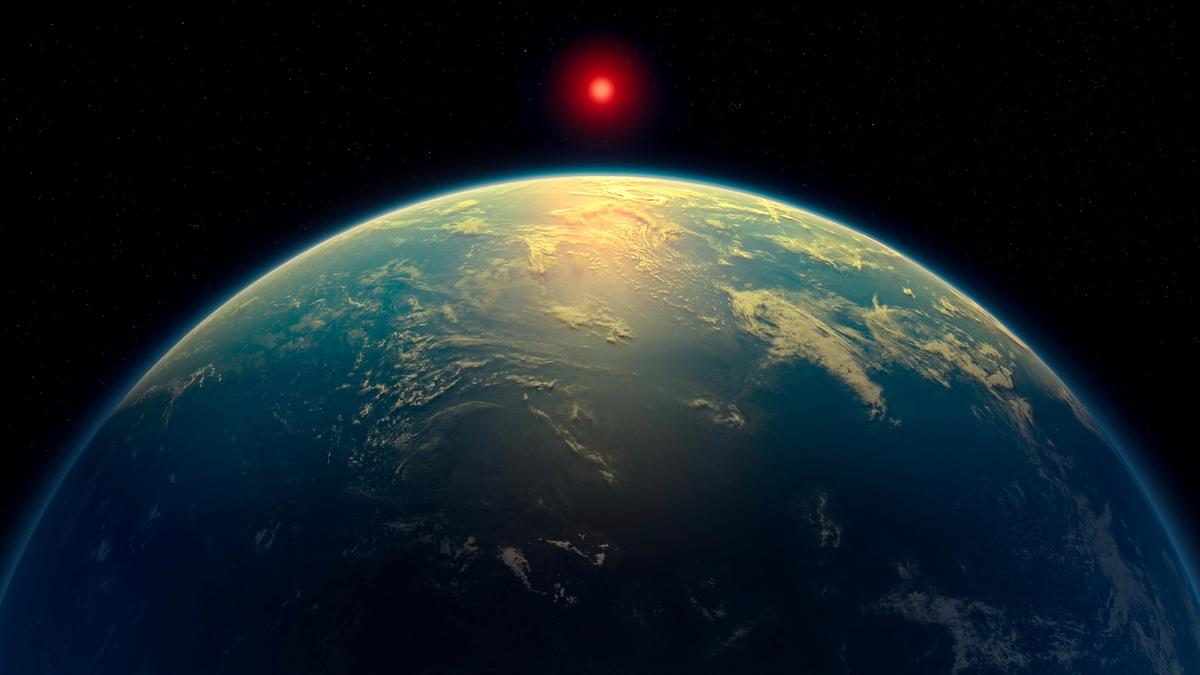
One important open issue is whether small planets around cool, active M-dwarf stars can retain their atmospheres and surface water over billions of years. Modelling studies have indicated that planets that spend millions of years exposed to intense stellar radiation — like that M-dwarf stars are known to emit — tend to lose water and build up false-positive oxygen atmospheres.
Say intense ultraviolet radiation from an M-dwarf star breaks up water molecules on the planet: H2O → H+ + OH–. Further breakdown leads to O and H atoms accumulating in the atmosphere. Over time, the H escapes to space more easily than O, and the O atoms left behind pair up to form O2. If there aren’t enough surface ‘sinks’ that can absorb this oxygen fast enough — the way rocks and oceans do on the earth — the O2 will accumulate. When a telescope looks at this planet and finds an excess of oxygen in its atmosphere, scientists may think the planet’s surface has photosynthesis, which is how the earth’s atmosphere has lots of oxygen. But it’s actually due to the M-dwarf star’s radiation.
On the other hand, some planets around M-dwarf stars can keep their air for a long time, even if most can’t. If the star’s magnetic outflows — streams of charged particles blown off the star by its magnetic field — are weak or shaped in such a way that they don’t hit the planet hard, and if the planet is farther out and cooler, its atmosphere will be eroded more slowly. A strong planetary magnetic field can also deflect a part of the stellar wind, while a massive planet with ongoing volcanic activity can replace some of the lost gases.
These are all system-specific conditions that require a specific mix of star activity, magnetic fields, orbit, planet mass, rotation, and internal heat. When they line up well, a planet can retain its atmosphere for billions of years. However, such planets are in the minority because M-dwarf stars often produce strong flares and many close-in planets lack strong magnetic shields.
Scientists can directly test these observations today. Using NASA’s James Webb Space Telescope (JWST), astronomers have started measuring the heat emitted from nearby rocky exoplanets. In TRAPPIST-1c, which is located near the inner edge of its system’s habitable zone 40.7 lightyears away, the JWST has ruled out a thick atmosphere rich in carbon dioxide. Previously, scientists using JWST data had also found that the innermost planet, TRAPPIST-1b, likely lacked a substantial atmosphere.
These are only two worlds in one system, yet they show that earth-sized isn’t synonymous with earth-like. Scientists still need more measurements of cooler, more temperate planets to understand how often atmospheres survive where earth-like life could plausibly persist.
Climate stabilisation
Another pillar of the rare earth hypothesis is long-term climate stabilisation. On the earth, the weathering of continental rocks and the recycling of carbon between the earth’s interior and the atmosphere have buffered the climate over geologic time. Many researchers have linked this buffering to plate tectonics, which subduct a carbonated crust and build new surface rocks. This said, the interiors of planets behave in different ways. Rocky planets can have one stiff shell that barely moves, long quiet times broken by short bursts of crust movement or plate-like tectonics (as on the earth). A planet can even switch between these modes over time. Some models also show that without modern plate tectonics, a planet might still keep a habitable climate by balancing volcanism (which adds gases), weathering (removes gases), burial (traps materials), and crustal foundering (sinks the crust). Scientists don’t have consensus either: while plate tectonics could help maintain a stable climate that in turn can support complex life, it may not be strictly required for life to begin.
The role of giants
A third line of debate is the role of giant planets like Jupiter. The old intuition was that Jupiter ‘shields’ the earth by deflecting comets and asteroids. Subsequent studies have complicated this story, however. Depending on a giant planet’s mass and orbit, scientists have found that it can reduce or increase the flux of impactors to the inner system and it can also deliver water-rich bodies early on. In other words, there seems to be no universal ‘filter’ on this front; it all depends on the system’s architecture. This conclusion has weakened the claim that a Jupiter-like planet is a necessary precondition for complex life on a rocky planet in the same system.
Thus, on the question of finding small, temperate planets, many scientists today argue that the occurrence rate of earth-sized planets in the habitable zones of sun-like stars is non-zero and may be a few tens of percent, per Kepler data, depending on the definitions and extrapolations. That undermines the notion that the earth’s basic orbital and size configuration is vanishingly uncommon. On the other hand, on the question of planets’ ability to retain atmospheres, have long climate cycles, be able to avoid catastrophic events, and so on, the data has become more sobering. The results keep open the possibility that truly earth-like surface environments supporting complex biospheres are less common than the count of earth-sized planets in the habitable zone would suggest.
Not definitive
Two more threads bear on the rare versus common debate. First, a recent effort to place an upper limit on the number of earth-like planets emphasised that a lot hinges on atmospheric processes that scientists can’t yet survey at scale. Second, searches for technosignatures — signs of technology made by extra-terrestrial life, especially things nature is unlikely to produce on its own — have sharpened the limits on the prevalence of civilisations whose activities emit radio waves (such ‘radio-loud’ activities on the earth include broadcasting for TV and radio and air traffic control). Multi-year surveys of thousands of stars by the Breakthrough Listen project haven’t found any convincing signals so far. While not detecting something doesn’t prove that it’s absent, it sets upper limits on how common it could be in the cosmos.
Taken together, the rare earth hypothesis remains plausible for complex life but it can’t be said to be demonstrably true. At this juncture, three developments could change the picture: (i) if scientists detect atmospheres on rocky, temperate planets, preferably around sun-like stars, showing gases consistent with active surface water cycles; (ii) if scientists place stronger better constraints on tectonic regimes on exoplanets (even indirectly), indicating whether long-term climate stabilisers are widespread or rare; and (iii) scientists detect biosignatures or technosignatures. The first steps are already underway. Extremely large ground telescopes currently under construction as well as future space missions are aimed squarely at planets with temperate atmospheres.
Until their observations mature, however, a fair summary seems to be: while microbial life could be common, long-lived ecosystems straddling land and ocean and capable of producing complex life may still be scarce. This seems to be as far as the data can take us today.
Published – November 12, 2025 08:30 am IST