

Skip to content
  • Facebook
  • X
  • Linkedin
  • WhatsApp
  • Associate Journalism
  • About Us
  • Privacy Policy
  • 033-46046046
  • editor@artifex.news
Artifex.News

Artifex.News

Stay Connected. Stay Informed.

  • Breaking News
  • World
  • Nation
  • Sports
  • Business
  • Science
  • Entertainment
  • Lifestyle
  • Toggle search form
  • Eknath Shinde Amid Uddhav Thackeray Bag Check Row
    Eknath Shinde Amid Uddhav Thackeray Bag Check Row Nation
  • Mallikarjun Kharge’s Name Likely To Be Proposed For INDIA bloc Chief
    Mallikarjun Kharge’s Name Likely To Be Proposed For INDIA bloc Chief Nation
  • Nagamangala violence: BJP sticks to demand for NIA probe
    Nagamangala violence: BJP sticks to demand for NIA probe Nation
  • Score a hundred: Jonathan Trott sets next target for Afghanistan batters
    Score a hundred: Jonathan Trott sets next target for Afghanistan batters Sports
  • RBI’s proposed framework to administer project financing | Explained
    RBI’s proposed framework to administer project financing | Explained Business
  • Yograj Singh At It Again, Sends Loud Message To Gautam Gambhir Over Virat Kohli’s Form
    Yograj Singh At It Again, Sends Loud Message To Gautam Gambhir Over Virat Kohli’s Form Sports
  • What Are The Most Important Gold IRA Pros And Cons?
    What Are The Most Important Gold IRA Pros And Cons? Business
  • Ex-RCB Fast Bowler Handed Major Punishment By ICC For ‘Abusing Fourth Umpire’
    Ex-RCB Fast Bowler Handed Major Punishment By ICC For ‘Abusing Fourth Umpire’ Sports
Mumbai-led team helps reveal mysterious twin rings around galaxy

Mumbai-led team helps reveal mysterious twin rings around galaxy

Posted on November 8, 2025 By admin


Imagine you’re playing football on a large, grassy ground. The game ends and you take a break, and that’s when you notice a coin you’d had in your pocket fell out somewhere. If you set out trying to find it by yourself, you’ll take a long time and you probably won’t even succeed. But if you recruit all your friends for the task and split up to different parts of the field, you’ll find it soon enough.

This is an analogy that University of Mumbai professor Ananda Hota gives to his Facebook group when they’re scanning the sky together to find rare celestial objects.

Dr. Hota and his collaborators have been running the RAD@home group since 2013. Today it boasts of around 4,700 members. Most of them are not professional astronomers yet they essay important roles in making real astronomical discoveries.

For instance, on October 2, the group reported a highly unusual object first identified only in 2019 — an odd radio circle (ORC) — using data from the LOFAR telescope network in Europe. ORCs are very large but very faint circular radio sources typically surrounding a distant galaxy. Prevailing theories suggest ORCs are the remnants of supermassive black hole mergers or enormous galactic shockwaves, and are among the least understood objects in deep space.

Beyond this headline discovery, the team regularly unearths significant information on new galaxies and transient astronomical phenomena. RAD@home thus showcases the power of research driven with the help of citizen science, plus the able assistance of one of the world’s most powerful radio telescopes, the Giant Metrewave Radio Telescope (GMRT) near Pune.

Coming full circle

Depending on their shape and structure, galaxies come in one of four main types: spiral, elliptical, irregular, and lenticular. Spiral galaxies like the Milky Way, with their characteristic winding arms, contain many hot, young, bluer stars — while elliptical galaxies, which are characteristically more oblong, are dominated by older, cooler, redder stars.

Most massive galaxies also host a supermassive black hole millions to billions of times the mass of our sun, at their centre. And while in most galaxies these monsters are quiet, in some they’re extraordinarily active. They feed on the gas, dust, and other debris surrounding them, releasing enormous amounts of energy. Such galaxies are said to be active. And when their black holes launch jets of plasma that shine brightly in the radio frequency, they’re called radio galaxies.

These jets can extend for millions of lightyears on either side of the galactic plane. At the ends of these jets there are two vast ‘radio lobes’. The appearance is not unlike two balloons tethered by slender threads to either side of a sphere.

Because these jets typically form in massive, elliptical galaxies, astronomers long believed that spiral galaxies couldn’t host them. That assumption was upended when Hota et al. discovered an exception during his postdoc: a rare case of a spiral galaxy producing large radio lobes.

“It was an accidental discovery,” he said.

It was 2011, and the internet was starting to penetrate everyday life through social media. Citizen science projects like ‘Zooniverse’ were gaining traction with their scientific discoveries. When Dr. Hota shared news of his discovery on a social media platform, he was surprised by the questions and comments his post elicited.

“When you do science, it becomes technically so difficult for the common man to understand that we astronomers sometimes feel we are almost not useful to the public,” Dr. Hota said.

His own interest in science and astronomy developed in high school as he listened to radio shows and read about galaxies, black holes, and powerful telescopes.

“It was time to give back,” he said, so he started a Facebook group and invited students to join, learn astronomy, and contribute to research.

Rare things

Each search begins with virtual lectures over a weekend, where Dr. Hota and other researchers train participants to recognise the standard colour and structures of galaxies in ultraviolet, optical, infrared, and radio images.

Radio galaxies can be classified by their shape and brightness. In the widely used Fanaroff–Riley (FR) classification, FR I sources are less luminous, with jets that fade as they move outward, and FR II sources are more powerful, with bright hotspots at the ends of their lobes. Astronomers also identify special subtypes such as X-shaped, double-double or giant radio galaxies, each revealing distinct episodes of jet activity.

Once participants understand what a typical radio galaxy looks like, they’re encouraged to look for sources that buck expectations.

“Anything that looks faint and fuzzy and irregular in the data is a sign of past black hole activity,” Dr. Hota said.

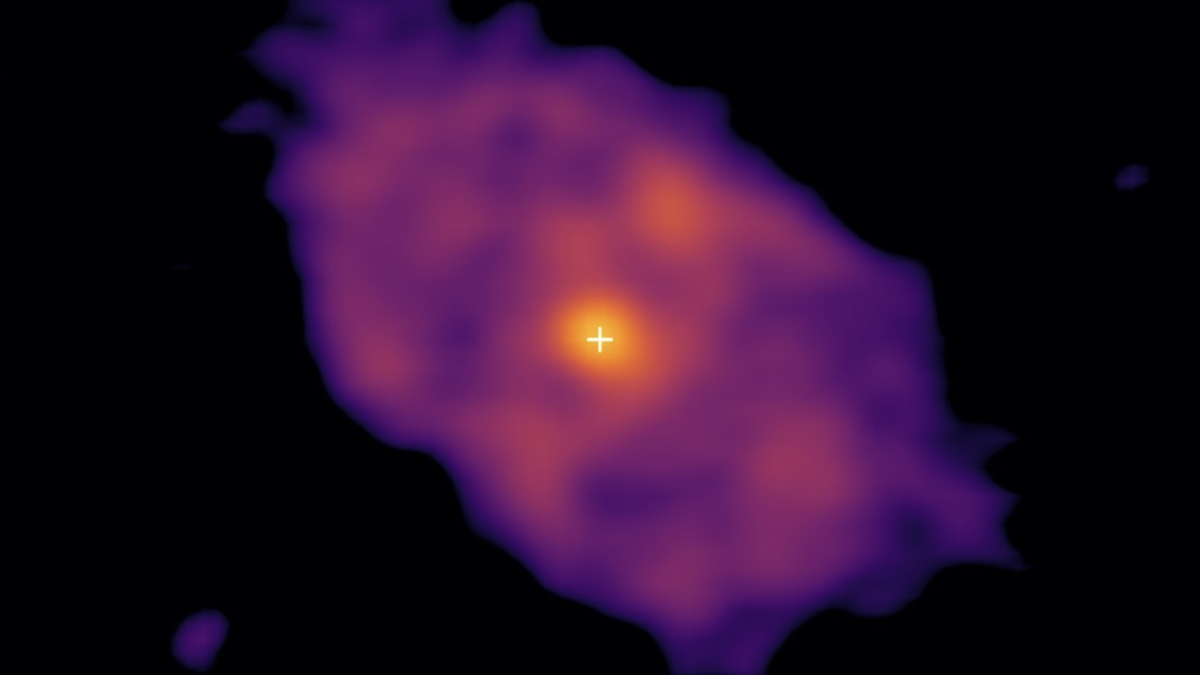
Their latest discovery, a rare ‘double ORC’, was published months after Prasun Machado, a RAD@home student participant, spotted two faint, circular structures in a non-standard radio galaxy in LOFAR data. These circles, far larger than the galaxies themselves, turned out to be a pair of ORCs, only the second known instance of such a twin. It was soon found to be one the farthest, most powerful ORCs ever recorded.

“When you find something extremely rare or very different from the normal, you suddenly get an opportunity to start a new investigation into the unknown,” Dr. Hota said.

Over the following months, Dr. Hota and his collaborators investigated the finding further using archival data from various radio and optical telescopes.

Anyone an astronomer

There is still no widely accepted definition of ORCs. Their true nature remains uncertain, and astronomers are exploring several possibilities.

Dr. Hota said one idea is that when galaxies collide, they can generate powerful shockwaves that propagate outward into intergalactic space. Over a billion years, these waves could form large circular structures, visible only at radio wavelengths. Another possibility is that ORCs are the aftereffects of powerful outbursts, perhaps when  two supermassive black holes merge.

In the case of the twin ORCs, Dr. Hota speculated that plasma rings might be expanding in opposite directions, forming two large circles located on either side of the galaxy.

“We need to discover and characterise many more such objects,” Dr. Hota said. “Only then can we begin to understand their true nature.”

For now, he and his collaborators aim to take advantage of the immense trove of data collected by the world-class GMRT facility, which is one of the largest and most sensitive low-frequency radio telescopes in the world.

“Our own GMRT is free for anyone to use, but that power is being underutilised,” according to Dr. Hota. “People still think education and research are two separate stages: you first study, then do research. That model is over. At any stage in your career, you can join research if you find a good mentor and a good project. Once we create this combined model of learning and discovery through various citizen science projects, Indian astronomy  will grow faster.”

Monika Mondal is a freelance science and environment journalist.


Source link

Science

Post navigation

Previous Post: Access Denied
Next Post: Five Indian nationals kidnapped in Mali

Related Posts

  • Watch: Chennai schoolboys win award for prototype to solve stubble-burning crisis
    Watch: Chennai schoolboys win award for prototype to solve stubble-burning crisis Science
  • Saltwater flooding a serious fire threat for electric vehicles
    Saltwater flooding a serious fire threat for electric vehicles Science
  • Panic in the time of cholera: addressing issues critical to managing a resurgence 
    Panic in the time of cholera: addressing issues critical to managing a resurgence  Science
  • In a first, Indian Institute of Astrophysics astronomers spot ultraviolet emissions from novae in Andromeda galaxy
    In a first, Indian Institute of Astrophysics astronomers spot ultraviolet emissions from novae in Andromeda galaxy Science
  • How the concept of open science can be beneficial
    How the concept of open science can be beneficial Science
  • In search of the elusive and threatened fishing cat
    In search of the elusive and threatened fishing cat Science

More Related Articles

AI accessibility? Blind gamer puts ChatGPT to the test AI accessibility? Blind gamer puts ChatGPT to the test Science
What is Google’s ‘quantum advantage’ leap? | Explained What is Google’s ‘quantum advantage’ leap? | Explained Science
Brazil’s Amazon fires off to record 2024 start as green union blames firefighting budget cut Brazil’s Amazon fires off to record 2024 start as green union blames firefighting budget cut Science
Gene that helps race horses manage BP could help human athletes, too Gene that helps race horses manage BP could help human athletes, too Science
What will Gaganyaan change for India? | Explained What will Gaganyaan change for India? | Explained Science
IAU approves ‘Statio Shiv Shakti’ as name for Chandrayaan-3 landing site IAU approves ‘Statio Shiv Shakti’ as name for Chandrayaan-3 landing site Science
SiteLock

Archives

  • November 2025
  • October 2025
  • September 2025
  • August 2025
  • July 2025
  • June 2025
  • May 2025
  • April 2025
  • March 2025
  • February 2025
  • January 2025
  • December 2024
  • November 2024
  • October 2024
  • September 2024
  • August 2024
  • July 2024
  • June 2024
  • May 2024
  • April 2024
  • March 2024
  • February 2024
  • January 2024
  • December 2023
  • November 2023
  • October 2023
  • September 2023
  • August 2023
  • July 2023
  • June 2023
  • May 2023
  • April 2023
  • March 2023
  • February 2023
  • January 2023
  • December 2022
  • November 2022
  • October 2022
  • September 2022
  • August 2022
  • July 2022
  • June 2022
  • May 2022

Categories

  • Business
  • Nation
  • Science
  • Sports
  • World

Recent Posts

  • Access Denied
  • Access Denied
  • Chinese firm bags contract to print Nepal’s Rs 1,000 bank notes
  • Access Denied
  • Access Denied

Recent Comments

  1. dfb{{98991*97996}}xca on UP Teacher Who Asked Students To Slap Muslim Classmate
  2. "dfbzzzzzzzzbbbccccdddeeexca".replace("z","o") on UP Teacher Who Asked Students To Slap Muslim Classmate
  3. 1}}"}}'}}1%>"%>'%> on UP Teacher Who Asked Students To Slap Muslim Classmate
  4. bfg6520<s1﹥s2ʺs3ʹhjl6520 on UP Teacher Who Asked Students To Slap Muslim Classmate
  5. pHqghUme9356321 on UP Teacher Who Asked Students To Slap Muslim Classmate
  • Nagamangala violence: BJP sticks to demand for NIA probe
    Tigress that killed 11 persons over three years caged in Maharashtra Nation
  • Blinken dismisses Russia accusations of Trump persecution
    Blinken dismisses Russia accusations of Trump persecution World
  • Access Denied World
  • Gatherings Banned, No Internet In Violence-Hit Beed City In Maharashtra
    Gatherings Banned, No Internet In Violence-Hit Beed City In Maharashtra Nation
  • One Killed As Dispute Between Tenants Turns Deadly In Greater Noida
    One Killed As Dispute Between Tenants Turns Deadly In Greater Noida Nation
  • What is the One Nation One Subscription explained
    What is the One Nation One Subscription explained Science
  • High Court Notice to Gujarat on Activist Teesta Setalvad’s Appeal
    High Court Notice to Gujarat on Activist Teesta Setalvad’s Appeal Nation
  • Vladimir Putin Arrives In Mongolia, Defies World Court’s Arrest Warrant Over Ukraine War
    Vladimir Putin Arrives In Mongolia, Defies World Court’s Arrest Warrant Over Ukraine War World

Editor-in-Chief:
Mohammad Ariff,
MSW, MAJMC, BSW, DTL, CTS, CNM, CCR, CAL, RSL, ASOC.
editor@artifex.news

Associate Editors:
1. Zenellis R. Tuba,
zenelis@artifex.news
2. Haris Daniyel
daniyel@artifex.news

Photograher:
Rohan Das
rohan@artifex.news

Artifex.News offers Online Paid Internships to college students from India and Abroad. Interns will get a PRESS CARD and other online offers.
Send your CV (Subjectline: Paid Internship) to internship@artifex.news

Links:
Associate Journalism
About Us
Privacy Policy

News Links:
Breaking News
World
Nation
Sports
Business
Entertainment
Lifestyle

Registered Office:
72/A, Elliot Road, Kolkata - 700016
Tel: 033-22277777, 033-22172217
Email: office@artifex.news

Editorial Office / News Desk:
No. 13, Mezzanine Floor, Esplanade Metro Rail Station,
12 J. L. Nehru Road, Kolkata - 700069.
(Entry from Gate No. 5)
Tel: 033-46011099, 033-46046046
Email: editor@artifex.news

Copyright © 2023 Artifex.News Newsportal designed by Artifex Infotech.