






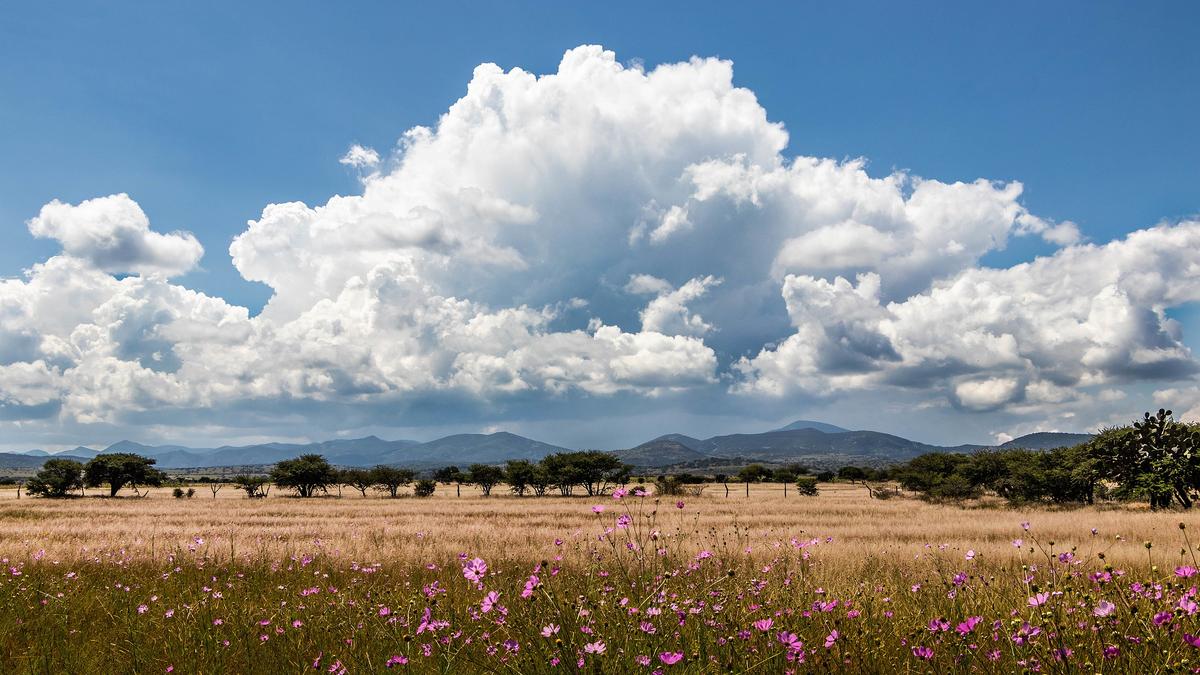
A large cumulonimbus cloud over Guanajuato, Mexico, 2018.
| Photo Credit: Tomascastelazo (CC BY-SA)
Cloud shapes arise from how air moves and mixes at different heights. When air rises, it cools. If it cools to its dew point, water vapour condenses into droplets or ice, forming a cloud.
If the rising is gentle and spread out, such as when warm air slides over cooler air, flat and layered stratus clouds form. If the rising is strong and localised, e.g. when wind pushes air up a hill, the result is the puffy cumulus cloud. If the same process happens harder and at higher altitudes, towering cumulonimbus clouds take shape.
The atmosphere’s stability controls vertical growth. In stable air, a lifted parcel tends to sink back down, but in unstable air, a lifted parcel keeps rising and so clouds build upward. Wind shear can stretch or flatten clouds. Steady, smooth winds over mountains can form smooth lenticular lenses. Layers of air sliding over each other can create wavy Kelvin-Helmholtz curls.
High humidity favours thicker, darker clouds and drier air frays the edges. Small droplets make smooth, milky layers. Mixed droplets and ice create more structure. At very high, cold levels, ice crystals grow into fibrous cirrus clouds.
Published – November 05, 2025 10:00 am IST