






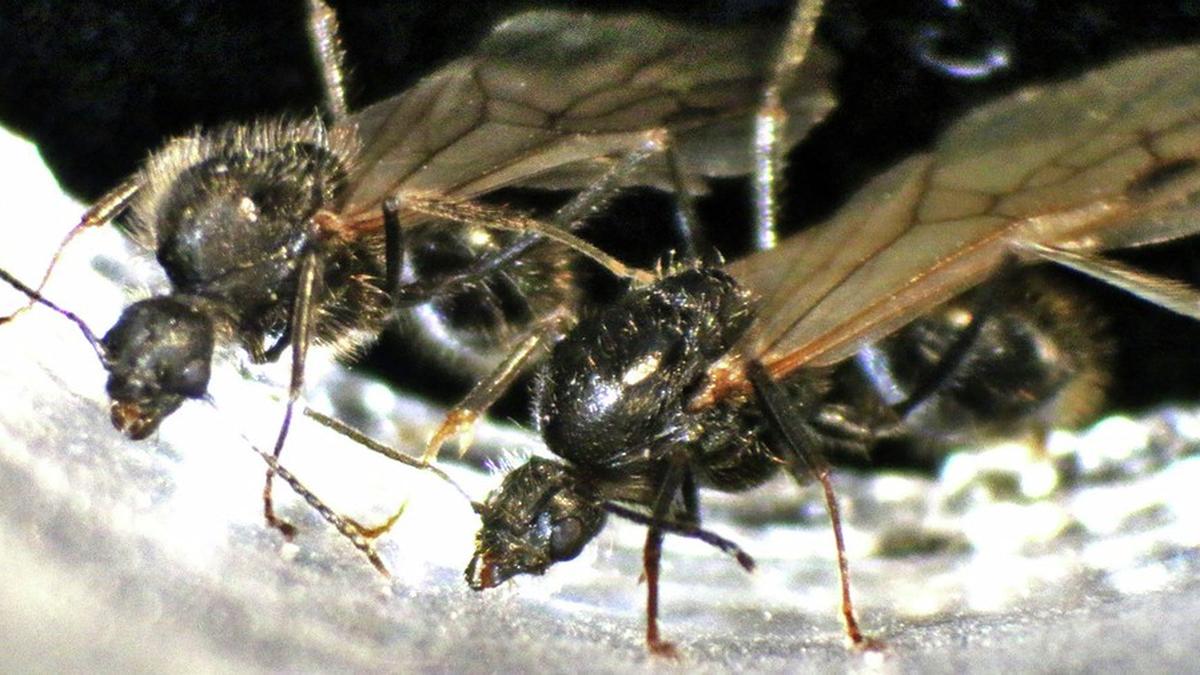
Cats give birth to kittens and dogs give birth to puppies. Neither cats nor dogs can give birth to both kittens and puppies. Yet a paper recently published in Nature, by researchers at the University of Montpellier in France, reported such a thing. The group found that females of one ant species, Messor ibericus, routinely produce sons belonging to two species: M. ibericus and M. structor.
Queens, workers, drones
The biological sex of an ant is determined by whether an individual ant is haploid or diploid. In other words, it depends on whether they have one set or two sets of chromosomes in the nuclei of their bodies’ cells. Haploid individuals inherit their sole set from the mother’s egg. Diploid individuals get one set from the mother’s egg and another from the father’s sperm.
Female ants — which include the queen and worker castes — develop from fertilised eggs. Males, known as drones, develop from unfertilised eggs. The queens mate and have progeny while the workers don’t make eggs and are sterile.
A queen will transfer only one chromosome of each chromosome pair she has to an egg. After the queen mates a drone, she will store the drone’s sperm in a sac called the spermatheca. Later, when she’s laying her eggs, she will decide which of them will also be fertilised by the sperm to become females and which will stay unfertilised and become into drones.
M. ibericus queens mate with both M. ibericus and M. structor drones. The eggs fertilised by M. ibericus sperm become queens. Those fertilised by M. structor sperm become hybrids of M. ibericus and M. structor that develop into workers. The unfertilised eggs become M. ibericus drones.
The puzzle is: how do M. ibericus queens beget M. structor progeny drones?
Cloning ants
The researchers found that the M. ibericus queens eliminated their chromosomes from some of their eggs either before or after fertilisation. When these eggs were fertilised with M. structor sperm, they contained only one set of M. structor chromosomes — which automatically led them to become M. structor drones.
Had the M. ibericus queens not eliminated the chromosomes, the colony wouldn’t have produced M. structor drones. These drones are essential to generate workers in the grand-children.
The researchers also found that the M. structor drones were all genetically identical to each other, meaning they’re clones. It seems ants discovered how to clone long before humans did.
M. ibericus is the first instance of an ant colony including drones of another species. It’s possible the M. ibericus genome evolved caste-biasing genes that caused the females bearing them to be destined to become queens. By generating M. structor drones, the colony could in the next generation produce inter-species hybrids that bypassed the caste-biasing and became workers. That the workers were inter-species hybrids ensured that they were sterile.
The researchers wrote in their paper that “by producing the required species’ males in their own colonies, M. ibericus has gained a clear advantage, as it maintains obligate hybridisation” — meaning hybridisation required for the ants to have a particular trait.
The study also solved a long-standing puzzle: of how all the castes of M. ibericus are found in Spain, Portugal, and Greece yet the M. structor individuals are all male.
In all other ant, and bee, species, the queens, workers, and drones of a colony belong to the same species. The workers are also sterile whereas the queen’s fertility is achieved by other means. Among the honeybees, a special item called royal jelly is fed to larvae to help them develop into queens.
Mitochondrial evidence
The researchers established that the M. structor drones were derived from M. ibericus queens by studying the DNA in their mitochondria. M. structor drones from M. ibericus colonies had M. structor DNA in their nuclei but M. ibericus DNA in mitochondria. On the other hand, drones from M. structor colonies contained M. structor DNA in both nuclei and mitochondria.
While most of an organism’s DNA lies in the cell’s nucleus, a small amount is located in mitochondria. This is mitochondrial DNA (mtDNA). Individuals inherit their mitochondria only via the mother’s egg. Mitochondria are not passed on by sperm cells to the next generation.
DNA sequencing showed that the nuclear DNA of the M. structor drones from M. ibericus colonies was most closely related to the nuclear DNA of wild M. structor. In contrast, their mitochondrial DNA was the same as that of their M. ibericus nestmates.
To find whether ‘domesticated’ males could mate with their wild female counterparts, the researchers analysed 45 M. structor genomes — and didn’t find any hybrid between the domesticated and wild lineages.
The domesticated males differed from their wild counterparts and from their ibericus male nestmates in that they were comparatively hairless. This raised a question: by virtue of their genetic isolation, should the domesticated males be classified as a different species? This is a legitimate question in the same way dogs, by being genetically isolated from wolves (Canis lupus), became Canis familiaris.
The researchers made a different argument: “The domesticating species is directly cloning the domesticated one by means of its own egg cytoplasms. Such replication of an alien genome within one’s own cytoplasm echoes the endosymbiotic domestication of organelles (for example, mitochondria) within eukaryotic cells. Clonal males may thus be regarded as organelles at the superorganism level.”
While there’s a parallel between the M. structor drones in an M. ibericus colony and the mitochondria of a cell, an M. ibericus colony can replenish itself with fresh M. structor genomes — but cells can’t acquire new mitochondria.
This replenishment in M. ibericus can be achieved by M. ibericus queens mating with wild M structor drones. This way, the colony can purge itself of M. structor genomes that accumulate undesirable mutations.
D.P. Kasbekar is a retired scientist.
Published – November 02, 2025 04:42 pm IST