


Skip to content
  • Facebook
  • X
  • Linkedin
  • WhatsApp
  • YouTube
  • Associate Journalism
  • About Us
  • Privacy Policy
  • 033-46046046
  • editor@artifex.news
Artifex.News

Artifex.News

Stay Connected. Stay Informed.

  • Breaking News
  • World
  • Nation
  • Sports
  • Business
  • Science
  • Entertainment
  • Lifestyle
  • Toggle search form
  • Indian Diplomats In Canada Under Surveillance, Centre Tells Parliament
    Indian Diplomats In Canada Under Surveillance, Centre Tells Parliament Nation
  • “It’s A Shame”: AB De Villiers On Racial Quota Chatter Around South Africa’s T20 World Cup Squad
    “It’s A Shame”: AB De Villiers On Racial Quota Chatter Around South Africa’s T20 World Cup Squad Sports
  • Access Denied World
  • Access Denied
    Access Denied Nation
  • The X-factor in Men in Blue’s white-ball arsenal Sports
  • Former Delhi captain Mithun Manhas set to be next BCCI President
    Former Delhi captain Mithun Manhas set to be next BCCI President Sports
  • This Reason Could Shift Pakistan’s Home Test Series vs England To Sri Lanka Or UAE: Report
    This Reason Could Shift Pakistan’s Home Test Series vs England To Sri Lanka Or UAE: Report Sports
  • 180,000 Gazans Displaced In 4 Days As Israeli Aggression Continues
    180,000 Gazans Displaced In 4 Days As Israeli Aggression Continues World
The curious case of the ant queen producing sons of two species

The curious case of the ant queen producing sons of two species

Posted on November 2, 2025 By admin


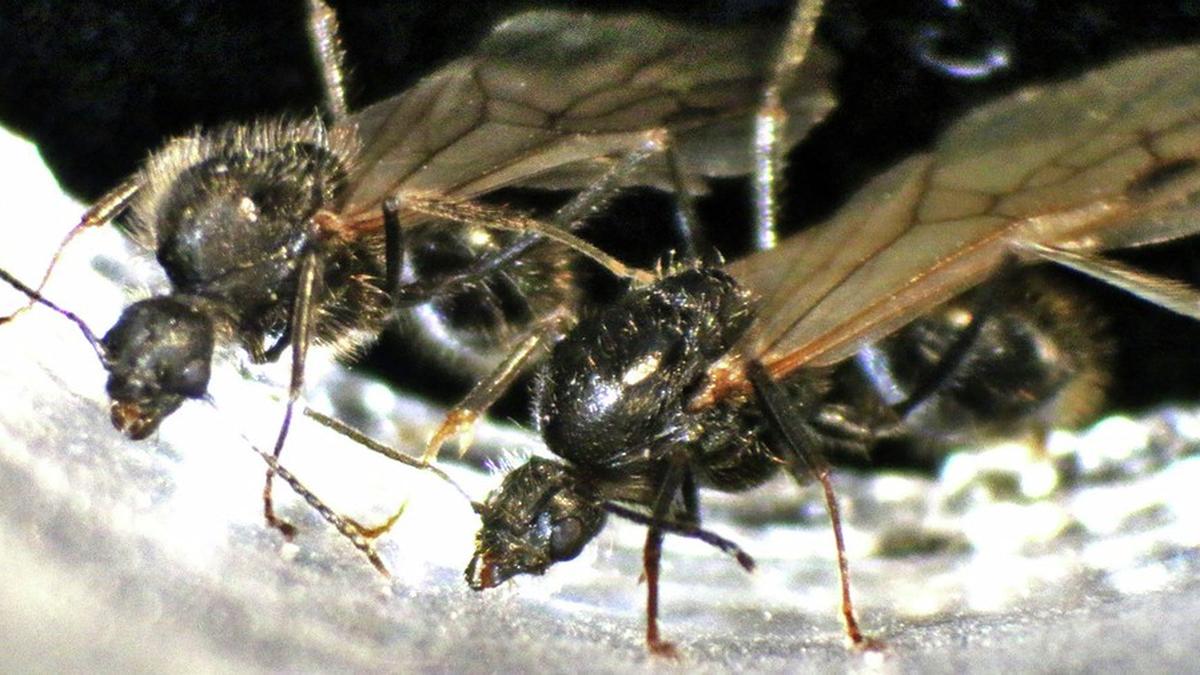
Cats give birth to kittens and dogs give birth to puppies. Neither cats nor dogs can give birth to both kittens and puppies. Yet a paper recently published in Nature, by researchers at the University of Montpellier in France, reported such a thing. The group found that females of one ant species, Messor ibericus, routinely produce sons belonging to two species: M. ibericus and M. structor.

Queens, workers, drones

The biological sex of an ant is determined by whether an individual ant is haploid or diploid. In other words, it depends on whether they have one set or two sets of chromosomes in the nuclei of their bodies’ cells. Haploid individuals inherit their sole set from the mother’s egg. Diploid individuals get one set from the mother’s egg and another from the father’s sperm.

Female ants — which include the queen and worker castes — develop from fertilised eggs. Males, known as drones, develop from unfertilised eggs. The queens mate and have progeny while the workers don’t make eggs and are sterile.

A queen will transfer only one chromosome of each chromosome pair she has to an egg. After the queen mates a drone, she will store the drone’s sperm in a sac called the spermatheca. Later, when she’s laying her eggs, she will decide which of them will also be fertilised by the sperm to become females and which will stay unfertilised and become into drones.

M. ibericus queens mate with both M. ibericus and M. structor drones. The eggs fertilised by M. ibericus sperm become queens. Those fertilised by M. structor sperm become hybrids of M. ibericus and M. structor that develop into workers. The unfertilised eggs become M. ibericus drones.  

The puzzle is: how do M. ibericus queens beget M. structor progeny drones?

Cloning ants

The researchers found that the M. ibericus queens eliminated their chromosomes from some of their eggs either before or after fertilisation. When these eggs were fertilised with M. structor sperm, they contained only one set of M. structor chromosomes — which automatically led them to become M. structor drones.

Had the M. ibericus queens not eliminated the chromosomes, the colony wouldn’t have produced M. structor drones. These drones are essential to generate workers in the grand-children.

The researchers also found that the M. structor drones were all genetically identical to each other, meaning they’re clones. It seems ants discovered how to clone long before humans did.

M. ibericus is the first instance of an ant colony including drones of another species. It’s possible the M. ibericus genome evolved caste-biasing genes that caused the females bearing them to be destined to become queens. By generating M. structor drones, the colony could in the next generation produce inter-species hybrids that bypassed the caste-biasing and became workers. That the workers were inter-species hybrids ensured that they were sterile.

The researchers wrote in their paper that “by producing the required species’ males in their own colonies, M. ibericus has gained a clear advantage, as it maintains obligate hybridisation” — meaning hybridisation required for the ants to have a particular trait.

The study also solved a long-standing puzzle: of how all the castes of M. ibericus are found in Spain, Portugal, and Greece yet the M. structor individuals are all male.

In all other ant, and bee, species, the queens, workers, and drones of a colony belong to the same species. The workers are also sterile whereas the queen’s fertility is achieved by other means. Among the honeybees, a special item called royal jelly is fed to larvae to help them develop into queens.

Mitochondrial evidence

The researchers established that the M. structor drones were derived from M. ibericus queens by studying the DNA in their mitochondria. M. structor drones from M. ibericus colonies had M. structor DNA in their nuclei but M. ibericus DNA in mitochondria.  On the other hand, drones from M. structor colonies contained M. structor DNA in both nuclei and mitochondria.

While most of an organism’s DNA lies in the cell’s nucleus, a small amount is located in mitochondria. This is mitochondrial DNA (mtDNA). Individuals inherit their mitochondria only via the mother’s egg. Mitochondria are not passed on by sperm cells to the next generation. 

 DNA sequencing showed that the nuclear DNA of the M. structor drones from M. ibericus colonies was most closely related to the nuclear DNA of wild M. structor. In contrast, their mitochondrial DNA was the same as that of their M. ibericus nestmates.

To find whether ‘domesticated’ males could mate with their wild female counterparts, the researchers analysed 45 M. structor genomes — and didn’t find any hybrid between the domesticated and wild lineages.

The domesticated males differed from their wild counterparts and from their ibericus male nestmates in that they were comparatively hairless.  This raised a question: by virtue of their genetic isolation, should the domesticated males be classified as a different species? This is a legitimate question in the same way dogs, by being genetically isolated from wolves (Canis lupus), became Canis familiaris.

The researchers made a different argument: “The domesticating species is directly cloning the domesticated one by means of its own egg cytoplasms. Such replication of an alien genome within one’s own cytoplasm echoes the endosymbiotic domestication of organelles (for example, mitochondria) within eukaryotic cells. Clonal males may thus be regarded as organelles at the superorganism level.”

While there’s a parallel between the M. structor drones in an M. ibericus colony and the mitochondria of a cell, an M. ibericus colony can replenish itself with fresh M. structor genomes — but cells can’t acquire new mitochondria.

This replenishment in M. ibericus can be achieved by M. ibericus queens mating with wild M structor drones. This way, the colony can purge itself of M. structor genomes that accumulate undesirable mutations.

D.P. Kasbekar is a retired scientist.

Published – November 02, 2025 04:42 pm IST



Source link

Science

Post navigation

Previous Post: Access Denied
Next Post: Access Denied

Related Posts

  • The value of attributing extreme events to climate change | Explained
    The value of attributing extreme events to climate change | Explained Science
  • Science for All | New atlas reveals tiled bodies are common across life on earth
    Science for All | New atlas reveals tiled bodies are common across life on earth Science
  • Machine learning can help blood tests have a separate ‘normal’ for each patient
    Machine learning can help blood tests have a separate ‘normal’ for each patient Science
  • Australia approves world’s first vaccine to save koalas from chlamydia
    Australia approves world’s first vaccine to save koalas from chlamydia Science
  • The case to rethink India’s influenza vaccination strategy
    The case to rethink India’s influenza vaccination strategy Science
  • science for all newsletter What are Trojan asteroids?
    science for all newsletter What are Trojan asteroids? Science

More Related Articles

Chemistry Nobel Prize for trio that made ‘artificial atoms’ Chemistry Nobel Prize for trio that made ‘artificial atoms’ Science
Women biotech scientists await funds for research Women biotech scientists await funds for research Science
New rocket, plus moon and Venus missions, herald new beginnings New rocket, plus moon and Venus missions, herald new beginnings Science
The science, technology, and pitfalls of using nuclear power in space The science, technology, and pitfalls of using nuclear power in space Science
BlueBird Block-2 mission: ISRO successfully launches LVM3-M6 rocket BlueBird Block-2 mission: ISRO successfully launches LVM3-M6 rocket Science
What is ‘healthocide’? What is ‘healthocide’? Science
SiteLock

Archives

  • May 2026
  • April 2026
  • March 2026
  • February 2026
  • January 2026
  • December 2025
  • November 2025
  • October 2025
  • September 2025
  • August 2025
  • July 2025
  • June 2025
  • May 2025
  • April 2025
  • March 2025
  • February 2025
  • January 2025
  • December 2024
  • November 2024
  • October 2024
  • September 2024
  • August 2024
  • July 2024
  • June 2024
  • May 2024
  • April 2024
  • March 2024
  • February 2024
  • January 2024
  • December 2023
  • November 2023
  • October 2023
  • September 2023
  • August 2023
  • July 2023
  • June 2023
  • May 2023
  • April 2023
  • March 2023
  • February 2023
  • January 2023
  • December 2022
  • November 2022
  • October 2022
  • September 2022
  • August 2022
  • July 2022
  • June 2022
  • May 2022

Categories

  • Business
  • Nation
  • Science
  • Sports
  • World

Recent Posts

  • Cuba has run out of diesel and fuel oil amid U.S. oil blockade
  • Karnataka’s Leader of Opposition R Ashok to reduce escort vehicles, travel by Namma Metro
  • China, U.S. should be ‘partners not rivals’, says Xi Jinping after meeting Donald Trump
  • UAE ‘denies reports’ of secret Netanyahu visit
  • Iran working on Hormuz ‘protocol’ to cover ‘costs’, says Deputy Foreign Minister Gharibabadi

Recent Comments

  1. OrvalMaync on UP Teacher Who Asked Students To Slap Muslim Classmate
  2. Jeffreyroure on UP Teacher Who Asked Students To Slap Muslim Classmate
  3. Stevemonge on UP Teacher Who Asked Students To Slap Muslim Classmate
  4. RichardClage on UP Teacher Who Asked Students To Slap Muslim Classmate
  5. StevenLek on UP Teacher Who Asked Students To Slap Muslim Classmate
  • Access Denied Business
  • Siddaramaiah Summoned For Questioning On Wednesday In Mysuru Land Scam Case
    Siddaramaiah Summoned For Questioning On Wednesday In Mysuru Land Scam Case Nation
  • Rishi Sunak Faces Cabinet Split On Taking UK Out Of Human Rights Pact
    Rishi Sunak Faces Cabinet Split On Taking UK Out Of Human Rights Pact World
  • Access Denied Business
  • ED restitutes assets worth Rs 4,025 crore in Bhushan Steel bank ‘fraud’ case
    ED restitutes assets worth Rs 4,025 crore in Bhushan Steel bank ‘fraud’ case Business
  • Rupee drops to lowest value ever against U.S. dollar due to equity outflows, oil prices
    Rupee drops to lowest value ever against U.S. dollar due to equity outflows, oil prices Business
  • Launch date of first uncrewed mission of Gaganyaan to be announced this week: ISRO Chairperson
    Launch date of first uncrewed mission of Gaganyaan to be announced this week: ISRO Chairperson Science
  • Early results show 50% of Moldovans vote ‘yes’ at referendum on EU aspirations
    Early results show 50% of Moldovans vote ‘yes’ at referendum on EU aspirations World

Editor-in-Chief:
Mohammad Ariff,
MSW, MAJMC, BSW, DTL, CTS, CNM, CCR, CAL, RSL, ASOC.
editor@artifex.news

Associate Editors:
1. Zenellis R. Tuba,
zenelis@artifex.news
2. Haris Daniyel
daniyel@artifex.news

Photograher:
Rohan Das
rohan@artifex.news

Artifex.News offers Online Paid Internships to college students from India and Abroad. Interns will get a PRESS CARD and other online offers.
Send your CV (Subjectline: Paid Internship) to internship@artifex.news

Links:
Associate Journalism
About Us
Privacy Policy

News Links:
Breaking News
World
Nation
Sports
Business
Entertainment
Lifestyle

Registered Office:
72/A, Elliot Road, Kolkata - 700016
Tel: 033-22277777, 033-22172217
Email: office@artifex.news

Editorial Office / News Desk:
No. 13, Mezzanine Floor, Esplanade Metro Rail Station,
12 J. L. Nehru Road, Kolkata - 700069.
(Entry from Gate No. 5)
Tel: 033-46011099, 033-46046046
Email: editor@artifex.news

Copyright © 2023 Artifex.News Newsportal designed by Artifex Infotech.