



Skip to content
  • Facebook
  • X
  • Linkedin
  • WhatsApp
  • YouTube
  • Associate Journalism
  • About Us
  • Privacy Policy
  • 033-46046046
  • editor@artifex.news
Artifex.News

Artifex.News

Stay Connected. Stay Informed.

  • Breaking News
  • World
  • Nation
  • Sports
  • Business
  • Science
  • Entertainment
  • Lifestyle
  • Toggle search form
  • More Than 13 Lakh UP Government Employees May Lose Salaries Over This Order
    More Than 13 Lakh UP Government Employees May Lose Salaries Over This Order Nation
  • India-U.S. ‘very close’ to finalising initial framework deal on reciprocal tariffs: Commerce Secretary
    India-U.S. ‘very close’ to finalising initial framework deal on reciprocal tariffs: Commerce Secretary Business
  • KVAFSU unveils statue of Dr. B.R. Ambedkar in campus in Bidar
    KVAFSU unveils statue of Dr. B.R. Ambedkar in campus in Bidar Nation
  • FIFA World Cup 2026: Kylian Mbappé condemns Paraguayan senator over racist remarks after match
    FIFA World Cup 2026: Kylian Mbappé condemns Paraguayan senator over racist remarks after match Sports
  • Access Denied
    Access Denied Nation
  • Russia, North Korea open first road link across shared border
    Russia, North Korea open first road link across shared border World
  • Govt extends RoDTEP export incentive scheme till March 31, 2026, exporters welcome the move
    Govt extends RoDTEP export incentive scheme till March 31, 2026, exporters welcome the move Business
  • Passengers Recall Bihar Train Accident Horror
    Passengers Recall Bihar Train Accident Horror Nation
Why the showcase of Indian idols at The British Museum must spark debate on colonial loot

Why the showcase of Indian idols at The British Museum must spark debate on colonial loot

Posted on October 24, 2025 By admin


Have you ever wondered how Indian deities came to have their signature physical features? The British Museum in London recently delved into this question, in an exhibition titled Ancient India: Living Traditions.

The nearly five-month-long exhibition, supported by Reliance Industries and Reliance Foundation, concluded on October 19, and traced the evolution of idol crafting in Hinduism, Buddhism, and Jainism across a period of more than 2,000 years. It promised visitors a sweeping journey through centuries of Indian religious art. The ideas of education and attempting to explain the value of these objects was a good step towards accountability and collaboration but the lingering irony remained: of this story being told, not in Varanasi, Amravati, or Nalanda, but in Britain, a country whose colonial record includes the wholesale removal of these idols from their homes in India.

Given the celebrities in attendance at the museum’s inaugural fundraising gala, the glamorous Pink Ball, co-chaired by businesswoman Isha Ambani, to coincide with the conclusion of the exhibition, one wonders whether at some point there was a surreal realisation of the incongruity as curators and art critics debated the “aesthetics of devotion”. Many of the idols on display likely arrived through legally and morally dubious channels of the British Empire and its well-oiled cultural loot machinery.

Exhibitions like these are cultural scholarship layered over cultural dispossession. They offer an opportunity to reflect on what happens when spiritual icons become permanent migrants; when they are moved out of their warm Indian homes to cities where their names are unknown and often mispronounced. However, as with other such efforts, the exhibition has largely missed the chance to start a substantial dialogue on restitution and the ways in which constructive communication around this idea could be developed.

Devotion versus wealth and display

An exhibit at the ‘Ancient India: Living Traditions’ exhibition at The British Museum.
| Photo Credit:
The British Museum

The presence of Indian idols in Britain is not an accident of chance. Both during and after colonial rule, countless artefacts have found their way to the U.K., either looted, “gifted” under duress, or smuggled. Many such artefacts were simply catalogued as curiosities by colonial administrators who treated Indian art as anthropological data rather than living faith. By the late 19th century, Indian deities were as likely to be encountered in Bloomsbury as in Bodh Gaya.

The London exhibition, with its scholarly catalogues and glossy posters, sanitised that story. It presented idols as aesthetic milestones. Although the exhibition served an educational purpose, its location betrayed its intended bona fide. It showed idols in an environment divorced from the adoration of devotees who once anointed them with sandalwood paste or garlanded them with marigolds. The acts of worship, sweat and penance, were replaced by acts of display, wealth and privilege. That is the legacy of cultural loot: not only physical displacement but also the transformation of meaning.

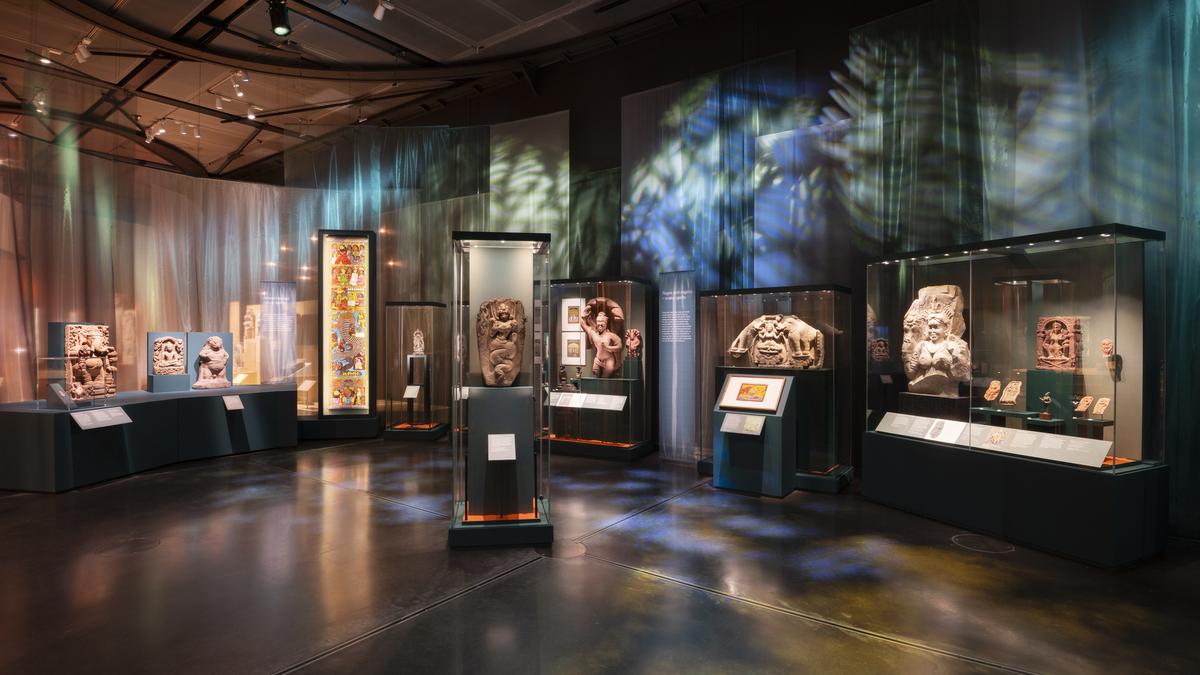
In this light, The British Museum’s long corridors, and the recent London exhibition, resemble nothing of a shrine and all of the spectacle of a cabinet of curiosities. The idols, once central to living religious practice of thronging devotees, are now objects of detached admiration. To see an idol of Lord Vishnu in a sterile glass case in the heart of an air-conditioned and humidity-controlled room with monochrome walls is to witness not continuity but interruption. A story broken in transit. 

A view of the exhibits at ‘Ancient India: Living Traditions’ at The British Museum in London.

A view of the exhibits at ‘Ancient India: Living Traditions’ at The British Museum in London.
| Photo Credit:
The British Museum

Monetising the sacred

The deeper irony is that these idols are not simply being preserved; they are being monetised. Visitors in London pay for entry, purchase catalogues, perhaps even pick up idol-inspired souvenirs on their way out. These idols, once objects of communal offering, have been converted into revenue streams for institutions far from their origins. While many museums in India, especially in the more remote parts of the country, struggle with funding and the government finds it difficult to protect village shrines from theft, The British Museum continues to turn colonial acquisitions into cultural and actual capital. 

This is where the exhibition revealed more than it intended. It was not just about “the evolution of idols” but about the evolution of ownership. 

‘Gaja-Lakshmi’, circa 1780, at The British Museum.

‘Gaja-Lakshmi’, circa 1780, at The British Museum.
| Photo Credit:
The British Museum

Their return must display the reverence for culture, imagination and foresight of the judges of the Court of Appeals for England and Wales who decided the Bumper Development Corporation v Commissioner of Police of the Metropolis and Others [1991] EWCA Civ J0213-5 case in 1991. In this case, seeking to establish ownership of a stolen Nataraja idol, the judges ruled that the temple in South India from where the Nataraja was stolen could be a juristic person in the U.K., and also that the idol could ‘speak’ through the temple priest and assert its ‘yearning to go home’.

Lessons for India

The Ancient India: Living Traditions exhibition has, no doubt, been considered a success as a cultural event. But it also served as a quiet indictment of a system that still profits from colonial acquisitions, without remorse, and of Indians with incomplete knowledge of their own history. To debate the “evolution” of idols while refusing to return them to their homes is an act of selective memory.

Ganesha made in Java from volcanic stone, 1000-1200 CE.

Ganesha made in Java from volcanic stone, 1000-1200 CE.
| Photo Credit:
The British Museum

For India, the lesson is not only about creating a transparent framework for demanding restitution. It is about building dialogue and real education. Idols are more than stone and bronze; they are embodiments of faith, history, and identity. They must be allowed their original contexts, to be able to get back in touch with their original environments and until then, given the correct explanation for them. Every exhibition abroad will carry with it the overbearing and looming shadow of dispossession.

India’s generosity of participating in redundant institutions like the Commonwealth should also enable the country to balance the ideas of the world as one family with the importance of cultural identity. There are some indications from international organisations that recognition of cultural dispossession must take precedence over display. In September 2025, UNESCO unveiled its virtual database of stolen objects. However, it is still very bare, containing only three objects submitted by India. To be truly effective, the database would also have to reflect the understanding of UNESCO’s 1970 ‘Convention on the Means of Prohibiting and Preventing the Illicit Import, Export and Transfer of Ownership of Cultural Property’ and create a comprehensive database of colonial era-looted cultural objects. 

For now, gods may travel across continents, but sensibility has been left behind.

Sahibnoor is Lecturer, Jindal Global Law School, and Lavanya is Lawyer, RFKN Advocates.

Published – October 24, 2025 04:09 pm IST



Source link

World Tags:The British Museum indian idols deities pink ball colonial loot restitution

Post navigation

Previous Post: Access Denied
Next Post: Access Denied

Related Posts

  • Calls for U.K. inquiry into ‘hounding’ of ex-Cambridge academic
    Calls for U.K. inquiry into ‘hounding’ of ex-Cambridge academic World
  • Vietnam to elect new president in October, parliament official says
    Vietnam to elect new president in October, parliament official says World
  • ‘Reckless’ H-1B fee will have negative impact on IT industry, say U.S. lawmakers and community
    ‘Reckless’ H-1B fee will have negative impact on IT industry, say U.S. lawmakers and community World
  • At least six people found dead in boxcar in Laredo, Texas, police say
    At least six people found dead in boxcar in Laredo, Texas, police say World
  • Access Denied World
  • Antonio Guterres ‘alarmed’ by Donald Trump rhetoric on Iranian energy plants: UN spokesperson
    Antonio Guterres ‘alarmed’ by Donald Trump rhetoric on Iranian energy plants: UN spokesperson World

More Related Articles

Access Denied World
Why Pope Leo XIV’s AI warning has everyone talking about the Butlerian Jihad from ‘Dune’ Why Pope Leo XIV’s AI warning has everyone talking about the Butlerian Jihad from ‘Dune’ World
US Announces 0 Million In New Military Aid For Ukraine US Announces $150 Million In New Military Aid For Ukraine World
Access Denied World
Three men charged with conspiring to smuggle U.S. artificial intelligence to China Three men charged with conspiring to smuggle U.S. artificial intelligence to China World
Access Denied World
SiteLock

Archives

  • October 2026
  • September 2026
  • August 2026
  • July 2026
  • June 2026
  • May 2026
  • April 2026
  • March 2026
  • February 2026
  • January 2026
  • December 2025
  • November 2025
  • October 2025
  • September 2025
  • August 2025
  • July 2025
  • June 2025
  • May 2025
  • April 2025
  • March 2025
  • February 2025
  • January 2025
  • December 2024
  • November 2024
  • October 2024
  • September 2024
  • August 2024
  • July 2024
  • June 2024
  • May 2024
  • April 2024
  • March 2024
  • February 2024
  • January 2024
  • December 2023
  • November 2023
  • October 2023
  • September 2023
  • August 2023
  • July 2023
  • June 2023
  • May 2023
  • April 2023
  • March 2023
  • February 2023
  • January 2023
  • December 2022
  • November 2022
  • October 2022
  • September 2022
  • August 2022
  • July 2022
  • June 2022
  • May 2022

Categories

  • Business
  • Nation
  • Science
  • Sports
  • World

Recent Posts

  • 2K Run, awareness activities mark Wildlife Week celebrations
  • Boy who underwent treatment after suffering head injury in train hit case dies
  • Telangana People’s Front seeks three urgent interventions to save education system
  • We would always like to take the aggressive option: Morkel
  • Deleted in SIR, four Bengal men now locked at Chhattisgarh detention centre for over a month

Recent Comments

  1. RobertGat on UP Teacher Who Asked Students To Slap Muslim Classmate
  2. RobertGat on UP Teacher Who Asked Students To Slap Muslim Classmate
  3. RobertGat on UP Teacher Who Asked Students To Slap Muslim Classmate
  4. Davidbrurf on UP Teacher Who Asked Students To Slap Muslim Classmate
  5. Danielwhipt on UP Teacher Who Asked Students To Slap Muslim Classmate
  • Access Denied Sports
  • Madrid Derby Suspended As Fans Target Real Madrid Goalkeeper Thibaut Courtois. Video
    Madrid Derby Suspended As Fans Target Real Madrid Goalkeeper Thibaut Courtois. Video Sports
  • Watch: ‘A great honour, privilege and opportunity’, says new ISRO chairman V. Narayanan
    Watch: ‘A great honour, privilege and opportunity’, says new ISRO chairman V. Narayanan Science
  • Iran-Israel war LIVE: Strait of Hormuz to stay closed until port blockade lifts, Iran says
    Iran-Israel war LIVE: Strait of Hormuz to stay closed until port blockade lifts, Iran says World
  • Ved Reddy: How TG20 unearthed Telangana’s 16-year-old spin sensation
    Ved Reddy: How TG20 unearthed Telangana’s 16-year-old spin sensation Sports
  • King Charles III to attend 80th anniversary of Auschwitz liberation
    King Charles III to attend 80th anniversary of Auschwitz liberation World
  • Pakistan court acquits Imran Khan, his close aides in Section 144 violation case
    Pakistan court acquits Imran Khan, his close aides in Section 144 violation case World
  • Access Denied Sports

Editor-in-Chief:
Mohammad Ariff,
MSW, MAJMC, BSW, DTL, CTS, CNM, CCR, CAL, RSL, ASOC.
editor@artifex.news

Associate Editors:
1. Zenellis R. Tuba,
zenelis@artifex.news
2. Haris Daniyel
daniyel@artifex.news

Photograher:
Rohan Das
rohan@artifex.news

Associate Journalists
1. Subrata Paul - AN/2020/01
2. Quamruz Zaman - AN/2021/22
3. Ahmed Sha - AN/2021/035
4. Ajay Kumar Shaw - AN/2021/39
5. Tahqiqul Hoda - AN/2021/21

Artifex.News offers Online Paid Internships to college students from India and Abroad. Interns will get a PRESS CARD and other online offers.
Send your CV (Subjectline: Paid Internship) to internship@artifex.news

Links:
Associate Journalism
About Us
Privacy Policy

News Links:
Breaking News
World
Nation
Sports
Business
Entertainment
Lifestyle

Registered Office:
72/A, Elliot Road, Kolkata - 700016
Tel: 033-22277777, 033-22172217
Email: office@artifex.news

Editorial Office / News Desk:
No. 13, Mezzanine Floor, Esplanade Metro Rail Station,
12 J. L. Nehru Road, Kolkata - 700069.
(Entry from Gate No. 5)
Tel: 033-46011099, 033-46046046
Email: editor@artifex.news

Copyright © 2023 Artifex.News Newsportal designed by Artifex Infotech.