







The story so far: Quantum mechanics says that particles can sometimes cross barriers they don’t have the energy to climb, like boring through a mountain instead of scaling it first. This process, called tunnelling, is common in nuclear and atomic physics. The 2025 physics Nobel Prize laureates John Clarke, Michel Devoret, and John Martinis showed that such behaviour can occur not only in subatomic particles but also in an electrical circuit made of superconductors. The finding opens the door to new technologies set to transform the way we collect, study, understand, and use information from our surroundings.
What is a Josephson junction?
The fundamental unit of the award-winning experiments the trio conducted is a device called a Josephson junction. Here, two superconductors are separated by a very thin insulator. The trio wanted to know if a parameter of the circuit as a whole, in this case the junction’s phase difference, could behave like a single quantum particle. They came away from their experiments with a resounding ‘yes’, by observing both macroscopic quantum mechanical tunnelling and discrete energy levels in the circuit.
A schematic illustration of a single Josephson junction. A and B are two superconductors; C is an ultrathin insulator.
| Photo Credit:
Miraceti (CC BY-SA)
In a superconductor, many electrons pair up and move without resistance. In a Josephson junction, the relevant variable is the phase difference of the superconducting order parameter. Put differently, the superconducting order parameter is a macroscopic variable that trillions of electron pairs in the material share and which describes the state the system is in. Theory predicts that the current through the junction depends on the value of the parameter, and that the phase difference evolves in time according to the voltage across the junction.
When the scientists sent a current through the Josephson junction, they found that if it was small enough, the flow of paired electrons was stalled and the circuit produced no voltage. In classical physics, this state would never change: the electrons’ flow would remain blocked. But in the quantum world, the current has a small chance of suddenly tunnelling out of the trap and flowing freely on the other side, creating a measurable voltage.
Why was the circuit fragile?
In the early 1980s, several groups searched for this tunnelling by varying the current and recording the value at which the junction produced a voltage. If the electron pairs were simply escaping to the other side due to thermal fluctuations — akin to being heated enough to jump across the mountain — cooling the device ought to steadily increase the amount of current required to produce a voltage. On the other hand, if the electron pairs were tunnelling through, the rate of crossing over would eventually stop changing with temperature.
Simple though the setup was, the challenge was in keeping stray microwave radiation from affecting the circuit and producing data consistent with the temperature-independent behaviour. So the experimenters needed to reduce and characterise environmental noise with great care.
The Berkeley team led by Clarke, working with Devoret and Martinis, solved this problem by redesigning their setup so stray signals couldn’t interfere. They used special filters and shielding to block unwanted microwaves and kept every part of the experiment extremely cold and stable. Then they sent in faint yet precisely tuned microwave pulses to gently test how the circuit responded, allowing them to measure its electrical properties accurately. When they finally cooled the system to very low temperatures, they saw that its behaviour matched the exact patterns predicted by quantum tunnelling theory.
How did the circuit show quantum effects?
The researchers also wanted to find out if the circuit’s trapped state behaved like a quantum system with distinct energy steps — a hallmark of a quantum state — instead of a smooth range. They shone microwaves of different frequencies onto the junction while adjusting the current. When the frequency exactly matched the gap between two allowed energy levels, the circuit suddenly escaped more easily from its trapped state. The higher the level, the faster this escape happened. These patterns showed that the circuit’s overall state could only receive or emit fixed packets of energy, which is also how a single particle following the rules of quantum mechanics would behave. In short, the circuit as a whole behaved like an atom.
Put together, the results revealed two facts. First, a macroscopic electrical circuit — one that you could see with the naked eye — could display quantum behaviour when sufficiently isolated from its environment. Second, the relevant macroscopic coordinate in that circuit could be understood using the standard tools of quantum mechanics.
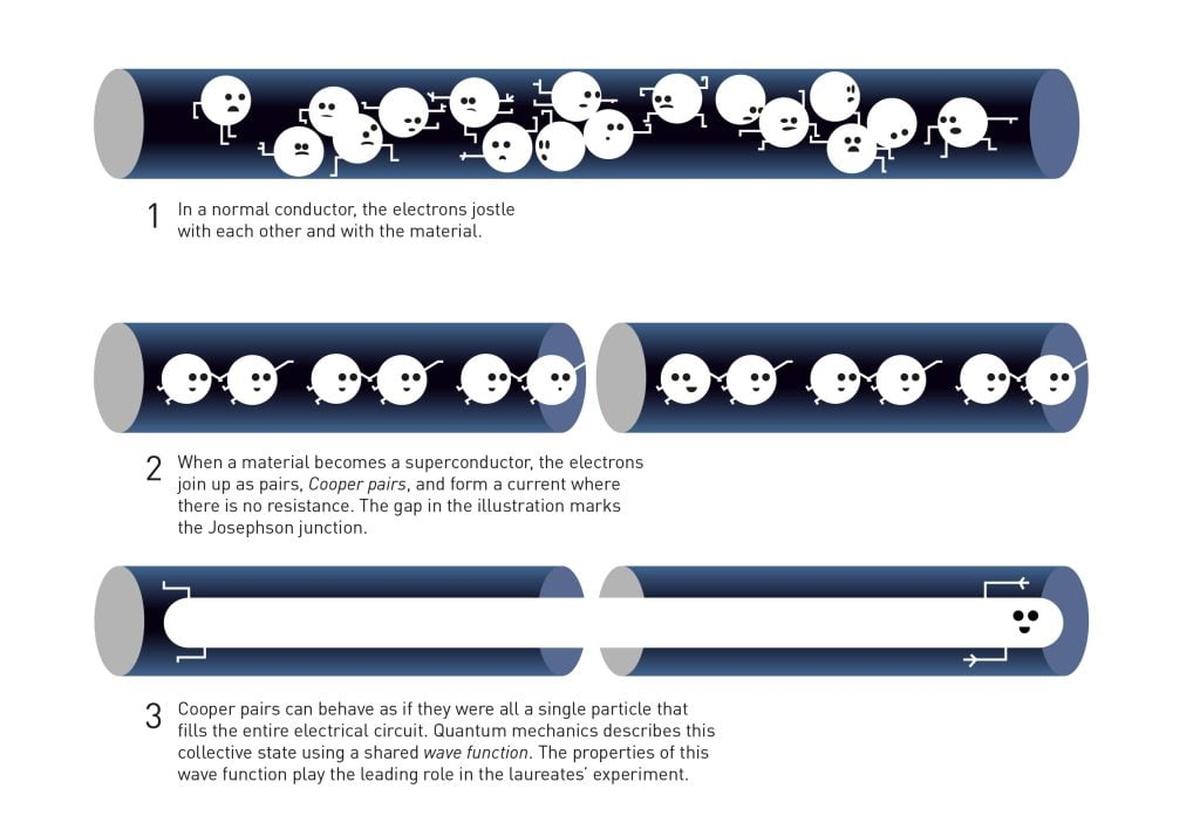
What happens inside a superconductor?
| Photo Credit:
Johan Jarnestad/The Royal Swedish Academy of Sciences
These experiments also pointed to a practical path for controlling and ‘reading’ macroscopic quantum states — in this case using a bias current, weak microwaves, and sufficient protections to shield the circuit from external radiation — one that gave the field a template to make reliable quantum measurements in solid-state devices. Subsequent work in the 1990s and 2000s extended these ideas, developing superconducting qubits, embedding them in microwave resonators, and improving their coherence (i.e. their ability to maintain their quantum states without them being destroyed by noise).
What are the applications of this work?
The technological applications flow from the same physics. A circuit with a Josephson junction can be made to mimic the quantised energy levels of an atom; microwaves could drive the circuit to jump between these energy levels; and carefully coupling the circuit to a resonator could allow an operator to measure changes in the circuit without disturbing it. This architecture, known as circuit quantum electrodynamics, is the foundation of many of today’s superconducting quantum processors.
(The resonator is like an echo chamber for microwaves. When the circuit is coupled to a resonator, the two can exchange energy in a controlled way, allowing scientists to measure the circuit’s state indirectly by observing changes in the resonator’s behaviour.)
Superconducting circuits that exploit macroscopic quantum effects are now central to several emerging technologies. They are quantum amplifiers that boost extremely weak signals without adding noise — a useful ability in diagnostics as much as searches for dark matter. They are used to measure current and voltage with extraordinary precision. They can be microwave-to-optical converters that link quantum processors to fibre-optic networks. They are components in quantum simulators used to model complex materials or even chemical reactions atom by atom.
Ultimately, these devices are useful because the circuits’ phase difference and the supercurrent respond to even small external influences with large, measurable changes. The laureates’ work turned this bug into a feature.
Published – October 07, 2025 07:24 pm IST