


Skip to content
  • Facebook
  • X
  • Linkedin
  • WhatsApp
  • YouTube
  • Associate Journalism
  • About Us
  • Privacy Policy
  • 033-46046046
  • editor@artifex.news
Artifex.News

Artifex.News

Stay Connected. Stay Informed.

  • Breaking News
  • World
  • Nation
  • Sports
  • Business
  • Science
  • Entertainment
  • Lifestyle
  • Toggle search form
  • Access Denied
    Access Denied Nation
  • Pakistan witnesses drop in terror attacks since Afghan border closure: report
    Pakistan witnesses drop in terror attacks since Afghan border closure: report World
  • Employees Fired Due To Work Stress? Noida Startup YesMadam Clarifies
    Employees Fired Due To Work Stress? Noida Startup YesMadam Clarifies Nation
  • Rupee rises 5 paise to 95.77 against U.S. dollar in early trade
    Rupee rises 5 paise to 95.77 against U.S. dollar in early trade Business
  • A.P. govt. sanctions ₹99.19 crore for Project SARTHI in Vizag
    A.P. govt. sanctions ₹99.19 crore for Project SARTHI in Vizag Nation
  • Access Denied Business
  • Retail inflation eases to 4.83% in April
    Retail inflation eases to 4.83% in April Business
  • GST Council did not even discuss the issue of compensating States for revenue loss: Telangana and Kerala
    GST Council did not even discuss the issue of compensating States for revenue loss: Telangana and Kerala Business
Remembering primatologist Jane Goodall, who should have got the Nobel Peace Prize

Remembering primatologist Jane Goodall, who should have got the Nobel Peace Prize

Posted on October 9, 2025 By admin


Much has been written about the universally loved Jane Goodall, primatologist and animal rights campaigner, on whom awards and honours far too numerous to list have been showered. She passed away on October 1 aged 91. One recognition, however, she did not but should have received is the Nobel Peace Prize. For all her life, Goodall worked for peace and harmony not just between humans but between Homo sapiens and all life on Earth.

Her own words best describe the start of her seven-decade-long journey to convince humanity to protect our magical planet: ‘If you are interested in animals,’ someone said to me about a month after my arrival in Africa, ‘then you should meet Dr. Leakey.’ I had already started on a somewhat dreary office job, since I had not wanted to overstay my welcome at my friend’s farm. I went to see Louis Leakey at what is now the National Museum of natural history in Nairobi, where at that same time he was Curator. Somehow he must have sensed that my interest in animals was not just a passing phase, but was rooted deep, for on the spot he gave me a job as an assistant secretary.

First encounter

I never got to meet Jane Goodall but she entered my life in 1966, six years after she began her work with the legendary Louis Leaky in Tanzania’s Gombe Stream National Park, when the National Geographic magazine placed her on their cover. Down the years, I could not help but compare her to the other Jane… Tarzan’s Jane, about whom she recently said with an impish smile: “Tarzan married the wrong Jane.” Her fascination for Africa and chimpanzees was undoubtedly influenced by her love for Tarzan of the Apes (1912) and Tarzan’s sidekick Cheeta the chimpanzee. Her version was a stuffed toy chimp named Mr. H. “[He] goes everywhere with me. We’ve been to 59 countries together and he’s probably been touched by about nearly 4 million people,” she once said.

British anthropologist and primatologist Jane Goodall in September 1974. (Getty Images)

In 1978, I bought a large format pictorial book, Savage Africa, authored by Hugo van Lawick, only to discover that Jane Goodall was Lawick’s former wife, and that they had jointly put together a book in 1971, Innocent Killers, with Goodall doing the writing and Hugo the photography. The detailed descriptions of hunts by carnivores such as hyenas, cheetahs and leopards were graphic and gory, but they conveyed an elemental truth: unlike humans, wild animals were not ‘cruel’ as judged by ethical human standards. Animals ate what they killed. Nothing went to waste.

Blazing a trail

Down the decades, Goodall showed the world that it was possible to love animals (she likes dogs more than chimps!). She told us that chimps lived in societies akin to ours and used tools to access food, an ability thus far attributed only to humans. What’s more, they had distinct personalities. Some, like one individual she named David Greybeard, displayed likeable traits, while some were unlikeable, even cannibalistic. None of these field observations came easy. It took years to win the trust of the chimps, never hiding from them until she became a part of the non-threatening backdrop, a harmless pale-coloured ape. No naturalist had ever attempted this before. The most important of all her observations was the ability of apes to insert twigs into termite nests, pull them out repeatedly with ants attached and consume as food. When Louis Leaky saw evidence of this from images shot by a National Geographic photographer, he sent this now-famous telegram to his protégé: “NOW WE MUST REDEFINE TOOL STOP REDEFINE MAN STOP OR ACCEPT CHIMPANZEES AS HUMAN”.

Goodall faced considerable opposition over the years, largely by testosterone-driven males who questioned both her capability and ability to survive in the rough-and-tumble world of Africa’s jungle life. Her mother, nevertheless, travelled all the way to be with her young daughter as the attitude of men spurred her on to achieve more and discover more, and cut a trail not merely in Africa but clean through academia in England.

Misplaced criticism

She was also the target of misplaced criticism from human rights activists who accused her of protecting apes at the cost of local human communities. Working in a male-dominated sector in her early days, she was unfairly criticised for being an amateur with anthropomorphic biases that ended up superimposing human attributes and capabilities onto wild apes.

A decade ago, some academics pointed out that a manuscript of hers, for Seeds of Hope (2013), omitted crediting sources. Emily Brelage of DePauw University wrote, “It’s important to not ignore the flaws that make them [admired heroes] human, while we celebrate what makes them great.” With characteristic grace, Goodall responded that she would delay publication with added credits, saying, “I hope it is obvious that my only objective was to learn as much as I could so that I could provide straightforward factual information.”
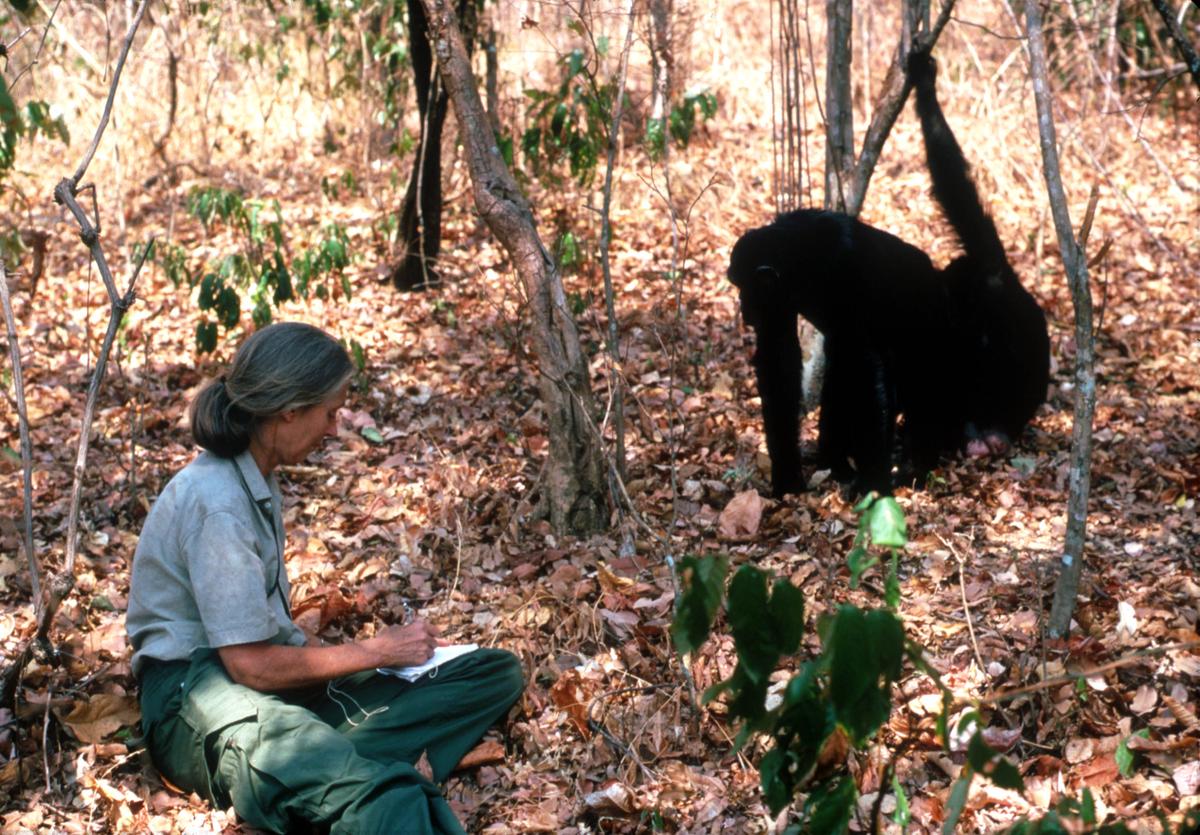
Scientist Jane Goodall studies the behaviour of a chimpanzee during her research in February 1987 in Tanzania. (Getty Images)

Scientist Jane Goodall studies the behaviour of a chimpanzee during her research in February 1987 in Tanzania. (Getty Images)

She never needed to respond to the accusations of anthropomorphic biases because in 1965, Newnham College in Cambridge University settled the issue by accepting her deeply scientific doctoral thesis titled ‘The Behaviour of Free-living Chimpanzees in the Gombe Stream Reserve’. Valerie Jane Morris Goodall was now Dr. Jane Goodall.

To the human rights activists, she responded as saying that protecting the apes’ jungles was in the interests of the African people whose jungles were being brutally colonised by the industrial North.

Even today, the developed world continues to trot out arguments to justify deforestation, a primary cause of our current climate crisis. In my book, that amounts to intergenerational colonisation. In her last days, Goodall travelled the globe, met young and old, villagers, royalty and power brokers, urging them all to rein in carbon, protect the biosphere, and leave our children a climate-safe world.
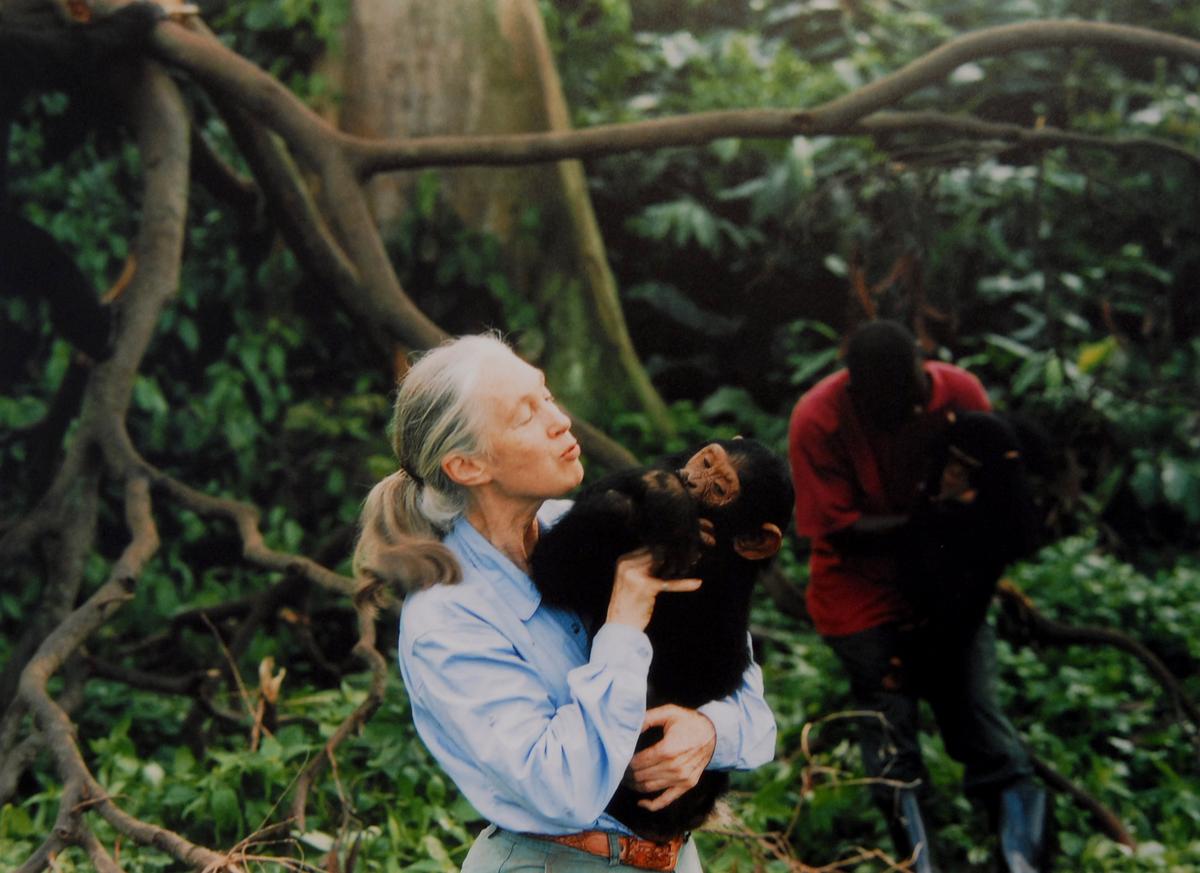
Jane Goodall, English primatologist, ethologist, and anthropologist, with a chimpanzee in her arms, in 1995. (Getty Images)

Jane Goodall, English primatologist, ethologist, and anthropologist, with a chimpanzee in her arms, in 1995. (Getty Images)

She was met everywhere with what can only be called veneration. Jane Goodall did her job on Planet Earth by re-emphasising conclusively what Charles Darwin had posited on November 24, 1859, the day his controversial book On the Origin of Species was published. He said we were descended from apes. She revealed that chimps’ brains were capable of using tools, a fact that scientists of the day refused to accept.

Both suffered severe criticism from religious quarters that believed only humans had souls, and were given dominion over all other life by ‘the creator’. What is more, Jane Goodall sprinkled us with the magic of hope with the example of a life well lived.

The writer is editor of Sanctuary Asia and founder of Sanctuary Nature Foundation.

Published – October 09, 2025 06:16 pm IST


Source link

Science Tags:Africa, chimpanzee lady, chimpanzees, Climate change, Deforestation, Gombe Stream, Jane Goodall, Jane Goodall obituary, Jane Goodall tribute, Louis Leakey, Nobel Peace Prize, Tanzania

Post navigation

Previous Post: Access Denied
Next Post: Access Denied

Related Posts

  • Steve Smith’s eye-blacks and the slippery slope of cricket’s tool rules
    Steve Smith’s eye-blacks and the slippery slope of cricket’s tool rules Science
  • Sci-Five | The Hindu Science Quiz: On Sci-fi writers
    Sci-Five | The Hindu Science Quiz: On Sci-fi writers Science
  • Copper becomes unexpectedly hard under extreme strain rate
    Copper becomes unexpectedly hard under extreme strain rate Science
  • Brazil’s Amazon fires off to record 2024 start as green union blames firefighting budget cut
    Brazil’s Amazon fires off to record 2024 start as green union blames firefighting budget cut Science
  • Great Barrier Reef records largest annual coral loss in 39 years
    Great Barrier Reef records largest annual coral loss in 39 years Science
  • Study reveals how new species evolve without geographic barriers 
    Study reveals how new species evolve without geographic barriers  Science

More Related Articles

A beginner’s guide to quantum computing | Explained A beginner’s guide to quantum computing | Explained Science
Does research strengthen teaching? – The Hindu Does research strengthen teaching? – The Hindu Science
Aditya-L1: IIA-NASA collaborate to record spectroscopic observations of a CME in visible wavelength range for very first time Aditya-L1: IIA-NASA collaborate to record spectroscopic observations of a CME in visible wavelength range for very first time Science
What are ceramics? What are ceramics? Science
Reproduce or it didn’t happen: why replicable science is better science Reproduce or it didn’t happen: why replicable science is better science Science
What is an earthquake swarm? What is an earthquake swarm? Science
SiteLock

Archives

  • September 2026
  • August 2026
  • July 2026
  • June 2026
  • May 2026
  • April 2026
  • March 2026
  • February 2026
  • January 2026
  • December 2025
  • November 2025
  • October 2025
  • September 2025
  • August 2025
  • July 2025
  • June 2025
  • May 2025
  • April 2025
  • March 2025
  • February 2025
  • January 2025
  • December 2024
  • November 2024
  • October 2024
  • September 2024
  • August 2024
  • July 2024
  • June 2024
  • May 2024
  • April 2024
  • March 2024
  • February 2024
  • January 2024
  • December 2023
  • November 2023
  • October 2023
  • September 2023
  • August 2023
  • July 2023
  • June 2023
  • May 2023
  • April 2023
  • March 2023
  • February 2023
  • January 2023
  • December 2022
  • November 2022
  • October 2022
  • September 2022
  • August 2022
  • July 2022
  • June 2022
  • May 2022

Categories

  • Business
  • Nation
  • Science
  • Sports
  • World

Recent Posts

  • DUSU polls: Dipke alleges money power, says campaigners travel in luxury cars
  • The paradox of self-reliance: India-China trade dynamics | Data Point
  • U.S. seeks ‘AI dialogue’ with China as officials set stage for Trump-Xi summit
  • Locally-built drone is highlight of Belagavi tech summit
  • Bangladesh raises fuel prices by up to 17% amid global oil price surge

Recent Comments

  1. LarryKef on UP Teacher Who Asked Students To Slap Muslim Classmate
  2. Josephjab on UP Teacher Who Asked Students To Slap Muslim Classmate
  3. LarryKef on UP Teacher Who Asked Students To Slap Muslim Classmate
  4. Jasonnekly on UP Teacher Who Asked Students To Slap Muslim Classmate
  5. Jasonnekly on UP Teacher Who Asked Students To Slap Muslim Classmate
  • Access Denied
    Access Denied Nation
  • Atletico build confidence before Arsenal but Barrios hurt
    Atletico build confidence before Arsenal but Barrios hurt Sports
  • Access Denied
    Access Denied Nation
  • “Rohit Sharma Was Backed Despite Not Having Stellar Start…”: Gautam Gambhir’s Blunt Take
    “Rohit Sharma Was Backed Despite Not Having Stellar Start…”: Gautam Gambhir’s Blunt Take Sports
  • Chinese National Arrested In US For Stealing Google AI Technology
    Chinese National Arrested In US For Stealing Google AI Technology Nation
  • Access Denied
    Access Denied Nation
  • Access Denied Sports
  • Court drops all charges against a Thai woman in a 2015 bombing at a Bangkok shrine that killed 20
    Court drops all charges against a Thai woman in a 2015 bombing at a Bangkok shrine that killed 20 World

Editor-in-Chief:
Mohammad Ariff,
MSW, MAJMC, BSW, DTL, CTS, CNM, CCR, CAL, RSL, ASOC.
editor@artifex.news

Associate Editors:
1. Zenellis R. Tuba,
zenelis@artifex.news
2. Haris Daniyel
daniyel@artifex.news

Photograher:
Rohan Das
rohan@artifex.news

Artifex.News offers Online Paid Internships to college students from India and Abroad. Interns will get a PRESS CARD and other online offers.
Send your CV (Subjectline: Paid Internship) to internship@artifex.news

Links:
Associate Journalism
About Us
Privacy Policy

News Links:
Breaking News
World
Nation
Sports
Business
Entertainment
Lifestyle

Registered Office:
72/A, Elliot Road, Kolkata - 700016
Tel: 033-22277777, 033-22172217
Email: office@artifex.news

Editorial Office / News Desk:
No. 13, Mezzanine Floor, Esplanade Metro Rail Station,
12 J. L. Nehru Road, Kolkata - 700069.
(Entry from Gate No. 5)
Tel: 033-46011099, 033-46046046
Email: editor@artifex.news

Copyright © 2023 Artifex.News Newsportal designed by Artifex Infotech.