
Skip to content
  • Facebook
  • X
  • Linkedin
  • WhatsApp
  • YouTube
  • Associate Journalism
  • About Us
  • Privacy Policy
  • 033-46046046
  • editor@artifex.news
Artifex.News

Artifex.News

Stay Connected. Stay Informed.

  • Breaking News
  • World
  • Nation
  • Sports
  • Business
  • Science
  • Entertainment
  • Lifestyle
  • Toggle search form
  • European Commission fines Gucci, Chloé and Loewe 3 million for price interference
    European Commission fines Gucci, Chloé and Loewe $183 million for price interference World
  • Access Denied World
  • Access Denied
    Access Denied Nation
  • Access Denied World
  • Access Denied World
  • Access Denied World
  • Mexican Influencer, 27, Dies Of Cardiac Arrest After Liposuction Procedure
    Mexican Influencer, 27, Dies Of Cardiac Arrest After Liposuction Procedure World
  • 85 Indians Discharged From Russian Military Ahead Of BRICS Summit
    85 Indians Discharged From Russian Military Ahead Of BRICS Summit Nation
NASA IMAP to show how solar particles are energised and shield us

NASA IMAP to show how solar particles are energised and shield us

Posted on September 30, 2025 By admin


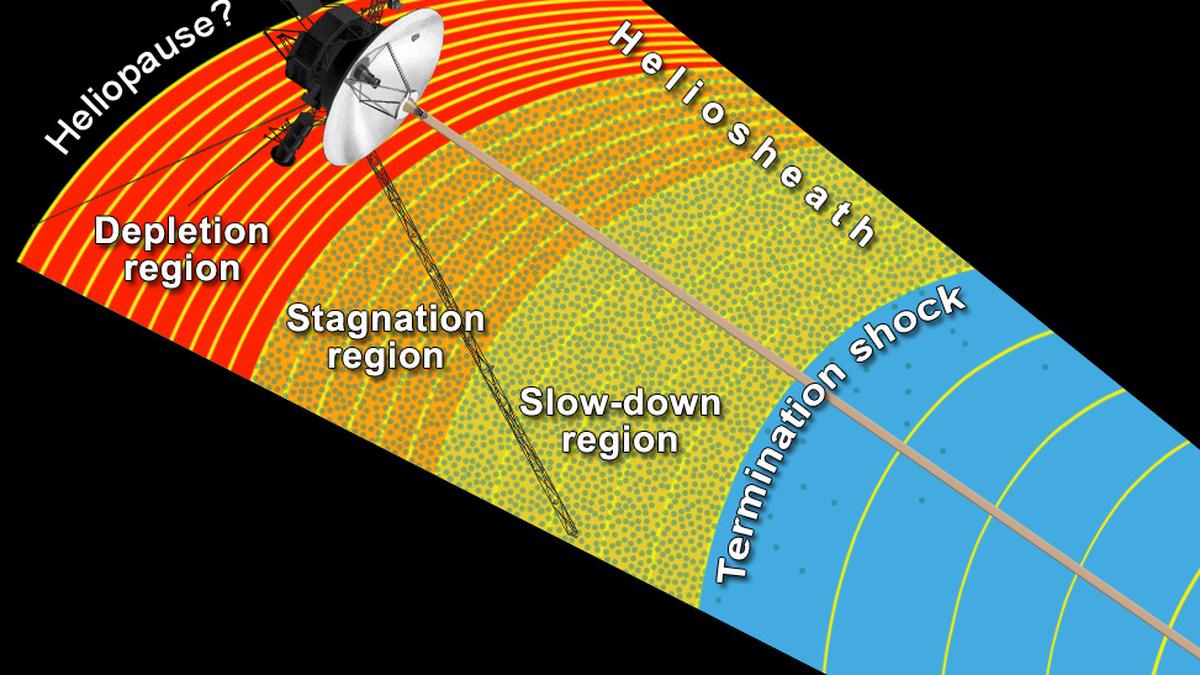
An infographic featuring the outer regions of the heliosphere based on data from the Voyager spacecraft.
| Photo Credit: NASA/JPL

Space isn’t empty. The sun issues a continuous stream of charged particles called the solar wind, which create a vast region around our solar system called the heliosphere. This region acts like a protective bubble that shields the planets from cosmic rays and interstellar particles. Yet the structure, dynamics, and boundary of the heliosphere are still poorly understood. Scientists want to know how particles are accelerated in the solar wind and how it interacts with the space between stars. Changes in the solar wind and its particles also affect space weather, which can damage satellites, harm astronauts, and disrupt communication systems on the earth.

To address these questions, NASA launched the Interstellar Mapping and Acceleration Probe (IMAP) on September 24. Its goal is to map the heliosphere’s boundary, trace energetic particles, and improve space weather forecasting.

IMAP is equipped with 10 scientific instruments, each designed to detect different types of particles or phenomena in space. Some of them are energetic neutral-atom detectors (IMAP-Lo, IMAP-Hi, IMAP-Ultra), which capture neutral atoms that were once charged ions but were changed by acquiring electrons. Other instruments detect charged particles directly, magnetic fields, interstellar dust, and solar-wind structures.

After launch, IMAP will travel to the sun-earth Lagrange point 1 (L1), about 1.6 million km from the earth toward the sun, where gravitational forces balance in a way that allows the spacecraft to remain in a stable orbit with minimal fuel use. Once there, IMAP will continuously observe incoming solar wind and energetic particles from a fixed vantage point. IMAP will also send data in near real-time to help scientists monitor space weather conditions.

Based on mission design and early operations, scientists expect IMAP will produce the most detailed maps yet of the heliosphere’s boundary, revealing how the solar wind collides with the interstellar medium. It will also trace how particles accelerate from the sun, move out or are energised in the heliosphere. In more specialised research, IMAP-Lo is expected to be able to observe interstellar neutral hydrogen and deuterium, possibly distinguishing primary versus secondary populations of these atoms at the heliopause, which is the outermost layer of the heliosphere.

IMAP data are expected to have profound implications. By revealing the structure and dynamics of the heliosphere, physicists can deepen their understanding of how our solar system is protected against cosmic radiation. That is relevant to understanding the earth’s habitability and that of exoplanets as well. Second, better data on solar wind behaviour will strengthen physicists’ ability to forecast space weather, in turn helping protect satellites, communications networks, power grids, and orbital crews.

For future human exploration beyond the earth, IMAP’s measurements of how particles travel and are accelerated will help plan safer routes and design better shielding for spacecraft. From a fundamental science perspective, IMAP illustrates how ancient astrophysical processes can be observed in our cosmic backyard itself. The mission may also inform our understanding of how other stars carve their own protective bubbles and how galactic environments influence planetary systems.

Published – September 30, 2025 04:41 pm IST


Source link

Science

Post navigation

Previous Post: Access Denied
Next Post: Access Denied

Related Posts

  • U.K. to rejoin Europe’s Horizon science programme
    U.K. to rejoin Europe’s Horizon science programme Science
  • In search of the elusive and threatened fishing cat
    In search of the elusive and threatened fishing cat Science
  • Hypoxia rewires membrane lipids, drives pancreatic cells to move: IIT-Bombay study
    Hypoxia rewires membrane lipids, drives pancreatic cells to move: IIT-Bombay study Science
  • Where is the centre of the universe?
    Where is the centre of the universe? Science
  • Why are numbers arranged differently on keypads and calculators?
    Why are numbers arranged differently on keypads and calculators? Science
  • ISRO’s SpaDeX docking experiment postponed to January 9
    ISRO’s SpaDeX docking experiment postponed to January 9 Science

More Related Articles

NASA hit by fuel leak during practice countdown of moon rocket NASA hit by fuel leak during practice countdown of moon rocket Science
Is groundwater contamination high in India? | Explained Is groundwater contamination high in India? | Explained Science
When AI changes the way we do science, will we understand the results? When AI changes the way we do science, will we understand the results? Science
Why do we feel the need to go to the bathroom when we’re nervous or scared? Why do we feel the need to go to the bathroom when we’re nervous or scared? Science
Spin Science: Explaining the Magnus effect Spin Science: Explaining the Magnus effect Science
Union Budget 2026: push for technology, planetary science in space programme Union Budget 2026: push for technology, planetary science in space programme Science
SiteLock

Archives

  • May 2026
  • April 2026
  • March 2026
  • February 2026
  • January 2026
  • December 2025
  • November 2025
  • October 2025
  • September 2025
  • August 2025
  • July 2025
  • June 2025
  • May 2025
  • April 2025
  • March 2025
  • February 2025
  • January 2025
  • December 2024
  • November 2024
  • October 2024
  • September 2024
  • August 2024
  • July 2024
  • June 2024
  • May 2024
  • April 2024
  • March 2024
  • February 2024
  • January 2024
  • December 2023
  • November 2023
  • October 2023
  • September 2023
  • August 2023
  • July 2023
  • June 2023
  • May 2023
  • April 2023
  • March 2023
  • February 2023
  • January 2023
  • December 2022
  • November 2022
  • October 2022
  • September 2022
  • August 2022
  • July 2022
  • June 2022
  • May 2022

Categories

  • Business
  • Nation
  • Science
  • Sports
  • World

Recent Posts

  • Nicobarese oppose proposal for three wildlife sanctuaries
  • Visakhapatnam Collector calls for inter-departmental synergy to boost investments
  • Kohli’s masterful knock powers Royal Challengers to the top
  • Senior IPS officer Asra Garg posted IGP Intelligence
  • Vijay Narayan earns rare distinction of being Advocate General under two different governments

Recent Comments

  1. StevenLek on UP Teacher Who Asked Students To Slap Muslim Classmate
  2. Leonardren on UP Teacher Who Asked Students To Slap Muslim Classmate
  3. NathanQuins on UP Teacher Who Asked Students To Slap Muslim Classmate
  4. Davidgof on UP Teacher Who Asked Students To Slap Muslim Classmate
  5. NathanJobre on UP Teacher Who Asked Students To Slap Muslim Classmate
  • Access Denied Business
  • Access Denied Sports
  • Access Denied
    Access Denied Nation
  • Device with low-grade explosives found inside private hospital in Pune; ATS joins probe
    Device with low-grade explosives found inside private hospital in Pune; ATS joins probe Nation
  • Sexual abuse: SIT interrogates Hassan MP Prajwal Revanna
    Sexual abuse: SIT interrogates Hassan MP Prajwal Revanna Nation
  • India’s Schedule At Paris Paralympics 2024, September 3: Chance For Avani Lekhara, Others To Take Tally Past 20
    India’s Schedule At Paris Paralympics 2024, September 3: Chance For Avani Lekhara, Others To Take Tally Past 20 Sports
  • Access Denied
    Access Denied Nation
  • U.S. Fed cuts interest rates, nods to limits of data during shutdown; two policymakers dissent
    U.S. Fed cuts interest rates, nods to limits of data during shutdown; two policymakers dissent World

Editor-in-Chief:
Mohammad Ariff,
MSW, MAJMC, BSW, DTL, CTS, CNM, CCR, CAL, RSL, ASOC.
editor@artifex.news

Associate Editors:
1. Zenellis R. Tuba,
zenelis@artifex.news
2. Haris Daniyel
daniyel@artifex.news

Photograher:
Rohan Das
rohan@artifex.news

Artifex.News offers Online Paid Internships to college students from India and Abroad. Interns will get a PRESS CARD and other online offers.
Send your CV (Subjectline: Paid Internship) to internship@artifex.news

Links:
Associate Journalism
About Us
Privacy Policy

News Links:
Breaking News
World
Nation
Sports
Business
Entertainment
Lifestyle

Registered Office:
72/A, Elliot Road, Kolkata - 700016
Tel: 033-22277777, 033-22172217
Email: office@artifex.news

Editorial Office / News Desk:
No. 13, Mezzanine Floor, Esplanade Metro Rail Station,
12 J. L. Nehru Road, Kolkata - 700069.
(Entry from Gate No. 5)
Tel: 033-46011099, 033-46046046
Email: editor@artifex.news

Copyright © 2023 Artifex.News Newsportal designed by Artifex Infotech.