


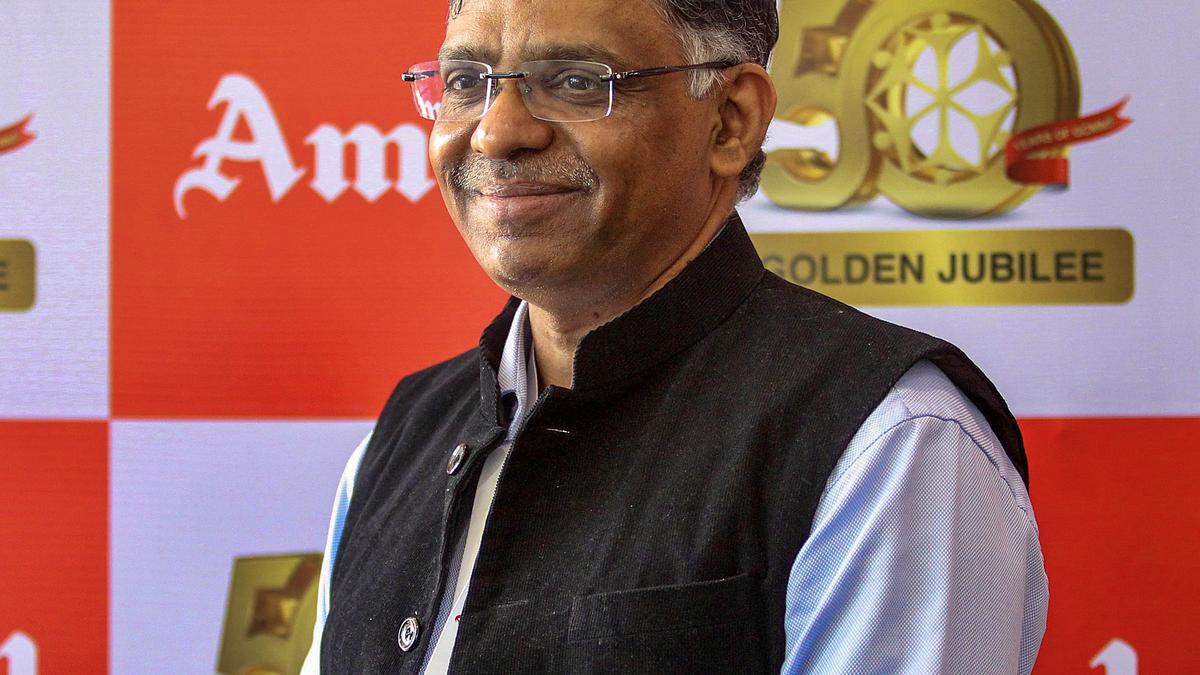
In a freewheeling conversation withThe Hinduin Gujarat’s Anand, the brand’s headquarters, Mr. Jayen Mehta said that while India maintained a uniform 30% import duty on all dairy products, the U.S. imposed much steeper tariffs ranging from 40-75% on items like ghee, butter, cheese, flavoured milk, cream, and shrikhand.
How is Amul going to deal with the new tariffs the United States have imposed on India?
We have been exporting to the U.S. since 1998, and the Indian diaspora there wants butter, cheese, ghee, shrikhand, ice cream, and all our other products. Two things I want to put on record: the U.S. calls India the “tariff king,” but it charges 40%, 60%, and up to 75% import duty on different dairy products imported into the U.S. before August 1. They already charge almost 50% on ghee and butter, cheese is 40%, flavoured milk is 61%, cream is 40%, and shrikhand 75%. In contrast, India’s import duty on dairy is 30%. Actually, they have been the tariff kings of the world, at least for the dairy business. The point here is that if the Government of India says dairy is important for livelihoods and still maintains a relatively open import policy, the U.S. is far more protective of its farmers. When you charge a high import duty, what does it mean? You are placing an extra burden on consumers, making local produce more affordable than imported products, and essentially supporting domestic production. They have been doing this for years, but unfortunately, it is often projected the other way – that India is a high-duty country. It’s the other way around. We are very clear on our stance, and even the Prime Minister (Narendra Modi) said during the 2019 RCEP (Regional Comprehensive Economic Partnership) announcement that the government will always stand by small farmers, small businesses, and, of course, the country’s dairy producers. Milk is the largest agricultural crop in India, with over 10 crore families depending on it for their livelihood. The value of milk output in India is greater than that of wheat, paddy, and oilseeds combined. Obviously, it is a vital part of livelihoods, and it will not be leveraged for the benefit of any other sector. This is the stated objective of the government, and it has been made very clear that dairy will not be negotiated under any free trade agreement.
 How is the Indian diaspora going to accept these new tariff rates?
My business after the new tariff announcement has not declined. My order books at the new tariff level are the same as before, and in fact, for a couple of distributors, orders have even increased ahead of the festive season. We don’t see it as a big issue at the moment, considering that the Indian diaspora already knows that if they want to buy ghee and butter, they have been paying high import duty on these products. The market should be in a position to absorb it.
You started selling milk, your primary product, in the US last year. How is the market, not just the Indian diaspora, but locals too, accepting it?
We started this in May last year, and I’m happy to say that the mainstream market has also accepted the product. We are now present in more than 35 states in the United States, and it’s not just Indian grocery stores buying it — mainstream retailers like Costco are also stocking it. For the first time in history, the US is consuming 6% fat milk (compared to the usual 3%). Interestingly, it is now locally called Barista Milk, because for making coffee, it needs to be creamy, high in protein, and capable of producing good froth, all qualities of a good coffee milk. We are selling quite well at nearly double the price of local milk. While regular 3% milk sells for $3 to $3.50 per gallon, ours retails at $6.50 to $7 per gallon.
Amul is in how many countries, and are you planning to expand?
We are present in 40 countries, and in June, we entered Portugal and Spain. By the end of August, or at the latest by September, we will be in Switzerland, Germany, and France. Everything is in place — we are only waiting for the new pack design. In Spain, we will be locally sourcing milk by partnering with cooperatives. We have four major foreign markets: the Middle East, with an office in Dubai; South-East Asia; Japan, where our business is growing significantly; and the United States. Historically, we have not had a presence in Europe, so this marks our first entry into the continent.
How is the protein market for Amul with its new range of products?
Protein is the “global currency” now. We offer high-protein buttermilk, lassi, dahi, flavoured milk, and paneer with 50 grams of protein — and we will soon launch paneer with 70 grams of protein. The key advantage we have is whey. Every litre of whey contains 0.6% whey protein, while milk has 3% protein. When you make cheese, most of the protein stays in the cheese, but the whey protein that remains is highly valuable. I remember attending an international dairy conference in Athens, Greece, in 1998 or 1999. In one session, a scientist said, “When we make cheese from milk, we eat the cheese and throw away the whey. One day, we will throw away the cheese and use the whey.” At the time, I didn’t believe him — but the idea stayed with me. Our protein products taste great because we blend protein into our existing products, rather than going the powder route. In our flavoured milk drink, Amul Kool, the protein content is 10 grams deliberately lower, so that customers can gradually move towards mainstream high-protein products. All our products are affordable, value-for-money, high in protein, and of good quality.
Big picture behind protein products?
We are clearly not just selling buttermilk, lassi, or curd, but the concept. We need one gram of protein per kilogram of body weight every day. If this fits into your diet, you don’t need any other supplements. If you need to have something as a supplement, include it as part of your daily diet. Protein is not just for ‘gym bros’; it is for everyone. A child requires it in the same ratio, and a senior citizen requires it in the same ratio. Our aim is to make a big difference in the health of the country. There is no dearth of raw material with me as I get 30 lakh litres of whey every day, and we are making one more product out of it. I have not stopped at protein products.
So? What other products are you able to derive from whey?
From 5 lakh litres of whey, we produce 20,000 litres of bio-ethanol — or rectified spirit — with 97% purity. The process begins with milk, from which cheese is made. Cheese yields whey, which is used to extract protein and, subsequently, ethanol. Along the way, dry ice is produced, followed by methane, and finally water. The water is returned to the land, helping grass grow, which in turn feeds cows, producing more milk and dung. The dung is collected to generate methane, biogas, and bio-CNG — enough to fuel vehicles and kitchen stoves. The residue serves as organic fertiliser for crops, and the produce is sold as organic food. This closed-loop system makes India Atmanirbhar (self-reliant) and demonstrates the power of a circular economy. Everything is commercially viable, and we need to take the dairy industry to the next level and tell the world that the cow is not a problem, but a solution. This is a model.
Getting into the lifestyle industry with ethanol?
Perfume is made from bio-ethanol. As a consumer-facing company, we thought, why not create a value-added product in this space? Since we are in the food business – Amul, the Taste of India – we believe taste can also be enhanced through aroma. By Diwali, we plan to launch a range of perfumes and deodorants designed to appeal to all market segments. Leveraging our reputation for quality, we will ensure the fragrances are of the highest standard. Pricing is still under consideration. In addition, we are developing food sprays that can make dishes more tempting and give home-cooked meals a restaurant-like appeal.
How are your protein products doing in the international market?
We are yet to fully enter the international market. In the U.S., we tried selling protein-flavoured milk products. As I said, protein is the global currency, and it would sell anywhere. But our primary mission is in India. We are not just selling a product; we are promoting good health. There is a severe protein deficit in this country, and we need a reliable solution for it. We should not have to depend on imported products, where quality cannot be guaranteed. These are not products being forced on consumers; rather, we aim for them to become a natural part of daily diets. That said, we will be launching them in Dubai very soon, where demand is very high. India is the largest producer of milk and, by default, will be the largest producer of protein in the world.
Will Amul go for an IPO?
That will never happen. As a cooperative, our purpose is the opposite of what drives listed companies. They buy low and sell high; we pay farmers the maximum we can and still give consumers the best value. There’s hardly any room left for profit in the way the stock market measures it. We’re owned by farmers, so we have to keep them happy — they are our shareholders. If we went public, the pressure would be to show higher profits. The simplest way to do that would be to cut the price we pay farmers for milk and increase the price of products. But that would hurt both farmers and consumers. If both are unhappy, we’ve failed our mission. And we won’t do that to keep investors happy. We can’t change the character of the organisation.