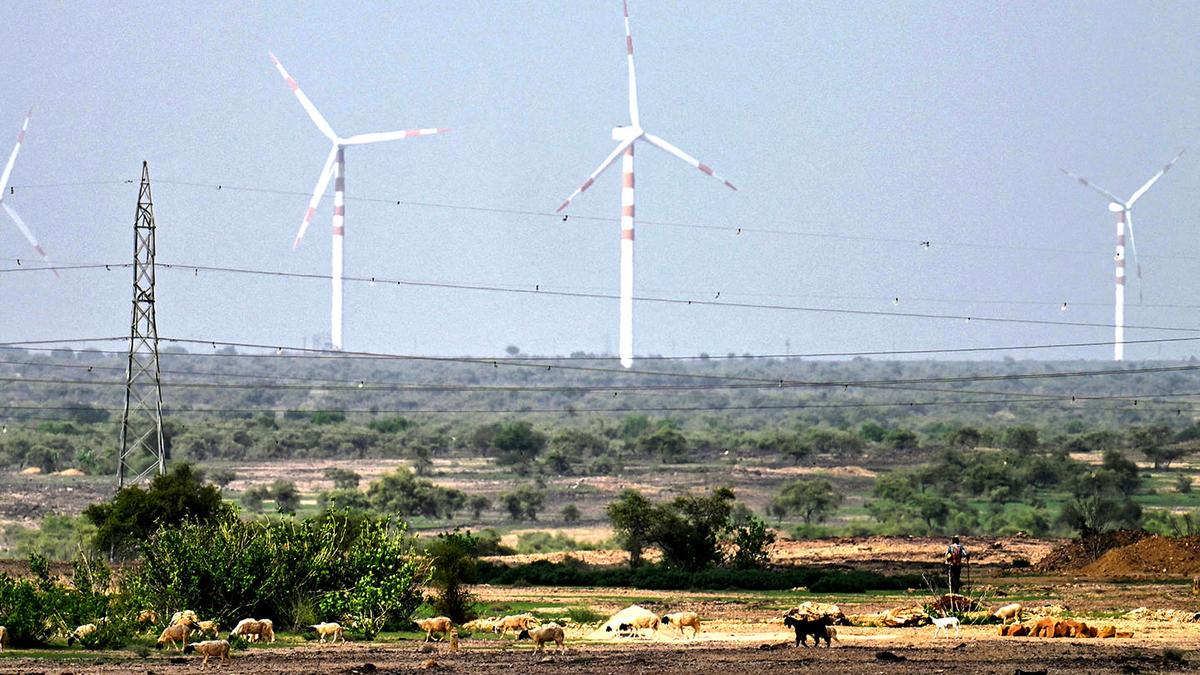
In the first half of 2025, India added around 3.5 GW to the wind sector – an 82% year-on-year growth – taking the total installed capacity to 51.3 GW. Even so, India’s wind power remains largely untapped. According to the National Institute of Wind Energy, India’s gross wind power potential is 1163.9 GW at 150 m above ground level.
At the Global Wind Day Conference in June, Union Minister of New and Renewable Energy Pralhad Joshi urged States to address land availability and transmission delays post-haste.
India’s ambitious climate goals and surging energy demands mean renewable energy development will continue to accelerate. Experts are concerned, however, that the addition of wind power capacity has been coming at the expense of avian welfare.
Bird mortality at wind farms
For years, researchers have raised concerns about the impact of wind turbines on fauna, particularly birds. A study by the Wildlife Institute of India (WII), published recently in Nature Scientific Reports, has estimated globally high bird mortality rates at wind farms in the Thar Desert.
The study was conducted in a 3,000 sq. km desert landscape in Jaisalmer, Rajasthan, home to around 900 wind turbines and 272 bird species, including the critically endangered great Indian bustard. Across seven multi-season surveys, WII researchers searched for bird carcasses within a 150-m radius of 90 randomly selected wind turbines and found 124.
The estimated annual bird mortality per 1,000 sq. km came up to 4,464 birds after correcting for non-detection due to vegetation cover or carcass degradation during the survey and due to carcass scavenging before the survey.
The researchers conducted similar surveys at 28 randomly selected control sites (between 500 and 2,000 m of any turbine) to account for the natural mortality of birds and found no carcasses.
“Very few studies have robust data to have accurate assessments that correct for detection issues and have controls for comparison,” Yadvendradev Jhala, one of the authors of the study, said.
The WII study isn’t the first to examine bird mortality in wind farms in India. A 2019 study documented bird deaths at wind farms in Kutch and Davangere. However, the estimate of 0.47 bird deaths per turbine per year at both sites now pale in comparison to the 1.24 bird deaths per turbine per month in the Thar Desert.
“It’s quite a high estimate, but that’s quite possible,” Ramesh Kumar Selvaraj, an independent consultant and author of the 2019 paper, said. “[Mortality rate] will vary depending on geography, season, and other factors.”
Bird density, infrastructure density, and configuration are crucial factors, according to Jhala. The Thar Desert is part of the Central Asian Flyway — a major migration route for birds across Eurasia — and a prominent wintering destination.
The desert mortality estimates also included bird collisions with power lines linked to the wind turbines. The Gujarat and Karnataka study didn’t include this cause.
Per both studies, raptors were the most affected group of birds, echoing findings worldwide. “Raptors are long-lived species that lay fewer eggs, and any additional mortality can lead to population-level impacts,” Selvaraj said. “Their flight altitude and soaring flight behaviour means they are more vulnerable while manoeuvring rotating wind turbines.”
Organisations like Birdlife International have proposed several mitigation measures to reduce bird collisions with wind turbines, including painting one of the turbine blades to increase visibility and shutting turbines down at a certain time of day or season. However, Selvaraj said he believes the most crucial step in mitigation is to carefully select the site of a wind farm.
Avian Sensitivity Tool for Energy Planning (AVISTEP) is an open-source platform developed by Birdlife International that helps developers identify and avoid sites where renewable energy could affect birds. Selvaraj, previously with the Bombay Natural History Society, coordinated India’s map for AVISTEP.
“The whole of India, including offshore areas, have been divided into different categories of avian sensitivity such as ‘low’, ‘moderate’, ‘high’, and ‘very high’,” Selvaraj said. “While AVISTEP can serve as a guide, ground-level studies are crucial before installing wind farms,” he added.
However, onshore wind energy projects in India aren’t mandated to conduct an environmental impact assessment (EIA) before installation.
From land to ocean
Offshore wind farms are emerging as a valuable renewable energy resource worldwide. According to the Global Wind Energy Council, operational offshore wind capacity worldwide is currently around 83 GW.
India has also turned its attention offshore and aims to install 30 GW of offshore wind capacity by 2030. In June, the Ministry of New and Renewable Energy launched offshore wind energy bids totalling 4 GW in Gujarat and Tamil Nadu.
The primary motivation is to look beyond land-based resources, which are becoming increasingly “complex” and “time-consuming” to procure for renewable project development, Disha Agarwal, senior programme lead, Council on Energy, Environment and Water (CEEW), New Delhi, said.
With a coastline stretching across 7,600 km and exclusive economic zones covering 2.3 million sq. km, India has considerable offshore wind energy potential.
According to CEEW research, the addition of offshore wind to the renewable energy pool in Gujarat will benefit power system operations in the State. “We saw that offshore wind will aid in system adequacy and help meet reliability requirements during peak load hours,” Agarwal said
However, despite the growing interest, there has been limited research on the environmental consequences of offshore wind farms.
Offshore wind energy is a complex infrastructure asset that requires detailed marine spatial planning exercises to assess environmental and social impacts, according to Gopal K. Sarangi, head of the Department of Policy and Management Studies at the TERI School of Advanced Studies, New Delhi.
“As observed in other countries, there are numerous environmental risks for offshore wind farms,” Sarangi said. “They could disturb marine biodiversity, create noise pollution for marine habitats, and pollute the ocean water at various stages of project development.”
According to the National Offshore Wind Energy Policy, unlike other renewable energy developments in the country, EIAs are essential for offshore wind energy.
The rapid EIA report of the proposed offshore wind farm in the Gulf of Khambhat in Gujarat documented five marine mammals, including dolphins and sharks, and a reptile within the study area. While the report recognised that increased turbidity and noise levels during the construction phase of the wind farm may drive away highly sensitive species, it deemed the noise and vibrations during the operation phase to be “limited”.
Selvaraj said he doesn’t agree with the report’s inference that there are very few bird species passing through the study region. “Gujarat and its coasts are a key area within the Central Asian Flyway and the African-Eurasian Flyway,” according to him.
Per AVISTEP as well, the proposed location has a high avian sensitivity score. Thus, Selvaraj urged a longer, more thorough study to understand how migratory bird species use the area and the possible effects of wind farms on these birds.
Nikhil Sreekandan is an independent journalist.