



Skip to content
  • Facebook
  • X
  • Linkedin
  • WhatsApp
  • Associate Journalism
  • About Us
  • Privacy Policy
  • 033-46046046
  • editor@artifex.news
Artifex.News

Artifex.News

Stay Connected. Stay Informed.

  • Breaking News
  • World
  • Nation
  • Sports
  • Business
  • Science
  • Entertainment
  • Lifestyle
  • Toggle search form
  • Five Hindu Bangladeshi immigrants in Karnataka get citizenship, but wait for others is still long
    Five Hindu Bangladeshi immigrants in Karnataka get citizenship, but wait for others is still long Nation
  • Election Commission Seeks Modification Of Electoral Bonds Order, Supreme Court Hearing Today
    Election Commission Seeks Modification Of Electoral Bonds Order, Supreme Court Hearing Today Nation
  • 3-Member Panel Probing Causes Behind Manipur Violence Gets Another Extension
    3-Member Panel Probing Causes Behind Manipur Violence Gets Another Extension Nation
  • Daily Quiz | On March 19 events
    Daily Quiz | On March 19 events World
  • Missing Dog’s Dramatic Reunion With US Family, 2,000 Miles From Home
    Missing Dog’s Dramatic Reunion With US Family, 2,000 Miles From Home World
  • Trump dismissive as New York attorney general accuses him of inflating his net worth by  billion
    Trump dismissive as New York attorney general accuses him of inflating his net worth by $2 billion World
  • Long Covid Symptoms To Last Longer In Pregnant Women: Study
    Long Covid Symptoms To Last Longer In Pregnant Women: Study Nation
  • Rinku Singh’s Emotional Post For ‘Brother’ Dhruv Jurel After His Heroics In Ranchi Test Is Viral
    Rinku Singh’s Emotional Post For ‘Brother’ Dhruv Jurel After His Heroics In Ranchi Test Is Viral Sports
Gold superheated far beyond its melting point can stay solid

Gold superheated far beyond its melting point can stay solid

Posted on July 24, 2025 By admin


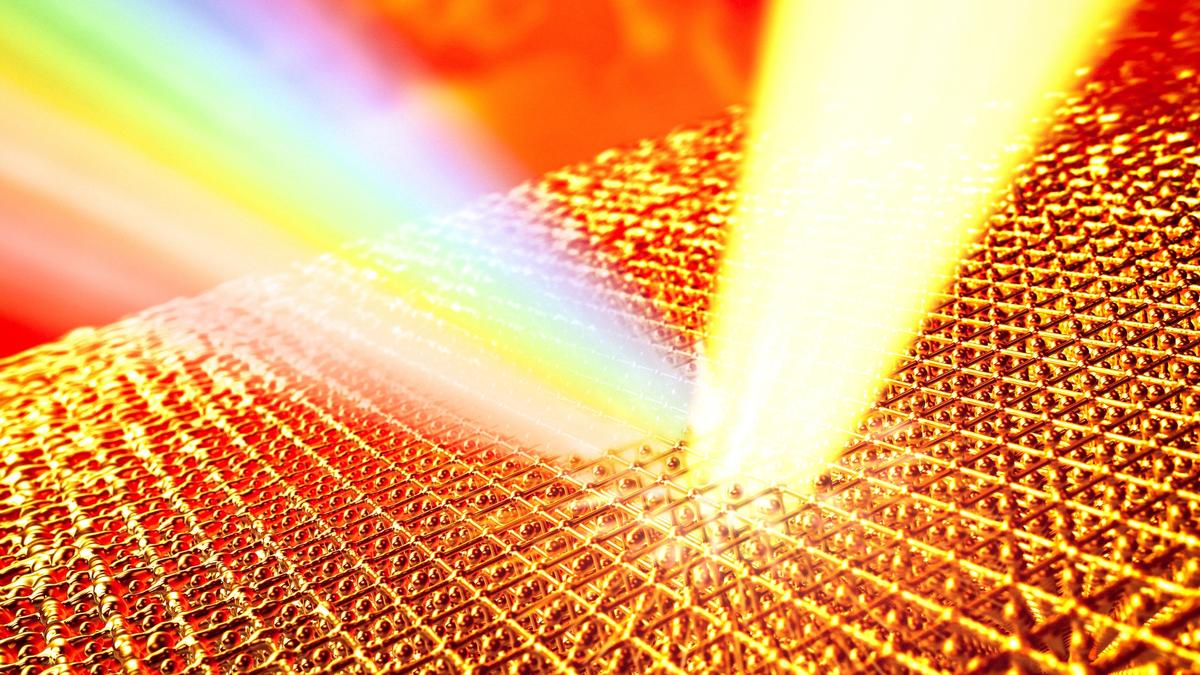
When gold is heated really quickly, it seems it remains solid at temperatures far beyond the point where it should have become liquid, a new study in Nature has found.

The term for when a solid stays a solid at or beyond its melting point is superheating. Most materials can be superheated only in a short range after that point, before they promptly melt. Scientists used to think this range was fixed because of a limit called the entropy catastrophe.

Entropy is a measure of disorder in a system. When you heat a substance, its entropy increases (among other attributes). Previously, scientists thought that if you heated a crystal to about three-times its melting temperature, it wouldn’t be able to stay a solid any more: it’d have to melt because its atoms would have become too disordered.

Entropy catastrophe

In 1948, an American chemist named Walter Kauzmann flipped this. He found that when he continuously cooled a liquid to under its melting point but at the same time prevented it from crystallising, the amount of entropy in the liquid would be less than that in a crystal of the same material beyond a specific temperature — which shouldn’t be possible. This came to be called the Kauzmann paradox.

Four decades later, Hans-Jörg Fecht from Germany and William Johnson from the US flipped this once more. They reported that when a solid was superheated to around three-times its melting point, it would eventually possess more entropy than its liquid form beyond a particular temperature, which is another impossibility. This temperature was called TEC, where EC stood for “entropy catastrophe”.

Both these outcomes are “catastrophic” because of the second law of thermodynamics, which states that in an isolated system evolving spontaneously, the entropy can’t decrease over time. For two phases at the same temperature and pressure, the phase with higher entropy is (loosely speaking) the more disordered one. As the German physicist Rudolf Clausius interpreted this law, the entropy of an isolated system can’t spontaneously decrease — yet that is what the entropy of a solid being higher than that of a liquid implies.

The “catastrophe” is thus a warning that extrapolating to those problematic temperatures in the Kauzmann and Fecht-Johnson experiments doesn’t enjoy thermodynamic legitimacy. It’s also a sign that something happens before those temperatures to prevent the impossible outcomes.

Heat it quickly

For example, Kauzmann found that the liquid would either crystallise first or that it would turn into a glass well before it reached the “catastrophe” temperature. This avoidance is why every ordinary piece of glass you come across — like the one on your windows, say — forms around a glass‑transition temperature that’s noticeably higher than the problem temperature. Similarly, a crystal melts long before its “catastrophe” temperature or simply vaporises.

The new study with gold explores what happens to these expectations when the metal is heated very quickly.

Understanding the limit of how much heat a solid can imbibe without changing its phase (i.e. turning from solid to liquid) is important for engineers to design materials that work in extreme environments, such as on planets with brutal atmospheres or in facilities that manufacture them using punishing physical conditions.

As with a lot of research of this type, the new study used a simple process but wasn’t possible to conduct until now because the technologies required have only just become accessible. The researchers, from Germany, Italy, the UK, and the US, used powerful laser pulses to heat gold films about 50 nm thick. They used the lasers in order to heat the gold rapidly, without giving it time to disintegrate or liquefy. Each pulse lasted only 45 femtoseconds and was just 400 nanometres long.

Then the team used a technique called high-resolution inelastic X-ray scattering to determine the gold atoms’ temperature. A device produced and emitted streaks of X-ray radiation, which struck the gold atoms and scattered off only a few picoseconds after they’d been heated. By measuring the changes in energies of those X-rays and the directions in which they emerged from the nanofilms, the team could deduce how fast the atoms were moving, and from that figure out the temperature. (The temperature of a material is simply the average kinetic energy of its constituent particles.)

Older results stay

Thus the team found that solid gold superheated to 14-times its melting point — leagues beyond the three-times limit — remains solid for a few trillionths of a second, which is a significantly long time in the microscopic realm. The X-ray diffraction patterns revealed the atoms were still arranged in the ordered pattern typical of solid crystals.

According to the researchers, the rapid heating could overtake the effects that came with heating more slowly. This isn’t a gimmick so much as a signal that if a material is heated rapidly enough, there may not actually be an “entropy catastrophe”. The ultrashort laser pulses made sure the gold atoms didn’t have time to “relax” before the X-ray instrument came on, revealing the nanofilm to have been solid even at a temperature where melting was expected to be unavoidable.

In fact, when the researchers calculated the nanofilms’ entropy in conditions where the films lacked the time to expand due to heating, they found that the films themselves could never reach the classical catastrophe temperature.

The findings challenge  materials scientists’ core assumptions about how matter behaves at extreme conditions. At the same time, they don’t invalidate the work of Kauzmann and Fecht and Johnson: the latter two assumed the material they worked with could expand when heated whereas the new study didn’t allow for that possibility.

Nonetheless, the implications could go beyond the earth. For example, certain substances may be able to survive in the cores of planets or on stars in a particular phase for longer than  what models have predicted. Such details may come to light when scientists apply the technique in this experiment to more materials.

Published – July 24, 2025 11:52 am IST



Source link

Science

Post navigation

Previous Post: Bacterial cell walls could hold clues to better human health, say CCMB scientists
Next Post: Easy like Sunday morning quiz

Related Posts

  • IISc researchers develop sustainable method to remove heavy metal contaminants from groundwater
    IISc researchers develop sustainable method to remove heavy metal contaminants from groundwater Science
  • Bovine H5N1 displays pronounced neurotropism in many mammals
    Bovine H5N1 displays pronounced neurotropism in many mammals Science
  • ISRO successfully carries out vacuum ignition trial of cryogenic engine
    ISRO successfully carries out vacuum ignition trial of cryogenic engine Science
  • Why spacesuits need a major upgrade for the next phase of exploration
    Why spacesuits need a major upgrade for the next phase of exploration Science
  • U.S. and China renew bilateral S&T Agreement | Explained
    U.S. and China renew bilateral S&T Agreement | Explained Science
  • Rising up to the challenge
    Rising up to the challenge Science

More Related Articles

COP16: Will financial roadblocks continue to hinder conservation efforts? | Explained COP16: Will financial roadblocks continue to hinder conservation efforts? | Explained Science
The Science Quiz | Security features of rupee notes The Science Quiz | Security features of rupee notes Science
science for all newsletter What are Trojan asteroids? science for all newsletter What are Trojan asteroids? Science
Scientists are working on a way to detect cancer with ultrasound waves Scientists are working on a way to detect cancer with ultrasound waves Science
75 years since Assam quake, Himalayas prep for large hydro projects 75 years since Assam quake, Himalayas prep for large hydro projects Science
Paper-based platform for rapid detection of antibiotic-resistant bacteria Paper-based platform for rapid detection of antibiotic-resistant bacteria Science
SiteLock

Archives

  • August 2025
  • July 2025
  • June 2025
  • May 2025
  • March 2025
  • February 2025
  • January 2025
  • December 2024
  • November 2024
  • October 2024
  • September 2024
  • August 2024
  • July 2024
  • June 2024
  • May 2024
  • April 2024
  • March 2024
  • February 2024
  • January 2024
  • December 2023
  • November 2023
  • October 2023
  • September 2023
  • August 2023
  • July 2023
  • June 2023
  • May 2023
  • April 2023
  • March 2023
  • February 2023
  • January 2023
  • December 2022
  • November 2022
  • October 2022
  • September 2022
  • August 2022
  • July 2022
  • June 2022
  • May 2022

Categories

  • Business
  • Nation
  • Science
  • Sports
  • World

Recent Posts

  • Access Denied
  • Microsoft workers and activists protest against company’s Israel ties, occupy part of campus
  • MSMEs in textiles, diamonds, chemicals to be most hit by U.S. tariffs: CRISIL Intelligence
  • Honda sets up new subsidiary in India for auto financing business, to apply for NBFC licence
  • Access Denied

Recent Comments

  1. dfb{{98991*97996}}xca on UP Teacher Who Asked Students To Slap Muslim Classmate
  2. "dfbzzzzzzzzbbbccccdddeeexca".replace("z","o") on UP Teacher Who Asked Students To Slap Muslim Classmate
  3. 1}}"}}'}}1%>"%>'%> on UP Teacher Who Asked Students To Slap Muslim Classmate
  4. bfg6520<s1﹥s2ʺs3ʹhjl6520 on UP Teacher Who Asked Students To Slap Muslim Classmate
  5. pHqghUme9356321 on UP Teacher Who Asked Students To Slap Muslim Classmate
  • Arjun Tendulkar Turns 25, Sachin Tendulkar Writes In Special Wish: “Your Love…”
    Arjun Tendulkar Turns 25, Sachin Tendulkar Writes In Special Wish: “Your Love…” Sports
  • Shubman Gill-led new-look Team India lands in Harare for T20Is against Zimbabwe
    Shubman Gill-led new-look Team India lands in Harare for T20Is against Zimbabwe Sports
  • UN Report Warns India Heading Towards Groundwater Depletion Tipping Point
    UN Report Warns India Heading Towards Groundwater Depletion Tipping Point Nation
  • Russia pummels exhausted Ukrainian forces with smaller attacks ahead of a springtime advance
    Russia pummels exhausted Ukrainian forces with smaller attacks ahead of a springtime advance World
  • Rishabh Pant Achieves Massive IPL Feat, Joins Virat Kohli And Gautam Gambhir In Elite List
    Rishabh Pant Achieves Massive IPL Feat, Joins Virat Kohli And Gautam Gambhir In Elite List Sports
  • U.S.-Japan security talks focus on bolstering military cooperation amid rising China threat
    U.S.-Japan security talks focus on bolstering military cooperation amid rising China threat World
  • Hathras Stampede Probe Team Submits Report
    Hathras Stampede Probe Team Submits Report Nation
  • Anthropocene epoch declaration unlikely soon, but the idea lives on | Explained
    Anthropocene epoch declaration unlikely soon, but the idea lives on | Explained Science

Editor-in-Chief:
Mohammad Ariff,
MSW, MAJMC, BSW, DTL, CTS, CNM, CCR, CAL, RSL, ASOC.
editor@artifex.news

Associate Editors:
1. Zenellis R. Tuba,
zenelis@artifex.news
2. Haris Daniyel
daniyel@artifex.news

Photograher:
Rohan Das
rohan@artifex.news

Artifex.News offers Online Paid Internships to college students from India and Abroad. Interns will get a PRESS CARD and other online offers.
Send your CV (Subjectline: Paid Internship) to internship@artifex.news

Links:
Associate Journalism
About Us
Privacy Policy

News Links:
Breaking News
World
Nation
Sports
Business
Entertainment
Lifestyle

Registered Office:
72/A, Elliot Road, Kolkata - 700016
Tel: 033-22277777, 033-22172217
Email: office@artifex.news

Editorial Office / News Desk:
No. 13, Mezzanine Floor, Esplanade Metro Rail Station,
12 J. L. Nehru Road, Kolkata - 700069.
(Entry from Gate No. 5)
Tel: 033-46011099, 033-46046046
Email: editor@artifex.news

Copyright © 2023 Artifex.News Newsportal designed by Artifex Infotech.