



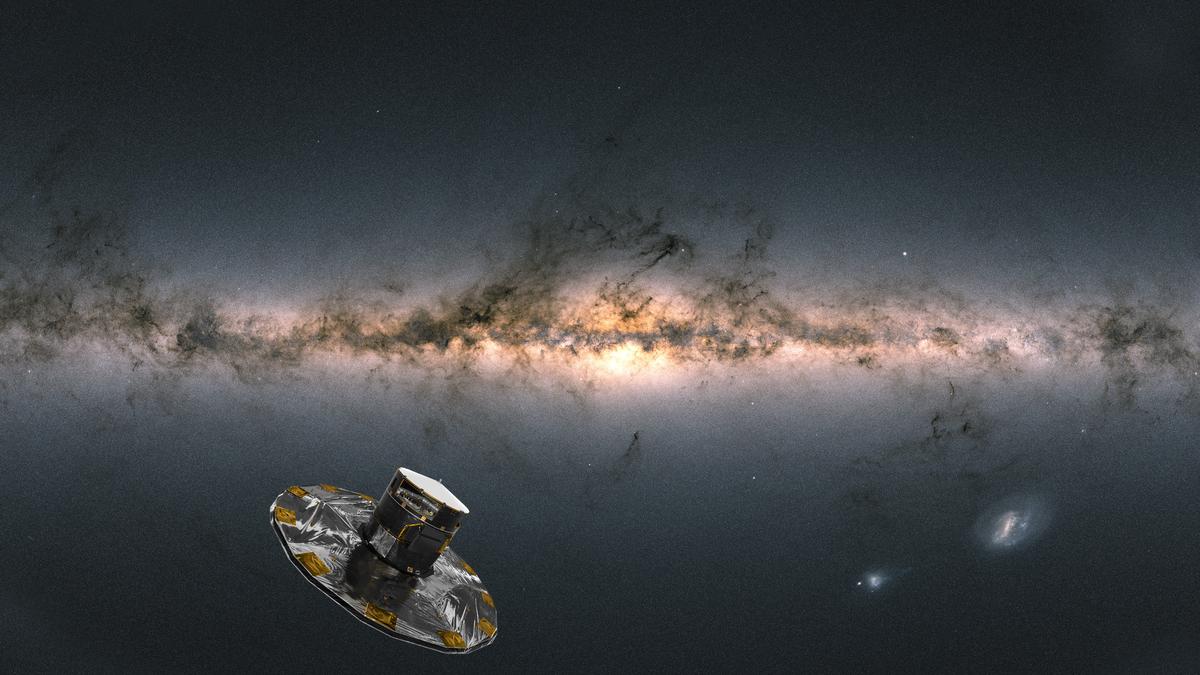
Astronomers have discovered a gigantic black hole named Gaia BH3 hiding close to the earth, the third of its kind. All three were discovered by the European Space Agency’s Gaia telescope, which has been constantly monitoring the motions of billions of stars in our galaxy since 2013.
Black holes are fascinating to non-scientists and astronomers alike. They warp spacetime around them such that anything that gets close enough to the centre, even light, can’t escape back to the universe. Yet black holes are still ‘visible’ because of the unique effects they have on their surroundings. As matter swirls around a black hole, it is compressed, heated up, and emits X-rays.
In the Milky Way, there are around a thousand black holes accompanied by X-ray emissions. Cygnus X-1 is probably the most well known.
Cosmic geometry
Of late, the Gaia spacecraft has also been spotting the quiet ones not associated with X-ray emissions.
If a (light-emitting) star orbits a black hole, it will appear from a distance to be orbiting empty space. Gaia projects the star’s orbit on a plane in the sky. Ground-based telescopes meanwhile track how light from the star is shifted by the Doppler effect to reveal its motion along our line of sight, which is perpendicular to the plane of the sky.
Putting these observations together, astronomers can determine the orientation of the star’s orbit in space and based on that estimate its mass and then the mass inside the ‘blank’ space.
When a sufficiently massive star dies, a black hole forms. The star’s death may happen as a violent supernova explosion or a more prosaic collapse. Most supernova explosions leave behind neutron stars rather than black holes, but neutron stars can have no more than about three solar masses.
If Gaia and Kepler’s third law together reveal a luminous star orbiting a dark object whose mass exceeds this threshold, it must be a black hole.
Gaia’s first black hole
On June 13, 2022, Gaia scientists published the spacecraft’s third data collection comprising more than a billion stars. This dataset revealed a star going around something dark every half earth-year. Its measured velocity matched data collected by the Large Sky Area Multi-object Fiber Spectroscopic Telescope (LAMOST)in China.
The Magellan Clay telescope in Chile observed the star on July 6, 2022, and reported a much greater velocity. These and subsequent measurements, made by other telescopes more than three weeks later, suggested the star was racing around something no one could see.
The dark object and the yellow star were as far apart as the sun and Mars are. But the star was orbiting the dark region three-times faster. For a given separation, Kepler’s third law says the pair’s total mass is related to the square of the orbital velocity. Because the star was moving three-times faster than Mars, the dark object must have been about nine-times as massive as the sun — which meant it could only have been a black hole.
Astronomers called the system Gaia BH1. It’s located about 1,560 light years away and is the closest black hole to the earth yet. This distance is 1.4% of the Milky Way’s width. The black hole at the galaxy’s centre is 26,670 light years away.

A third is revealed
A team of scientists headed by Kareem El-Badry from the California Institute of Technology observed a second black hole with a mass of nine solar masses on August 22, 2022, again by tracking a star rapidly orbiting a seemingly empty volume of space. The team announced the discovery, called Gaia BH2, in early 2023.
BH1 and BH2 are quite similar but Gaia BH3 — the newest — is completely different. It’s the first black hole astronomers have found in the Milky Way galaxy’s outer reaches and the largest known stellar-mass black hole in the galaxy.
In July 2023, astrophysicist Pasquale Panuzzo at the Paris Observatory was examining unreleased Gaia data. He was looking at what he called “binary fake solutions”: stars that seemed to be orbiting massive dark objects but only because of undetected errors. But one of the fakes turned out to be real. In fact, Panuzzo and his colleagues soon realised they had discovered the largest stellar-mass black hole to date.
Its 33 solar masses easily surpasses Cygnus X-1, the galaxy’s prevailing heavyweight, by 12 solar masses. A yellow giant star nearby orbited the black hole every 11.6 years. On average, the star and the black hole are slightly closer together than the sun and Uranus are. The team reported the discovery in April 2024.
‘A rare occurrence’
In the sky, Gaia BH3 is located about 2,000 light years away in the constellation Aquila and appears to be a passive black hole: it isn’t actively pulling material in from its surroundings. Scientists have interpreted this to mean it lacks a significant supply of matter in its neighbourhood. It doesn’t have associated X-ray emissions either.
Studies of the composition of the star orbiting it suggested that it was very old. Harvard University astrophysicist Avi Loeb suggested in a statement that this means black holes as massive as BH3 “were made early in the universe”.

Black holes of this class were first revealed in 2015 when the LIGO and VIRGO experiments detected gravitational waves emitted by a pair of black holes merging. Each possessed 30 solar masses and were located 1-2 billion light years away from the earth.
Panuzzo said in a statement, “We finally have an equivalent in our galaxy that we can study because it’s so nearby.”
“Further data from ground-based telescopes confirmed that it is many times more massive than any black hole previously found in our galaxy. Such a discovery is a rare occurrence in astronomical research,” he added.
Shamim Haque Mondal is a researcher in the Physics Division, State Forensic Science Laboratory, Kolkata.
Published – February 05, 2025 05:30 am IST