



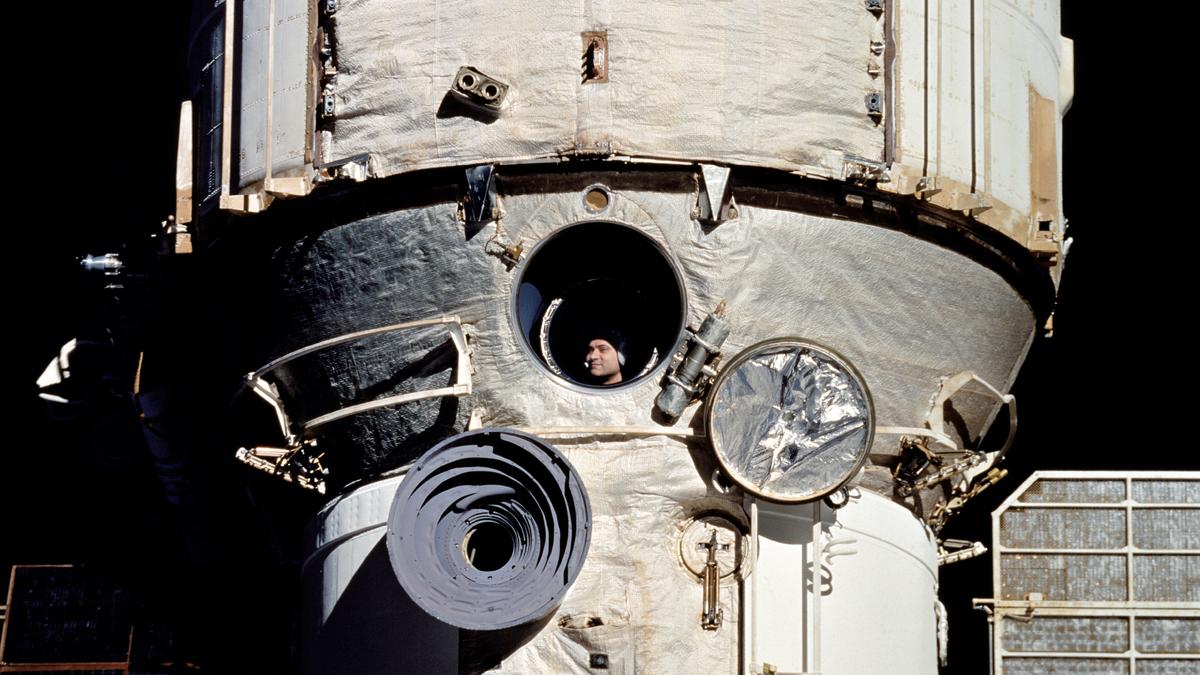
Docking in space or space docking is a space-tech marvel that enables us to join two spacecraft together in space. An important step for various missions, especially those that are exploratory in nature or involve space stations, only a handful of countries have mastered this art. India is now one of them, having become just the fourth country to do so after the U.S., Russia, and China, by successfully demonstrating docking as part of the Space Docking Experiment (SpaDeX) mission in January 2025.
Space docking has now been carried out for nearly 60 years, ever since NASA’s Gemini 8 spacecraft docked with an uncrewed Agena Target Vehicle on March 16, 1966. In addition to these docking missions, there are many others that lead up to successful docking. The STS-63 mission was one such mission that acted as a dress rehearsal, paving the way for STS-71, the first docking of the space shuttle with the Mir space station.
Cold War foes come together
When the STS-63 crew – commander James Wetherbee, pilot Eileen Collins, payload commander Bernard Harris Jr., and mission specialists Janice Voss, Michael Foale, and Vladimir Titov – was first announced in late 1993, they might not have imagined that their mission would pan out the way it eventually did. Titov’s inclusion made this the second shuttle mission with a Russian cosmonaut, as the Cold War foes were coming together in space ventures – efforts that eventually resulted in the construction of the International Space Station (ISS).
With the U.S. and Russian flags in the background, five NASA astronauts and a Russian cosmonaut named to fly aboard the Space Shuttle Discovery for the mission pose for the flight crew portrait at the Johnson Space Center (JSC). Left to right (front row) are Janice Voss, mission specialist; Eileen Collins, pilot; James Wetherbee, mission commander; and Vladimir Titov of the Russian Space Agency (RSA), mission specialist. In the rear are Bernard Harris Jr., payload commander; and Michael Foale, mission specialist.
| Photo Credit:
NASA
Initially scheduled for launch in May 1994, a series of high-level agreements between the U.S. and Russia led to STS-63 being chosen to demonstrate space shuttle Discovery’s capacity to rendezvous with Mir. As the plans evolved, launch dates were pushed to early 1995.
Rendezvous steals limelight
By the start of 1995, the launch date was fixed for February 2. While there were 20 experiments that were going to be conducted aboard the Spacehab-3 module, the planned rendezvous on the fourth day of the flight garnered the most public attention. The mission earned the nickname “near-Mir” from the media as the launch day grew nearer.
Failure of one of Discovery’s three Inertial Measurement Units (IMUs) meant that launch was pushed by 24 hours to February 3. History was made when the crew of STS-63 rocketed away from the Kennedy Space Center. This was because Collins was occupying a front row seat in the spacecraft, becoming, in the process, the first female to serve as a space shuttle pilot.
Leaks of one kind and another
Even though Discovery made it to the preliminary orbit in nine minutes, the days leading up to the rendezvous weren’t without incident. Few of the 44 Reaction Control System (RCS) thrusters exhibited irregularities, including a nose-mounted thruster that began leaking.
When the crew went to bed on the first day of the flight on February 3, Discovery trailed the Mir space station by 11,250 km and was closing by around 330 km every orbit. This distance was brought down to 1,850 km the evening before the rendezvous on February 5, with Discovery now closing in on Mir by 130 km per orbit. The leak notwithstanding, the rendezvous was still officially on.
Wetherbee woke up to encouraging news the following day as the leak had both slowed down and stabilised on February 6. The decision of whether the final rendezvous would see the Discovery manoeuvre to 10 m from Mir or take a conservative approach and reach no further than 120 m was still to be taken.
The Russian cosmonauts Aleksandr Viktorenko, Yelena Kondakova and Valeri Polyakov, aboard the Mir space station got to know about the decision first. And since the two crews were testing out a new VHF radio that enabled the shuttle crew to talk directly with those aboard Mir, the STS-63 crew members too found out about the final approach before the mission control at Houston officially communicated it to them.
After passing within 330 m of Mir, Wetherbee executed RCS firings to eliminate the chance of contamination. He halted Discovery at a distance of 120 m in order to obtain further permission before advancing further. VHF ship-to-ship communications was initiated between Discovery and Mir’s crews at a distance of 60 m.
In the minutes that followed, Wetherbee edged Discovery closer, reaching a distance of 12 m (37 feet) from Mir. While this is the distance mentioned in official press releases, Wetherbee maintains the closest approach was 33 feet (10 m) in his NASA oral history.
Even as he was flying the first-ever rendezvous between the Discovery and Mir precisely and as perfectly as he could, the moment was upon him to deliver words over the communication channels that would probably be heard by a global audience. He had prepared for this in the hours leading up to the event, and had also taken Titov’s help to make sure he could deliver the same message in English and Russian with alacrity.
“As we are bringing our spaceships closer together, we are bringing our nations closer together,” Wetherbee told Viktorenko through the VHF radio link as the point of closest approach neared. “The next time we approach, we will shake your hand and together we will lead our world into the next millennium.”
“We are one. We are human”
“We are one. We are human,” were Viktorenko’s words, echoing a shared sentiment.
Wetherbee held Discovery at the point of closest approach to Mir for about 15 minutes, before receding to a distance of 120 m. After completing a slow, quarter-loop flyaround of Mir, he carried out the final separation manoeuvre.
With the near-Mir operations successfully carried out, attention switched to other tasks at hand in the days that followed. This included the deployment on February 7 of the SPARTAN-204 astronomy satellite, Harris and Foale’s historic spacewalk on February 9 and two days of free flight for astronomical observations. When Discovery touched down on Earth on February 11, not only had the shuttle-Mir docking come closer to reality, but the beginnings of the ISS as well.
Thirty years since this special spacewalk
The extra-vehicular activity or spacewalk that took place as part of the STS-63 mission happened 30 years ago on February 9, 1995.
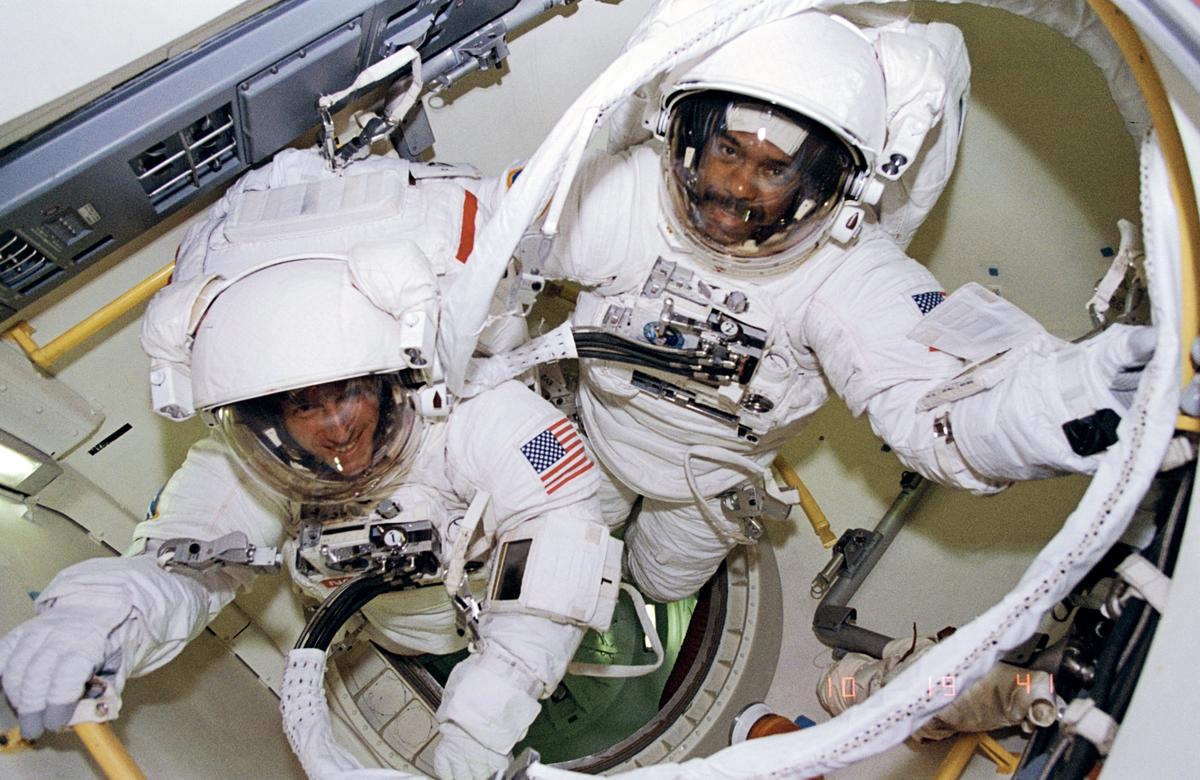
Astronauts Bernard Harris Jr., STS-63 payload commander (right) and Michael Foale, mission specialist, are ready to egress airlock for an extravehicular activity (EVA) on February 9, 1995.
| Photo Credit:
NASA
Payload commander Bernard Harris and mission specialist Michael Foale became the first African-American and British-born spacewalkers respectively in the process.
The pair tested modifications to their spacesuits done to keep astronauts warmer in the extreme cold that they experience in space. Putting on these massive, multi-later suits was not only cumbersome, but also required time and assistance from crewmates.
They also experimented moving large objects by hand in a microgravity environment. This included handling the SPARTAN spacecraft that weighed over 1,100 kg as a way of rehearsing space station assembly techniques.
Even though the EVA lasted four hours and 38 minutes, it didn’t run the entire course as mission control cut it short after Harris and Foale reported feeling very cold. It is worth mentioning that this portion of the walk was performed during a night pass, without sunlight.
Published – February 09, 2025 12:47 am IST