





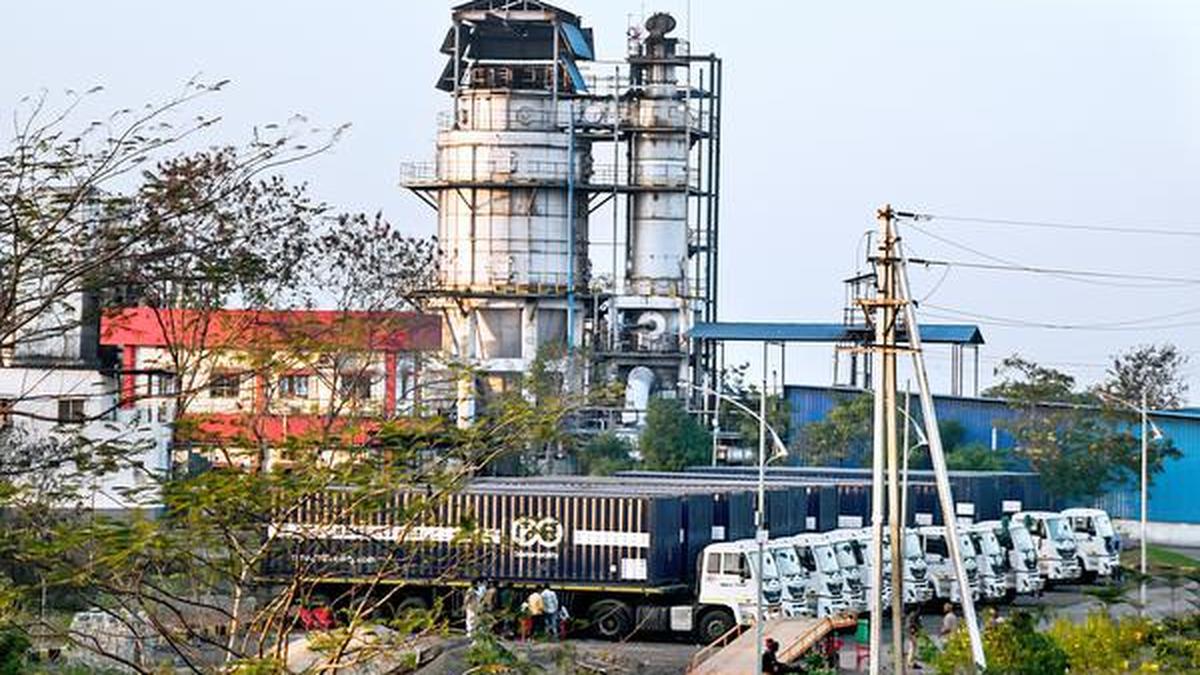
The story so far: On January 2, Madhya Pradesh government authorities moved 358 tonnes of hazardous waste from the defunct Union Carbide facility in Bhopal to the Pithampur industrial area in Dhar district. On December 3 last year, the Madhya Pradesh High Court had set a four-week deadline for authorities to dispose of this waste, nearly 40 years after the gas disaster that killed more than 4,000 people and injured or debilitated thousands more.
What is the waste’s status?
The disaster on the intervening night of December 2-3, 1984, was the result of poisonous gases leaking from the plant, which Union Carbide had set up to manufacture fertilisers. The waste at the facility is composed of the ingredients required to make these fertilisers.
After years of lying in Bhopal and multiple petitions from civil society groups, the Madhya Pradesh government was to incinerate the waste at a treatment, storage, and disposal facility (TSDF) in Pithampur more than 200 km away. Officials arranged for the waste to be packaged and labelled according to the Hazardous Waste Management Rules and transported in secure long-haul containers.
But protests in the industrial town by a local population fearful of harmful emissions from the incineration have paused the State’s plans.
On January 6, 2025, the Madhya Pradesh High Court gave the State government six weeks to safely dispose of the waste. The order came after State authorities had also sought time to spread awareness about the manner of disposal and measures to minimise its effects on health and the environment.
The Central government has allocated ₹126 crore to the State to incinerate the waste and deposit the residue in the TSDF landfill.
Why Pithampur?
In 2007, the Madhya Pradesh government had attempted to dispose of some of the waste at an incinerator-equipped TSDF in Ankleshwar, Gujarat, but the facility declined.
Five years later, the Supreme Court selected the Pithampur facility as being the most suitable final destination for the waste. According to the Central Pollution Control Board (CPCB), this is the sole TSDF in the State and also includes a landfill and an incinerator.
The CPCB followed up with an affidavit to the apex court in 2013 attesting to the Pithampur TSDF’s ability to ‘handle’ the waste from the Union Carbide plant.
The year after — a decade ago now — Madhya Pradesh organised a ‘trial run’ during which it incinerated 10,157 kg of the waste at the TSDF, then operated by the Ramky Group. The CPCB monitored the process with help from experts from private laboratories in Chennai and Hyderabad. Notably, the State had secretly advanced the incineration date by a few days to sidestep local resistance.
According to Bhopal Gas Tragedy Relief and Rehabilitation Department director Swatantra Kumar Singh, the emissions from the trial were under stipulated limits. The State’s public relations office also reported no adverse effects on the environment or on public health. The implication was that the rest of the waste could be incinerated and disposed of in the same way.

Is the waste harmful?
The ‘trial’ waste consisted of 4.8 tonnes of excavated waste, 1.6 tonnes of semi-processed residue, 1.3 tonnes of naphthol waste, 1.3 tonnes of carbaryl residue, and 0.8 tonnes of reactor residue. The State said it had rationed the mass of each waste type according to their relative abundance at the plant. Naphthol is 1-naphthol, a precursor compound in the manufacture of carbaryl, the insecticide the plant was built to make.
According to a December 2024 press release from the State’s public relations office, the Regional Director (Central) of CPCB Bhopal had collected and tested five water samples from around the Pithampur TSDF. The report (numbered WW24.25-188.189) indicated the water colour, chloride, sulphate, and fluoride concentrations, hardness, and the amount of total dissolved solids “exceeded permissible limits” specified in the IS 10500 standard in two open wells near the landfill.
However, the release said “scientists involved in the analysis” said the higher values “generally reflect groundwater quality and don’t appear to be linked to the TSDF operations”.
The release also responded to an unspecified media report that it said had claimed people in villages around the TSDF had elevated levels of skin diseases. Experts from the All India Institute of Medical Sciences (AIIMS) Bhopal and the Indian Council of Medical Research reportedly surveyed 12 villages and found the prevalence of skin and respiratory ailments here to be lower than the national average.
Credible media reports in 2015 had said around four-times as much ash and residue as the waste combusted (by mass) had been generated and which the CPCB had said it would dispose of in the landfill, including protections to prevent leachates from escaping into the soil.
The US Environmental Protection Agency (EPA) has said composite liners at landfills with hazardous waste will degrade and have to be reinstalled at periodic intervals.
What next?
The Madhya Pradesh government has temporarily put off incinerating the waste. Authorities have said the local protests, including two attempts at self-immolation, mean they would first like to improve public confidence in the safety of the disposal process.
On January 4, as protesters pelted stones at the TSDF, rumours swirled that a truck carrying waste had disappeared. The police subsequently arrested three people.
“We are preparing 50-odd master trainers, including science teachers, professors, and officials,” Dhar collector Priyank Mishra was quoted as saying. “They will be informed about the exact status of the waste before they reach out to people to dispel misinformation.”
There will also be another trial run: a batch of 90 kg will be incinerated at 1,200º C, Mr. Singh said. According to the EPA, most organic compounds (like 1-naphthol) are destroyed when subjected to 590-650º C. Operating hazardous waste incinerators at 980-1,200º C could thus strip the waste of organics.
If the resulting emissions don’t breach legal thresholds, the rest will be incinerated in batches of 270 kg each over three months. If the emissions exceed, Mr. Singh had told The Hindu the batch size would be reduced and the duration extended to nine months.
The next hearing in the High Court is set for February 18.
With inputs from Mehul Malpani.
Published – January 18, 2025 05:00 am IST