







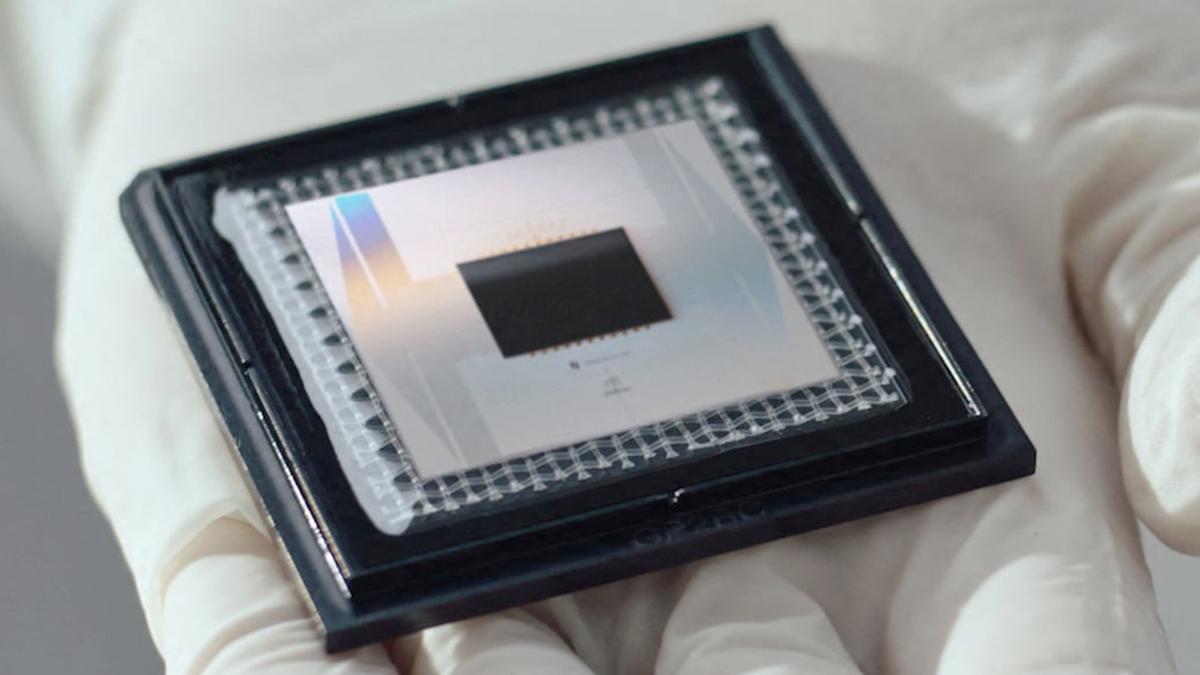
In recent years, the field of quantum computing has been experiencing fast growth, with technological advances and large-scale investments regularly making the news.
The United Nations has designated 2025 as the International Year of Quantum Science and Technology.
The stakes are high – having quantum computers would mean access to tremendous data processing power compared to what we have today. They won’t replace your normal computer, but having this kind of awesome computing power will provide advances in medicine, chemistry, materials science and other fields.
So it’s no surprise that quantum computing is rapidly becoming a global race, and private industry and governments around the world are rushing to build the world’s first full-scale quantum computer. To achieve this, first we need to have stable and scalable quantum processors, or chips.
What is a quantum chip?
Everyday computers – like your laptop – are classical computers. They store and process information in the form of binary numbers or bits. A single bit can represent either 0 or 1.
By contrast, the basic unit of a quantum chip is a qubit. A quantum chip is made up of many qubits. These are typically subatomic particles such as electrons or photons, controlled and manipulated by specially designed electric and magnetic fields (known as control signals).
Unlike a bit, a qubit can be placed in a state of 0, 1, or a combination of both, also known as a “superposition state”. This distinct property allows quantum processors to store and process extremely large data sets exponentially faster than even the most powerful classical computer.
There are different ways to make qubits – one can use superconducting devices, semiconductors, photonics (light) or other approaches. Each method has its advantages and drawbacks.
Companies like IBM, Google and QueRa all have roadmaps to drastically scale up quantum processors by 2030.
Industry players that use semiconductors are Intel and Australian companies like Diraq and SQC. Key photonic quantum computer developers include PsiQuantum and Xanadu.
Qubits: quality versus quantity
How many qubits a quantum chip has is actually less important than the quality of the qubits.
A quantum chip made up of thousands of low-quality qubits will be unable to perform any useful computational task.
So, what makes for a quality qubit?
Qubits are very sensitive to unwanted disturbances, also known as errors or noise. This noise can come from many sources, including imperfections in the manufacturing process, control signal issues, changes in temperature, or even just an interaction with the qubit’s environment.
Being prone to errors reduces the reliability of a qubit, known as fidelity. For a quantum chip to stay stable long enough to perform complex computational tasks, it needs high-fidelity qubits.
When researchers compare the performance of different quantum chips, qubit fidelity is one of the crucial parameters they use.
How do we correct the errors?
Fortunately, we don’t have to build perfect qubits.
Over the last 30 years, researchers have designed theoretical techniques which use many imperfect or low-fidelity qubits to encode an abstract “logical qubit”. A logical qubit is protected from errors and, therefore, has very high fidelity. A useful quantum processor will be based on many logical qubits.
Nearly all major quantum chip developers are now putting these theories into practice, shifting their focus from qubits to logical qubits.
In 2024, many quantum computing researchers and companies made great progress on quantum error corrections, including Google, QueRa, IBM and CSIRO.
Quantum chips consisting of over 100 qubits are already available. They are being used by many researchers around the world to evaluate how good the current generation of quantum computers are and how they can be made better in future generations.
For now, developers have only made single logical qubits. It will likely take a few years to figure out how to put several logical qubits together into a quantum chip that can work coherently and solve complex real-world problems.
What will quantum computers be useful for?
A fully functional quantum processor would be able to solve extremely complex problems. This could lead to revolutionary impact in many areas of research, technology and economy.
Quantum computers could help us discover new medicines and advance medical research by finding new connections in clinical trial data or genetics that current computers don’t have enough processing power for.
They could also greatly improve the safety of various systems that use artificial intelligence algorithms, such as banking, military targeting and autonomous vehicles, to name a few.
To achieve all this, we first need to reach a milestone known as quantum supremacy – where a quantum processor solves a problem that would take a classical computer an impractical amount of time to do.
Late last year, Google’s quantum chip Willow finally demonstrated quantum supremacy for a contrived task – a computational problem designed to be hard for classical supercomputers but easy for quantum processors due to their distinct way of working.
Although it didn’t solve a useful real-world problem, it’s still a remarkable achievement and an important step in the right direction that’s taken years of research and development. After all, to run, one must first learn to walk.
What’s on the horizon for 2025 and beyond?
In the next few years, quantum chips will continue to scale up. Importantly, the next generation of quantum processors will be underpinned by logical qubits, able to tackle increasingly useful tasks.
While quantum hardware (that is, processors) has been progressing at a rapid pace, we also can’t overlook an enormous amount of research and development in the field of quantum software and algorithms.
Using quantum simulations on normal computers, researchers have been developing and testing various quantum algorithms. This will make quantum computing ready for useful applications when the quantum hardware catches up.
Building a full-scale quantum computer is a daunting task. It will require simultaneous advancements on many fronts, such as scaling up the number of qubits on a chip, improving the fidelity of the qubits, better error correction, quantum software, quantum algorithms, and several other sub-fields of quantum computing.
After years of remarkable foundational work, we can expect 2025 to bring new breakthroughs in all of the above.
This article is republished from The Conversation under a Creative Commons license. Read the original article here.
Published – January 09, 2025 05:04 pm IST