



Skip to content
  • Facebook
  • X
  • Linkedin
  • WhatsApp
  • YouTube
  • Associate Journalism
  • About Us
  • Privacy Policy
  • 033-46046046
  • editor@artifex.news
Artifex.News

Artifex.News

Stay Connected. Stay Informed.

  • Breaking News
  • World
  • Nation
  • Sports
  • Business
  • Science
  • Entertainment
  • Lifestyle
  • Toggle search form
  • Access Denied
    Access Denied Nation
  • Kamala Harris Says De-Escalation Needed In Middle East Amid Israeli Offensive
    Kamala Harris Says De-Escalation Needed In Middle East Amid Israeli Offensive World
  • Fan Abuses, Misbehaves With Pakistan’s Shaheen Afridi In Ireland, Security Does This. Watch
    Fan Abuses, Misbehaves With Pakistan’s Shaheen Afridi In Ireland, Security Does This. Watch Sports
  • Access Denied World
  • Multiple Americans detained in Venezuela released, U.S. says
    Multiple Americans detained in Venezuela released, U.S. says World
  • Access Denied World
  • Unemployed Engineer Dies By Suicide In Noida
    Unemployed Engineer Dies By Suicide In Noida Nation
  • Access Denied Business
Astronomers build galaxy-sized ‘detector’ to map universe’s vibrations

Astronomers build galaxy-sized ‘detector’ to map universe’s vibrations

Posted on December 31, 2024 By admin


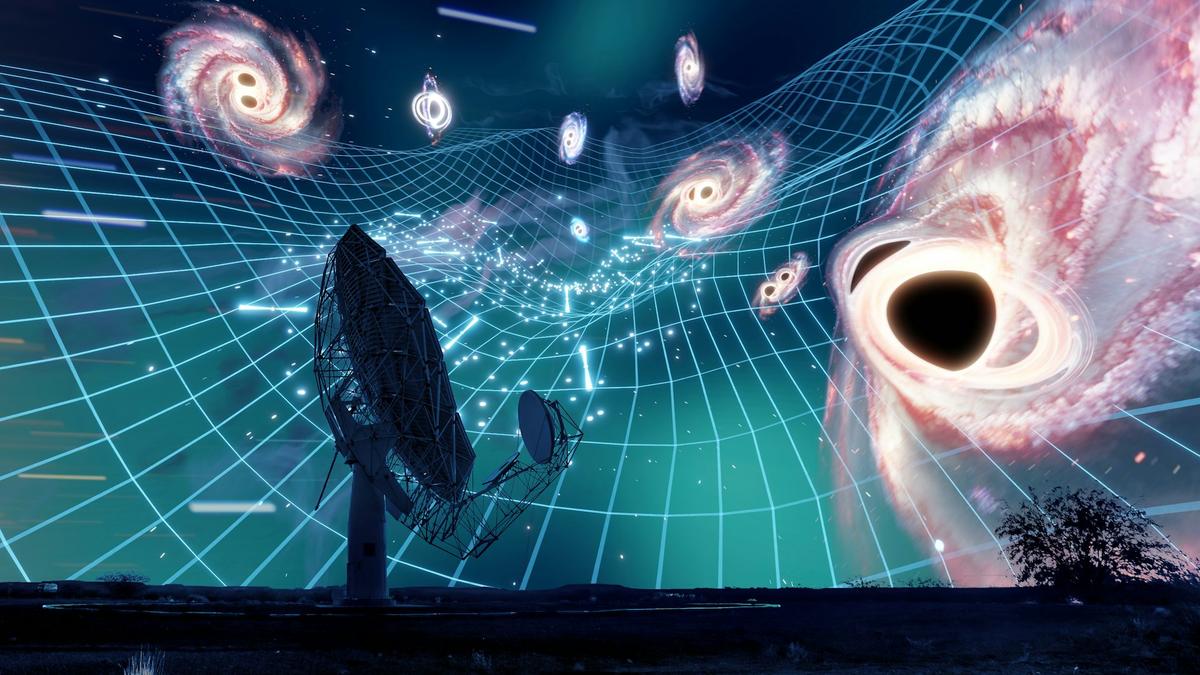
Using the largest gravitational wave detector ever made, we have confirmed earlier reports that the fabric of the universe is constantly vibrating. This background rumble is likely caused by collisions between the enormous black holes that reside in the hearts of galaxies.

The results from our detector – an array of rapidly spinning neutron stars spread across the galaxy – show this “gravitational wave background” may be louder than previously thought. We have also made the most detailed maps yet of gravitational waves across the sky, and found an intriguing “hot spot” of activity in the Southern Hemisphere.

Our research is published today in three papers in the Monthly Notices of the Royal Astronomical Society.

Ripples in space and time

Gravitational waves are ripples in the fabric of space and time. They are created when incredibly dense and massive objects orbit or collide with each other.

The densest and most massive objects in the universe are black holes, the remnants of dead stars. One of the only ways to study black holes is by searching for the gravitational waves they emit when they move near each other.

Just like light, gravitational waves are emitted in a spectrum. The most massive black holes emit the slowest and most powerful waves – but to study them, we need a detector the size of our galaxy.

The high-frequency gravitational waves created by collisions between relatively small black holes can be picked up with Earth-based detectors, and they were first observed in 2015. However, evidence for the existence of the slower, more powerful waves wasn’t found until last year.

Several groups of astronomers around the world have assembled galactic-scale gravitational wave detectors by closely observing the behaviour of groups of particular kinds of stars. Our experiment, the MeerKAT Pulsar Timing Array, is the largest of these galactic-scale detectors.

Today we have announced further evidence for low-frequency gravitational waves, but with some intriguing differences from earlier results. In just a third of the time of other experiments, we’ve found a signal that hints at a more active universe than anticipated.

We have also been able to map the cosmic architecture left behind by merging galaxies more accurately than ever before.

Black holes, galaxies and pulsars

At the centre of most galaxies, scientists believe, lives a gargantuan object known as a supermassive black hole. Despite their enormous mass – billions of times the mass of our Sun – these cosmic giants are difficult to study.

Astronomers have known about supermassive black holes for decades, but only directly observed one for the first time in 2019.

When two galaxies merge, the black holes at their centres begin to spiral towards each other. In this process they send out slow, powerful gravitational waves that give us an opportunity to study them.

We do this using another group of exotic cosmic objects: pulsars. These are extremely dense stars made mainly of neutrons, which may be around the size of a city but twice as heavy as the Sun.

Pulsars spin hundreds of times a second. As they rotate, they act like lighthouses, hitting Earth with pulses of radiation from thousands of light years away. For some pulsars, we can predict when that pulse should hit us to within nanoseconds.

Our gravitational wave detectors make use of this fact. If we observe many pulsars over the same period of time, and we’re wrong about when the pulses hit us in a very specific way, we know a gravitational wave is stretching or squeezing the space between the Earth and the pulsars.

However, instead of seeing just one wave, we expect to see a cosmic ocean full of waves criss-crossing in all directions – the echoing ripples of all the galactic mergers in the history of the universe. We call this the gravitational wave background.

A surprisingly loud signal – and an intriguing ‘hot spot’

To detect the gravitational wave background, we used the MeerKAT radio telescope in South Africa. MeerKAT is one of the most sensitive radio telescopes in the world.

As part of the MeerKAT Pulsar Timing Array, it has been observing a group of 83 pulsars for about five years, precisely measuring when their pulses arrive at Earth. This led us to find a pattern associated with a gravitational wave background, only it’s a bit different from what other experiments have found.

The pattern, which represents how space and time between Earth and the pulsars is changed by gravitational waves passing between them, is more powerful than expected.

This might mean there are more supermassive black holes orbiting each other than we thought. If so, this raises more questions – because our existing theories suggest there should be fewer supermassive black holes than we seem to be seeing.

The size of our detector, and the sensitivity of the MeerKAT telescope, means we can assess the background with extreme precision. This allowed us to create the most detailed maps of the gravitational wave background to date. Mapping the background in this way is essential for understanding the cosmic architecture of our universe.

It may even lead us to the ultimate source of the gravitational wave signals we observe. While we think it’s likely the background emerges from the interactions of these colossal black holes, it could also stem from changes in the early, energetic universe following the Big Bang – or perhaps even more exotic events.

The maps we’ve created show an intriguing “hot spot” of gravitational wave activity in the Southern Hemisphere sky. This kind of irregularity supports the idea of a background created by supermassive black holes rather than other alternatives.

However, creating a galactic-sized detector is incredibly complex, and it’s too early to say if this is genuine or a statistical anomaly.

To confirm our findings, we are working to combine our new data with results from other international collaborations under the banner of the International Pulsar Timing Array.

This article is republished from The Conversation under a Creative Commons license. Read the original article here.

Published – December 31, 2024 04:56 pm IST


Source link

Science Tags:Astronomy, astronomy news, black holes, science news, universe background rumble

Post navigation

Previous Post: Machine learning can help blood tests have a separate ‘normal’ for each patient
Next Post: Sensex declines 109 points in final session, ends 2024 with over 8% gains

Related Posts

  • Solar Electric Vehicle Championship from March 27-31 in Manipal
    Solar Electric Vehicle Championship from March 27-31 in Manipal Science
  • How Wallace and Bates revolutionised natural history
    How Wallace and Bates revolutionised natural history Science
  • See first images of human brain scanned by world’s most powerful MRI
    See first images of human brain scanned by world’s most powerful MRI Science
  • Govt. approves four semiconductor plants in Odisha, Punjab, Andhra Pradesh
    Govt. approves four semiconductor plants in Odisha, Punjab, Andhra Pradesh Science
  • Do heat waves affect urban trees more than their rural counterparts?
    Do heat waves affect urban trees more than their rural counterparts? Science
  • What is aircraft turbulence and how common is it? | Explainer
    What is aircraft turbulence and how common is it? | Explainer Science

More Related Articles

SpaceX’s Starship launches 6th Flight; first ever payload was a stuffed banana SpaceX’s Starship launches 6th Flight; first ever payload was a stuffed banana Science
The Science Quiz | Want to be tickled pink out of the blue? The Science Quiz | Want to be tickled pink out of the blue? Science
Unwrapping India’s plastic packaging problem: from boom to crisis Unwrapping India’s plastic packaging problem: from boom to crisis Science
Space is for everyone, collaboration crucial for progress, says ISRO Chairperson V. Narayanan Space is for everyone, collaboration crucial for progress, says ISRO Chairperson V. Narayanan Science
China’s Shenzhou-20 return mission delayed due to space debris impact China’s Shenzhou-20 return mission delayed due to space debris impact Science
Google’s new AI model offers new pathway in cancer drug research Google’s new AI model offers new pathway in cancer drug research Science
SiteLock

Archives

  • May 2026
  • April 2026
  • March 2026
  • February 2026
  • January 2026
  • December 2025
  • November 2025
  • October 2025
  • September 2025
  • August 2025
  • July 2025
  • June 2025
  • May 2025
  • April 2025
  • March 2025
  • February 2025
  • January 2025
  • December 2024
  • November 2024
  • October 2024
  • September 2024
  • August 2024
  • July 2024
  • June 2024
  • May 2024
  • April 2024
  • March 2024
  • February 2024
  • January 2024
  • December 2023
  • November 2023
  • October 2023
  • September 2023
  • August 2023
  • July 2023
  • June 2023
  • May 2023
  • April 2023
  • March 2023
  • February 2023
  • January 2023
  • December 2022
  • November 2022
  • October 2022
  • September 2022
  • August 2022
  • July 2022
  • June 2022
  • May 2022

Categories

  • Business
  • Nation
  • Science
  • Sports
  • World

Recent Posts

  • China, U.S. should be ‘partners not rivals’, says Xi Jinping after meeting Donald Trump
  • Iran working on Hormuz ‘protocol’ to cover ‘costs’, says Deputy Foreign Minister Gharibabadi
  • Zydus Lifesciences arm to acquire U.S. oncology firm Assertio for $166 million
  • Israel-Iran war LIVE: Iran working on Hormuz ‘protocol’ to cover ‘costs’, says Dy FM Gharibabadi
  • Russia to fulfil all agreements on energy supply to India: FM Lavrov

Recent Comments

  1. Jeffreyroure on UP Teacher Who Asked Students To Slap Muslim Classmate
  2. Stevemonge on UP Teacher Who Asked Students To Slap Muslim Classmate
  3. RichardClage on UP Teacher Who Asked Students To Slap Muslim Classmate
  4. StevenLek on UP Teacher Who Asked Students To Slap Muslim Classmate
  5. Leonardren on UP Teacher Who Asked Students To Slap Muslim Classmate
  • Kamala Harris And Trump Target Economy In Close US Election Battle
    Kamala Harris And Trump Target Economy In Close US Election Battle World
  • T20 World Cup: We wanted to finish off the game a bit earlier, says Samson
    T20 World Cup: We wanted to finish off the game a bit earlier, says Samson Sports
  • Access Denied World
  • 2nd Test Day 2 Live: Rain To Force A Delayed Start As India Eye 4th Wicket?
    2nd Test Day 2 Live: Rain To Force A Delayed Start As India Eye 4th Wicket? Sports
  • Rs 7.98 Crore Or Rs 55 Lakh? Missing Money In ‘Crorepati Constable’ Case
    Rs 7.98 Crore Or Rs 55 Lakh? Missing Money In ‘Crorepati Constable’ Case Nation
  • Union Budget 2024-25: FM allocates more than Rs 11 lakh crore towards capital expenditure, 3.4% of GDP
    Union Budget 2024-25: FM allocates more than Rs 11 lakh crore towards capital expenditure, 3.4% of GDP Business
  • Top Lashkar Commander Among 3 Terrorists Killed In Separate J&K Encounters
    Top Lashkar Commander Among 3 Terrorists Killed In Separate J&K Encounters Nation
  • EU seeks to cut Russia dependence; Hungary, Slovakia have other plans
    EU seeks to cut Russia dependence; Hungary, Slovakia have other plans World

Editor-in-Chief:
Mohammad Ariff,
MSW, MAJMC, BSW, DTL, CTS, CNM, CCR, CAL, RSL, ASOC.
editor@artifex.news

Associate Editors:
1. Zenellis R. Tuba,
zenelis@artifex.news
2. Haris Daniyel
daniyel@artifex.news

Photograher:
Rohan Das
rohan@artifex.news

Artifex.News offers Online Paid Internships to college students from India and Abroad. Interns will get a PRESS CARD and other online offers.
Send your CV (Subjectline: Paid Internship) to internship@artifex.news

Links:
Associate Journalism
About Us
Privacy Policy

News Links:
Breaking News
World
Nation
Sports
Business
Entertainment
Lifestyle

Registered Office:
72/A, Elliot Road, Kolkata - 700016
Tel: 033-22277777, 033-22172217
Email: office@artifex.news

Editorial Office / News Desk:
No. 13, Mezzanine Floor, Esplanade Metro Rail Station,
12 J. L. Nehru Road, Kolkata - 700069.
(Entry from Gate No. 5)
Tel: 033-46011099, 033-46046046
Email: editor@artifex.news

Copyright © 2023 Artifex.News Newsportal designed by Artifex Infotech.