




Skip to content
  • Facebook
  • X
  • Linkedin
  • WhatsApp
  • YouTube
  • Associate Journalism
  • About Us
  • Privacy Policy
  • 033-46046046
  • editor@artifex.news
Artifex.News

Artifex.News

Stay Connected. Stay Informed.

  • Breaking News
  • World
  • Nation
  • Sports
  • Business
  • Science
  • Entertainment
  • Lifestyle
  • Toggle search form
  • Access Denied Sports
  • Access Denied World
  • A Look At 2024 US Election Vocabulary
    A Look At 2024 US Election Vocabulary World
  • Access Denied Sports
  • “Kiss Was Consented, 100 Percent Non-Sexual”: Luis Rubiales On FIFA World Cup Final Controversy
    “Kiss Was Consented, 100 Percent Non-Sexual”: Luis Rubiales On FIFA World Cup Final Controversy Sports
  • A (very) basic guide to artificial intelligence
    A (very) basic guide to artificial intelligence Science
  • Day After Outcome In Border Talks, PM Modi, Xi Jinping Arrive In Russia
    Day After Outcome In Border Talks, PM Modi, Xi Jinping Arrive In Russia Nation
  • Dravid happy to forgo bonus amount after T20 World Cup triumph
    Dravid happy to forgo bonus amount after T20 World Cup triumph Sports
How much do dark matter particles weigh?

How much do dark matter particles weigh?

Posted on December 23, 2024 By admin


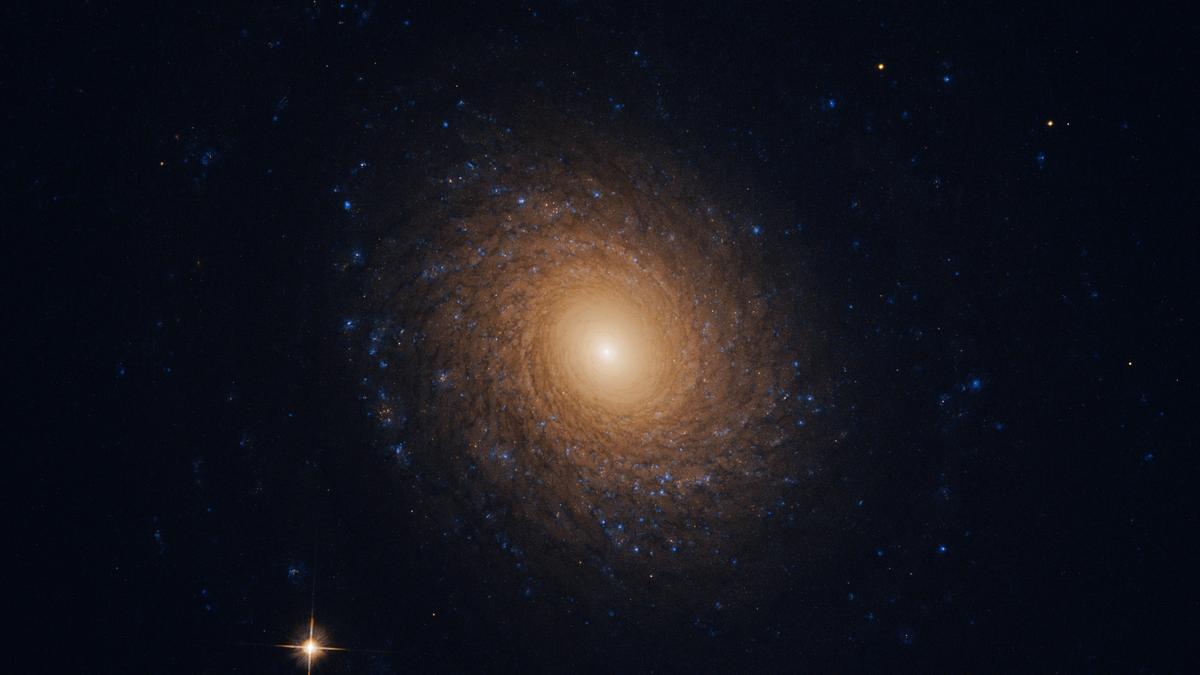
A Hubble Space Telescope view of the galaxy NGC2985. The evidence for dark matter emerged in the 1970s when astronomers found an unusual pattern in the rate at which stars in a galaxy rotated the farther they were from the centre.
| Photo Credit: Judy Schmidt/NASA

Dark matter is an enigmatic invisible substance supplying five-sixths of the matter of the universe. Unlike photons, the particles of light, the particles of dark matter need to have non-zero mass or else the dense and intricate structure of matter on cosmic scales will not form.

How light can a dark particle then be? For decades scientists thought this minimum mass was about 10-31 times the mass of a proton. But in May this year, theoretical physicists revised the limit and pushed it up by an order of magnitude, to 2.3 × 10⁻³⁰ proton masses. This is a significant update in the world of dark matter.

Uniformly or in lumps?

To understand these numbers and their importance, let us first build a mental picture of dark matter. Dark matter is said to be everywhere in the universe. Does that mean it is in your house? In 1922, Dutch astronomer Jacobus Kapteyn studied the motion of stars neighbouring the Sun and concluded the density of “dark matter” (using that term for one of the first times) must be 0.0003 solar masses per cubic light year.

Since then, through a century of increasingly sophisticated measurements, the accuracy of Kapteyn’s conclusion has held up remarkably well. This density of dark matter can be re-expressed as the heft of two protons per teaspoon, which means your house could contain dark matter with a mass equivalent of a trillion protons.

But this would also be naïve: Kapteyn’s and subsequent measurements are only valid when regarding the million-cubic-lightyear volume and doesn’t apply when we zoom in for a closer look. This is because stars, whose motion is used for the measurement, are themselves separated by a few light years. Whether or not dark matter is present on smaller length scales would depend on how it is distributed: either uniformly or in lumps.

An occasional visitor?

Let’s assume it is spread around like fine flour, which the standard theories of cosmology also predict. If it comes in lumps, the spacing between them may be as large as many light years and there will perhaps be no dark matter under your roof.

Now, since we know the local density of dark matter, the value of the unknown mass of the dark particle will determine the separation between two neighbouring particles. If it is 100 proton masses, the inter-particle separation will be 7 cm. Then dark particles at any given moment will not only be in your house but also in your head.

If dark matter is made of an elementary particle, the heaviest it can be is about 1019 times a proton’s mass. In that case the interparticle separation would be 30 km. So dark matter won’t be a resident of your house but will visit occasionally (since the particles travel randomly at around 300 km/s).

Then again, a 1020 gram agglomerate of dark particles would be apart by more than the size of the solar system, reducing our chance of discovering them.

Fluid rather than a flock

What about small masses? At 10-11 proton masses, every red blood cell in your body will contain a dark matter particle. But now quantum physics becomes important. Every object is also a wave, with its wavelength given by the inverse of its momentum. Thus the lighter a dark matter particle is, the larger its wavelength will be. For 10-11 proton masses, the wavelength will be about 2 cm, much larger than its micrometre interparticle separation.

So for small masses, we must picture a collection of dark particles as a fluid rather than as a flock of grains.

If we now dial the mass of a dark particle all the way down to 10-31 proton masses, the wavelength is 200 light years, about the size of a dwarf galaxy. The substance of a dwarf galaxy is chiefly in the form of dark matter, with only about 1% contribution from stars. This simple fact translates to a restriction on the dark matter particle’s mass: it must be greater than 10-31 proton masses. If it were lower, its spatial extent would exceed the dwarf galaxy and we can’t form a macroscopic object smaller than its microscopic constituents.

The time of computers

This is where the paper from May matters. Its authors have shown that this lore is too simplistic and that researchers can do something sharper. First, using data on how stars move in Leo II, a dwarf galaxy orbiting the Milky Way, they inferred the dark matter density in it as a function of the distance from its centre. This density profile isn’t unique due to measurement uncertainties, so they generate a set consistent with the stellar data. Next, they numerically solved the Schrödinger equation after modifying it to account for gravity and obtained an ensemble of density profiles. Finally, they carried out a statistical procedure to match the two sets of density profiles — the empirical one from observing Leo II and the theoretical one from solving the equation.

Their key finding here was that the inner regions of Leo II contained more invisible mass and which dark particles of 10-31 proton mass couldn’t account for. Thus they surmised heavier particles are needed to accommodate the inner crowding.

It’s not everyday that particle physics gets to redraw a fundamental goal post by an order of magnitude. And it is a sign of our times that this could only have been done with computers as opposed to a blackboard.

Nirmal Raj is an assistant professor of theoretical physics at the Centre for High Energy Physics in the Indian Institute of Science, Bengaluru. nraj@iisc.ac.in

Published – December 23, 2024 05:30 am IST



Source link

Science

Post navigation

Previous Post: Nara Devaansh sets world record in chess category
Next Post: Trump picks billionaire Stephen Feinberg to be Deputy Defense Secretary

Related Posts

  • ICMR study finds the drivers of COVID-19 vaccine hesitancy
    ICMR study finds the drivers of COVID-19 vaccine hesitancy Science
  • Remembering V. Rajaraman, a tireless evangelist of computer education
    Remembering V. Rajaraman, a tireless evangelist of computer education Science
  • Nearly 50% of pregnancies in India are high-risk
    Nearly 50% of pregnancies in India are high-risk Science
  • Hospital admission after taking hallucinogens triples risk of schizophrenia: study
    Hospital admission after taking hallucinogens triples risk of schizophrenia: study Science
  • Fourth Earth-bound manoeuvre of the Aditya-L1 mission performed successfully
    Fourth Earth-bound manoeuvre of the Aditya-L1 mission performed successfully Science
  • Twigstats: New tool reveals hi-res genetic view of people’s ancestors
    Twigstats: New tool reveals hi-res genetic view of people’s ancestors Science

More Related Articles

Horizon project: Which EU science schemes has Britain joined? Horizon project: Which EU science schemes has Britain joined? Science
Ganga Hospital Chairman ranked among top 2% of world scientists Ganga Hospital Chairman ranked among top 2% of world scientists Science
Scientists document remarkable sperm whale ‘phonetic alphabet’ Scientists document remarkable sperm whale ‘phonetic alphabet’ Science
Marine heatwave killed four million Alaska seabirds Marine heatwave killed four million Alaska seabirds Science
Entangled clocks may reveal where quantum physics and gravity meet Entangled clocks may reveal where quantum physics and gravity meet Science
Ultradian rhythms: The cycles of life Ultradian rhythms: The cycles of life Science
SiteLock

Archives

  • May 2026
  • April 2026
  • March 2026
  • February 2026
  • January 2026
  • December 2025
  • November 2025
  • October 2025
  • September 2025
  • August 2025
  • July 2025
  • June 2025
  • May 2025
  • April 2025
  • March 2025
  • February 2025
  • January 2025
  • December 2024
  • November 2024
  • October 2024
  • September 2024
  • August 2024
  • July 2024
  • June 2024
  • May 2024
  • April 2024
  • March 2024
  • February 2024
  • January 2024
  • December 2023
  • November 2023
  • October 2023
  • September 2023
  • August 2023
  • July 2023
  • June 2023
  • May 2023
  • April 2023
  • March 2023
  • February 2023
  • January 2023
  • December 2022
  • November 2022
  • October 2022
  • September 2022
  • August 2022
  • July 2022
  • June 2022
  • May 2022

Categories

  • Business
  • Nation
  • Science
  • Sports
  • World

Recent Posts

  • U.S. to drop graft charges against Gautam Adani: NY Times
  • ED arrests Kolkata Police DC Shantanu Sinha Biswas in money laundering case
  • One dead, several injured in landslide in Jamuria coal mines in West Bengal; many feared missing
  • ​Bursting at the seams: On the rise in inflation
  • Sinner reaches Italian Open semis, breaks Masters 1000 winning streak record

Recent Comments

  1. MartinbaW on UP Teacher Who Asked Students To Slap Muslim Classmate
  2. AlfredgeK on UP Teacher Who Asked Students To Slap Muslim Classmate
  3. WilliamTOP on UP Teacher Who Asked Students To Slap Muslim Classmate
  4. KevinPrics on UP Teacher Who Asked Students To Slap Muslim Classmate
  5. Davidexomi on UP Teacher Who Asked Students To Slap Muslim Classmate
  • AI firms flex lobbying muscle on both sides of the Atlantic
    AI firms flex lobbying muscle on both sides of the Atlantic Business
  • Ukraine says talks on France sending military instructors ongoing
    Ukraine says talks on France sending military instructors ongoing World
  • Aid trucks begin entering Gaza under agreement with Egypt to bypass Rafah
    Aid trucks begin entering Gaza under agreement with Egypt to bypass Rafah World
  • Congress’ Deepender Hooda Says State Ready For Change
    Congress’ Deepender Hooda Says State Ready For Change Nation
  • “Virat Kohli Will Slam His 50th Century Against…”: Sunil Gavaskar’s ‘Savoury’ Prediction For India Star
    “Virat Kohli Will Slam His 50th Century Against…”: Sunil Gavaskar’s ‘Savoury’ Prediction For India Star Sports
  • Karnataka Court Cancels Case Against Tejasvi Surya Over Sharing Fake News
    Karnataka Court Cancels Case Against Tejasvi Surya Over Sharing Fake News Nation
  • Access Denied
    Access Denied Nation
  • Household Debt Doubles In FY23, Savings More Than Halves To 5.15% Of GDP: SBI Research
    Household Debt Doubles In FY23, Savings More Than Halves To 5.15% Of GDP: SBI Research Business

Editor-in-Chief:
Mohammad Ariff,
MSW, MAJMC, BSW, DTL, CTS, CNM, CCR, CAL, RSL, ASOC.
editor@artifex.news

Associate Editors:
1. Zenellis R. Tuba,
zenelis@artifex.news
2. Haris Daniyel
daniyel@artifex.news

Photograher:
Rohan Das
rohan@artifex.news

Artifex.News offers Online Paid Internships to college students from India and Abroad. Interns will get a PRESS CARD and other online offers.
Send your CV (Subjectline: Paid Internship) to internship@artifex.news

Links:
Associate Journalism
About Us
Privacy Policy

News Links:
Breaking News
World
Nation
Sports
Business
Entertainment
Lifestyle

Registered Office:
72/A, Elliot Road, Kolkata - 700016
Tel: 033-22277777, 033-22172217
Email: office@artifex.news

Editorial Office / News Desk:
No. 13, Mezzanine Floor, Esplanade Metro Rail Station,
12 J. L. Nehru Road, Kolkata - 700069.
(Entry from Gate No. 5)
Tel: 033-46011099, 033-46046046
Email: editor@artifex.news

Copyright © 2023 Artifex.News Newsportal designed by Artifex Infotech.