


Skip to content
  • Facebook
  • X
  • Linkedin
  • WhatsApp
  • Associate Journalism
  • About Us
  • Privacy Policy
  • 033-46046046
  • editor@artifex.news
Artifex.News

Artifex.News

Stay Connected. Stay Informed.

  • Breaking News
  • World
  • Nation
  • Sports
  • Business
  • Science
  • Entertainment
  • Lifestyle
  • Toggle search form
  • Leopard Enters House’s Garden in Rajasthan, Pounces On Pet Dog Nation
  • OPEC expects share of Indian oil imports to rise again Business
  • Ricky Ponting To Bring In Ex-Australia Teammate To Punjab Kings Support Staff? Report Is Revealing Sports
  • Alex De Minaur Beats Stefanos Tsitsipas At Last To Reach Acapulco Semi-Finals Sports
  • You have to fight fire with fire: Angelo Mathews on Sri Lanka’s England clash Sports
  • Justice Sanjiv Khanna appointed next Chief Justice of India, will take oath on November 11 Nation
  • Team Sharad Pawar Complains To Poll Body Over BJP, Eknath Shinde’s Star Campaigners List Nation
  • Macron Warns Israel Against Forced Transfer Of Gazans World

Science for all newsletter Are ants in groups smarter than humans in groups?

Posted on January 2, 2025 By admin


(This article forms a part of the Science for All newsletter that takes the jargon out of science and puts the fun in! Subscribe now!)

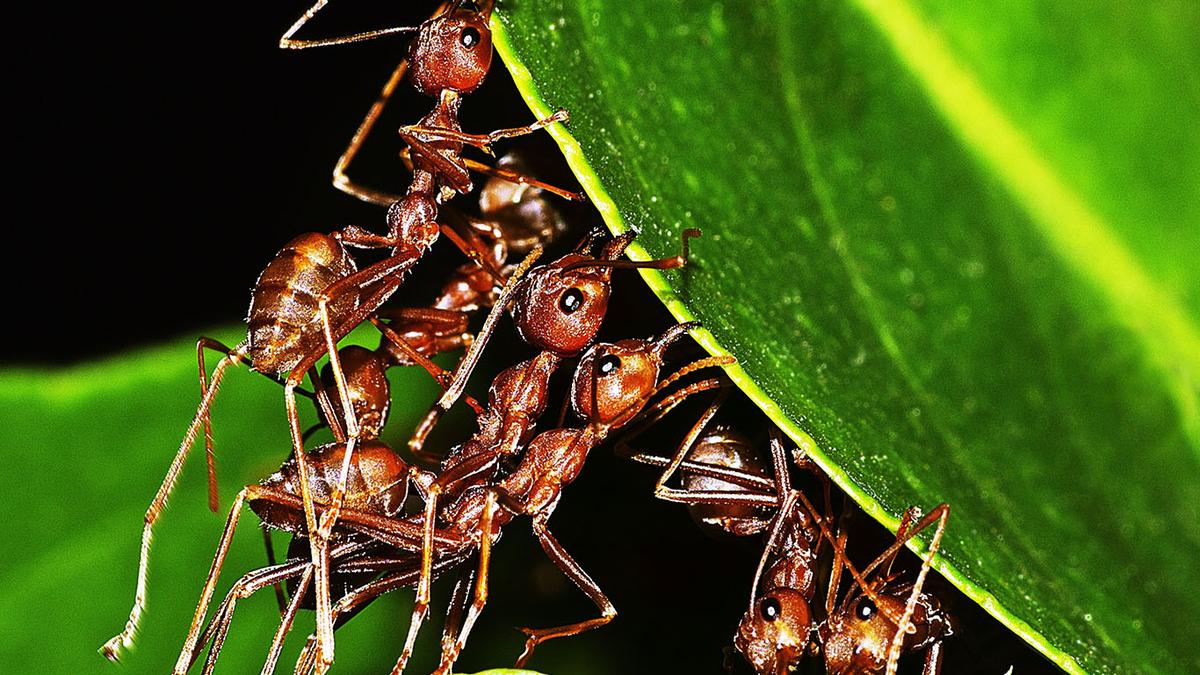
The small size of ants has nothing to do with their stature among insects and in fact in the animal kingdom. Over the years, they have colonised almost every major landmass on the planet and their total biomass is expected to exceed that of birds and mammals combined. They are eusocial insects: their colonies are organised with a great degree of cooperation and division of labour.

A study published in Proceedings of the National Academy of Sciences on December 23 offered to add one more feather to their caps. In the study, Israeli researchers explored how two species — longhorn crazy ants and humans — dealt with challenges by working together.

Just as it’s easier to haul a heavier object with a large number of people, the researchers have reported that a large number of ants can together make more complicated decisions by having different ants make different parts of each decision.

In an experiment, the researchers had the ants carry a T-shaped object through a series of ant-sized obstacles. This is a difficult task for ants because they can’t talk to each other about how they can fit the object through a particular entrance using only their pheromone-based communication.

In a parallel setup, the team had a bunch of people navigate a similar obstacle course carrying a similar oddly shaped object.

To level the playing field, the humans were made to wear sunglasses and masks and barred from speaking or gesturing to each other.

The team found that the ant groups outperformed their human counterparts. While individual ants struggled, ant groups were able to coordinate their efforts in ways that exceeded individual capabilities — an example of emergent persistence.

On the other hand, the people weren’t able to discuss and strategise their course, and often failed to improve on individual performances. Sometimes, in fact, human groups fared worse than individual humans.

According to the researchers, in the absence of communication, individuals tended to rush to do what they thought their teammates would do. This phenomenon, colloquially called groupthink, drove participants to pursue incorrect solutions like pulling the T-shaped object directly towards gaps in the wall.

Ants, on the other hand, banked on distributed coordination, allowing them to adjust and align their actions according to the actions of other ants, eventually arriving at the ‘correct’ solution.

The study highlighted the power of emergent behaviour in collective problem-solving.

“Similar examples in which grouping leads to newly acquired cognitive abilities are rare,” the researchers wrote in their paper. “One example comes from fish that can expand their sensing range by grouping, which allows the school to respond to environmental gradients that occur over long length scales. Another example comes from fish that modulate their responsiveness to risk by modifying the spatial structure of the group.”

It also remains to be seen how humans who don’t regularly communicate by talking would perform.

From the Science pages

Flora and fauna

Published – January 02, 2025 05:48 pm IST



Source link

Science

Post navigation

Previous Post: Who Can Replace Rohit Sharma In India Playing XI For 5th Australia Test? Report Reveals Answer
Next Post: 52 Years After Historic First Paralympics Gold, Para-Swimmer Murlikant Petkar Receives Arjuna Award

Related Posts

  • Europe’s Jupiter probe to stage daring lunar-earth fly-by  Science
  • New climate data set for India unveiled by Azim Premji University Science
  • How many trees do we have? Science
  • Is Mars tectonically more active than previously thought? Science
  • Fires ravage Brazil wetlands, incinerating snakes and monkeys Science
  • A guide to COP29 climate jargon Science

More Related Articles

Theory of relativity, quantum physics key to explaining Big Bang, says scientist Science
Proba-3 mission would significantly advance understanding of Sun’s Corona: Ex-ISRO scientist Science
New infectious diseases among bees threaten world’s economies Science
Consumption of ultra-processed and fast foods leading cause of diabetes in India, reveals new study Science
Solar Eclipse 2024: A total solar eclipse races across North America as clouds part along totality Science
Pyramids were built along a ‘lost’ branch of the Nile, study finds Science
SiteLock

Archives

  • January 2025
  • December 2024
  • November 2024
  • October 2024
  • September 2024
  • August 2024
  • July 2024
  • June 2024
  • May 2024
  • April 2024
  • March 2024
  • February 2024
  • January 2024
  • December 2023
  • November 2023
  • October 2023
  • September 2023
  • August 2023
  • July 2023
  • June 2023
  • May 2023
  • April 2023
  • March 2023
  • February 2023
  • January 2023
  • December 2022
  • November 2022
  • October 2022
  • September 2022
  • August 2022
  • July 2022
  • June 2022
  • May 2022

Categories

  • Business
  • Nation
  • Science
  • Sports
  • World

Recent Posts

  • Novak Djokovic’s Retirement Revelations, Says Dad Trying To Make Him Quit
  • Markets give up early gains; trade lower on foreign fund exodus
  • Trudeau Sends Aid To Fight Los Angeles Fire
  • Harsh Goenka On L&T Head’s 90-Hour Workweek Remark
  • Adani Group to raise ₹7,148 crore from Adani Wilmar stake sale

Recent Comments

  1. dfb{{98991*97996}}xca on UP Teacher Who Asked Students To Slap Muslim Classmate
  2. "dfbzzzzzzzzbbbccccdddeeexca".replace("z","o") on UP Teacher Who Asked Students To Slap Muslim Classmate
  3. 1}}"}}'}}1%>"%>'%> on UP Teacher Who Asked Students To Slap Muslim Classmate
  4. bfg6520<s1﹥s2ʺs3ʹhjl6520 on UP Teacher Who Asked Students To Slap Muslim Classmate
  5. pHqghUme9356321 on UP Teacher Who Asked Students To Slap Muslim Classmate
  • SpiceJet moves Supreme Court against Delhi HC order grounding 3 aircraft engines Business
  • Lok Sabha elections LIVE 2024 | Congress likely to decide Amethi and Rae Bareli candidates on April 27 Nation
  • Punjab Dismisses Cop For Facilitating TV Interview With Lawrence Bishnoi Nation
  • Two planes on same runway at Mumbai airport; DGCA de-rosters officer after near-miss incident Business
  • Telecom Watchdog TRAI Directs Carriers To Stop Spam Calls, Blacklist Callers Nation
  • India vs Australia Fourth Test: Border-gavaskar trophy Boxing Day Test in Melbourne. Day 1 tickets sold out at the iconic Melbourne Cricket Ground Sports
  • Cricket World Cup 2023: Rohit Sharma Set To Raise A Ton Of A Different Kind vs England Sports
  • Macron urges Xi Jinping to use clout, halt Russia’s Ukraine war World

Editor-in-Chief:
Mohammad Ariff,
MSW, MAJMC, BSW, DTL, CTS, CNM, CCR, CAL, RSL, ASOC.
editor@artifex.news

Associate Editors:
1. Zenellis R. Tuba,
zenelis@artifex.news
2. Haris Daniyel
daniyel@artifex.news

Photograher:
Rohan Das
rohan@artifex.news

Artifex.News offers Online Paid Internships to college students from India and Abroad. Interns will get a PRESS CARD and other online offers.
Send your CV (Subjectline: Paid Internship) to internship@artifex.news

Links:
Associate Journalism
About Us
Privacy Policy

News Links:
Breaking News
World
Nation
Sports
Business
Entertainment
Lifestyle

Registered Office:
72/A, Elliot Road, Kolkata - 700016
Tel: 033-22277777, 033-22172217
Email: office@artifex.news

Editorial Office / News Desk:
No. 13, Mezzanine Floor, Esplanade Metro Rail Station,
12 J. L. Nehru Road, Kolkata - 700069.
(Entry from Gate No. 5)
Tel: 033-46011099, 033-46046046
Email: editor@artifex.news

Copyright © 2023 Artifex.News Newsportal designed by Artifex Infotech.