






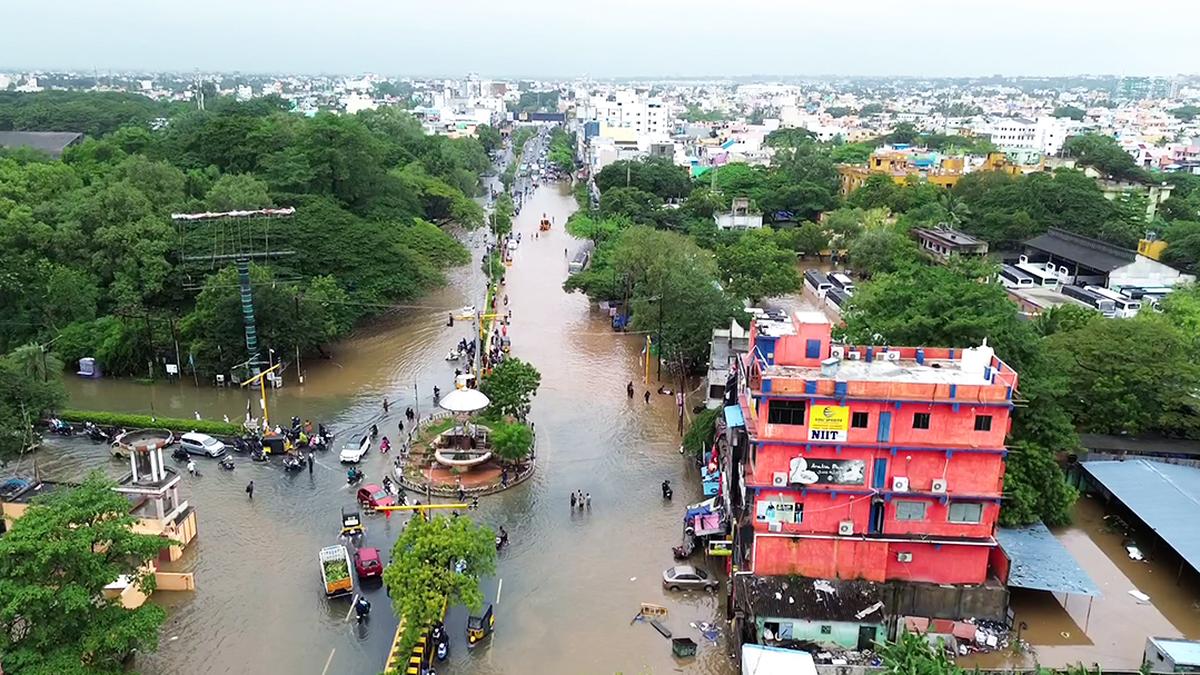
Heavy downpour: In Puducherry, Cyclone Fengal dumped 48.4 cm of rainfall in 24 hours.
| Photo Credit: ANI
Tropical cyclones rank among the most devastating natural phenomena, with the potential to inflict significant destruction and loss of life. While the North Indian Ocean basin experiences fewer cyclones compared to other regions, it remains highly susceptible to their impacts due to densely populated coastal areas. This vulnerability was tragically highlighted by the Bhola cyclone of 1970, the deadliest tropical cyclone on record. Observational evidence indicates shifts in the patterns, intensity, and frequency of tropical cyclones, underscoring the need for adaptive measures in vulnerable regions.
Climatologically, the Bay of Bengal experiences a higher frequency of tropical cyclones compared with the Arabian Sea. In recent years, there has been a 52% increase in the frequency of cyclonic storms in the Arabian Sea, alongside a threefold rise in the duration of very severe cyclonic storms. There is a greater likelihood of cyclonic storms intensifying into severe cyclonic storms. In the satellite era, the accumulated cyclone energy over the North Indian Ocean has shown an increasing trend. These trends are driven by environmental factors such as rising ocean heat content and decreasing vertical wind shear.
In future climate change scenarios, anthropogenic climate change is likely to fuel more powerful tropical cyclones. Additionally, the tropical cyclone precipitation rates are projected to rise, driven by increased atmospheric moisture associated with global warming. Ocean basins may also experience a higher frequency of rapid intensification events, a poleward migration of the latitude of maximum intensity, and a slowing of the forward motion of tropical cyclones.
The post-monsoon season of 2024 (October-December) was notably active, with as many as eight low-pressure systems forming over the North Indian Ocean. Among these, four intensified into depressions, and two further developed into cyclonic storms: Dana in October and Fengal in November. This heightened activity was attributed to above-normal sea surface temperatures and favourable atmospheric circulation including low vertical wind shear. Cyclone Dana significantly impacted Odisha and West Bengal, causing extensive damage. However, precise forecasts and effective disaster mitigation measures minimised the loss of human lives.
Cyclone Fengal created its place in history with its unusual trajectory and devastating impact on Tamil Nadu’s coastline. Emerging as a low-pressure area over the southeast Bay of Bengal on November 23, it made landfall near Puducherry on the night of November 30. Uniquely, the system stalled upon reaching the coast due to a rare balanced steering flow, allowing it to maintain its intensity even after landfall until the evening of December 1. This persistence was fuelled by abundant moisture from saturated coastal soils, already soaked by preceding rains. The stalling cyclone unleashed unprecedented rainfall, with several locations across Puducherry and Villupuram districts recording 40-50 cm in a single day. Neighbouring districts, including Cuddalore and Tiruvannamalai, also experienced torrential downpours exceeding 20 cm within 24 hours. The deluge submerged vast stretches of farmland, resulting in catastrophic losses for farmers and severely impacting local livelihoods.
The India Meteorological Department (IMD) has established an impressive track record for accurately predicting the track and landfall of tropical cyclones over the last decade. Despite this, Fengal presented significant forecasting challenges due to its unconventional track, variable speed, and intense rainfall during landfall. While IMD successfully predicted the landfall near Puducherry nearly three days in advance, certain aspects of the cyclone’s behaviour were difficult to forecast. For instance, its north-eastward movement on November 27 was not accurately predicted, and the slow progression or stalling near the coast also posed challenges.
More broadly, weather prediction models often struggle with forecasting the heavy rainfall associated with tropical cyclone landfalls, a limitation that was particularly evident in Fengal’s case. None of the prediction models accurately predicted the exceptional 24-hour rainfall totals exceeding 40 cm recorded in some areas. Limitations in observational data over oceans, and the complex cloud dynamics within the cyclone contribute to forecasting difficulties, necessitating continuous advancements in modeling techniques and real-time data assimilation. Two critical areas requiring further research are the prediction of tropical cyclone intensity, especially rapid intensification and forecasting of heavy rainfall associated with landfall. These challenges are becoming increasingly urgent as IPCC climate models project more intense cyclones, accompanied by heavier precipitation and slower translation speeds.
The post-monsoon cyclone activity of 2024 highlights the critical need for sustained investments in advanced forecasting technologies and research to address existing knowledge gaps. Despite significant progress, achieving precise tropical cyclone predictions remains a great challenge. It is imperative to prioritise measures that safeguard lives, livelihoods, and ecosystems from the devastating impacts of tropical cyclones.
(Madhavan Nair Rajeevan was former Secretary to the Government of India and presently the Vice Chancellor, Atria University, Bengaluru. Email: vc@atriauniveristy.edu.in)
Published – December 28, 2024 09:30 pm IST