





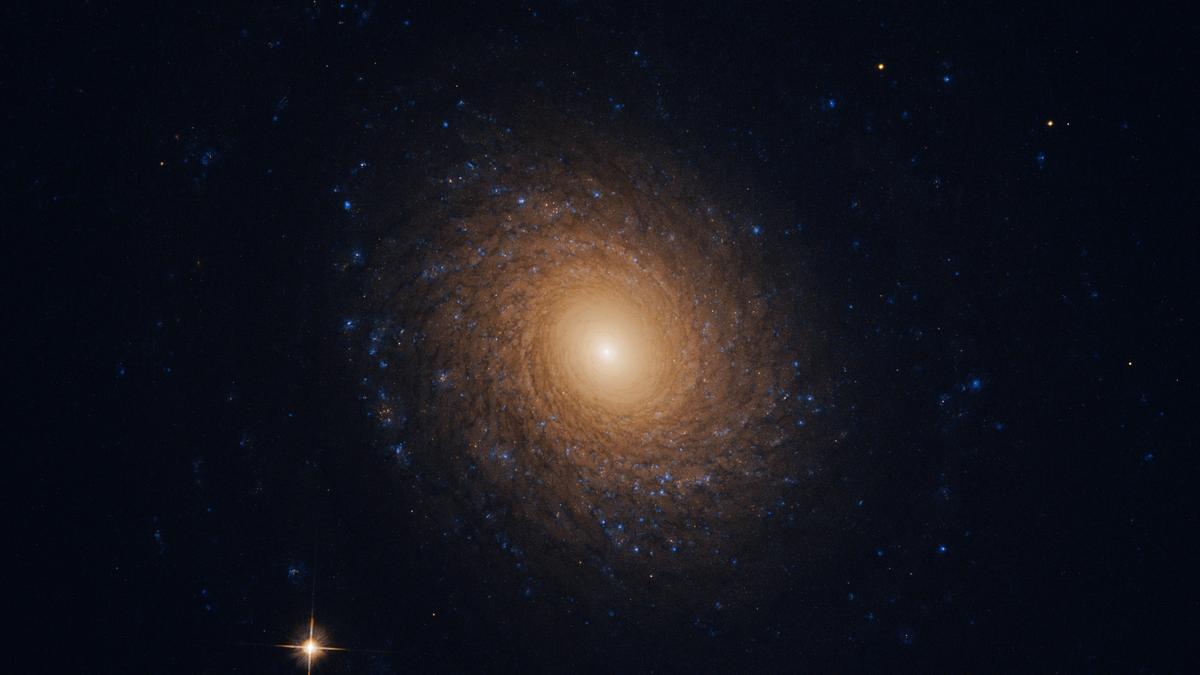
A Hubble Space Telescope view of the galaxy NGC2985. The evidence for dark matter emerged in the 1970s when astronomers found an unusual pattern in the rate at which stars in a galaxy rotated the farther they were from the centre.
| Photo Credit: Judy Schmidt/NASA
Dark matter is an enigmatic invisible substance supplying five-sixths of the matter of the universe. Unlike photons, the particles of light, the particles of dark matter need to have non-zero mass or else the dense and intricate structure of matter on cosmic scales will not form.
How light can a dark particle then be? For decades scientists thought this minimum mass was about 10-31 times the mass of a proton. But in May this year, theoretical physicists revised the limit and pushed it up by an order of magnitude, to 2.3 × 10⁻³⁰ proton masses. This is a significant update in the world of dark matter.

Uniformly or in lumps?
To understand these numbers and their importance, let us first build a mental picture of dark matter. Dark matter is said to be everywhere in the universe. Does that mean it is in your house? In 1922, Dutch astronomer Jacobus Kapteyn studied the motion of stars neighbouring the Sun and concluded the density of “dark matter” (using that term for one of the first times) must be 0.0003 solar masses per cubic light year.
Since then, through a century of increasingly sophisticated measurements, the accuracy of Kapteyn’s conclusion has held up remarkably well. This density of dark matter can be re-expressed as the heft of two protons per teaspoon, which means your house could contain dark matter with a mass equivalent of a trillion protons.
But this would also be naïve: Kapteyn’s and subsequent measurements are only valid when regarding the million-cubic-lightyear volume and doesn’t apply when we zoom in for a closer look. This is because stars, whose motion is used for the measurement, are themselves separated by a few light years. Whether or not dark matter is present on smaller length scales would depend on how it is distributed: either uniformly or in lumps.
An occasional visitor?
Let’s assume it is spread around like fine flour, which the standard theories of cosmology also predict. If it comes in lumps, the spacing between them may be as large as many light years and there will perhaps be no dark matter under your roof.
Now, since we know the local density of dark matter, the value of the unknown mass of the dark particle will determine the separation between two neighbouring particles. If it is 100 proton masses, the inter-particle separation will be 7 cm. Then dark particles at any given moment will not only be in your house but also in your head.
If dark matter is made of an elementary particle, the heaviest it can be is about 1019 times a proton’s mass. In that case the interparticle separation would be 30 km. So dark matter won’t be a resident of your house but will visit occasionally (since the particles travel randomly at around 300 km/s).
Then again, a 1020 gram agglomerate of dark particles would be apart by more than the size of the solar system, reducing our chance of discovering them.
Fluid rather than a flock
What about small masses? At 10-11 proton masses, every red blood cell in your body will contain a dark matter particle. But now quantum physics becomes important. Every object is also a wave, with its wavelength given by the inverse of its momentum. Thus the lighter a dark matter particle is, the larger its wavelength will be. For 10-11 proton masses, the wavelength will be about 2 cm, much larger than its micrometre interparticle separation.
So for small masses, we must picture a collection of dark particles as a fluid rather than as a flock of grains.
If we now dial the mass of a dark particle all the way down to 10-31 proton masses, the wavelength is 200 light years, about the size of a dwarf galaxy. The substance of a dwarf galaxy is chiefly in the form of dark matter, with only about 1% contribution from stars. This simple fact translates to a restriction on the dark matter particle’s mass: it must be greater than 10-31 proton masses. If it were lower, its spatial extent would exceed the dwarf galaxy and we can’t form a macroscopic object smaller than its microscopic constituents.

The time of computers
This is where the paper from May matters. Its authors have shown that this lore is too simplistic and that researchers can do something sharper. First, using data on how stars move in Leo II, a dwarf galaxy orbiting the Milky Way, they inferred the dark matter density in it as a function of the distance from its centre. This density profile isn’t unique due to measurement uncertainties, so they generate a set consistent with the stellar data. Next, they numerically solved the Schrödinger equation after modifying it to account for gravity and obtained an ensemble of density profiles. Finally, they carried out a statistical procedure to match the two sets of density profiles — the empirical one from observing Leo II and the theoretical one from solving the equation.
Their key finding here was that the inner regions of Leo II contained more invisible mass and which dark particles of 10-31 proton mass couldn’t account for. Thus they surmised heavier particles are needed to accommodate the inner crowding.
It’s not everyday that particle physics gets to redraw a fundamental goal post by an order of magnitude. And it is a sign of our times that this could only have been done with computers as opposed to a blackboard.
Nirmal Raj is an assistant professor of theoretical physics at the Centre for High Energy Physics in the Indian Institute of Science, Bengaluru. nraj@iisc.ac.in
Published – December 23, 2024 05:30 am IST