



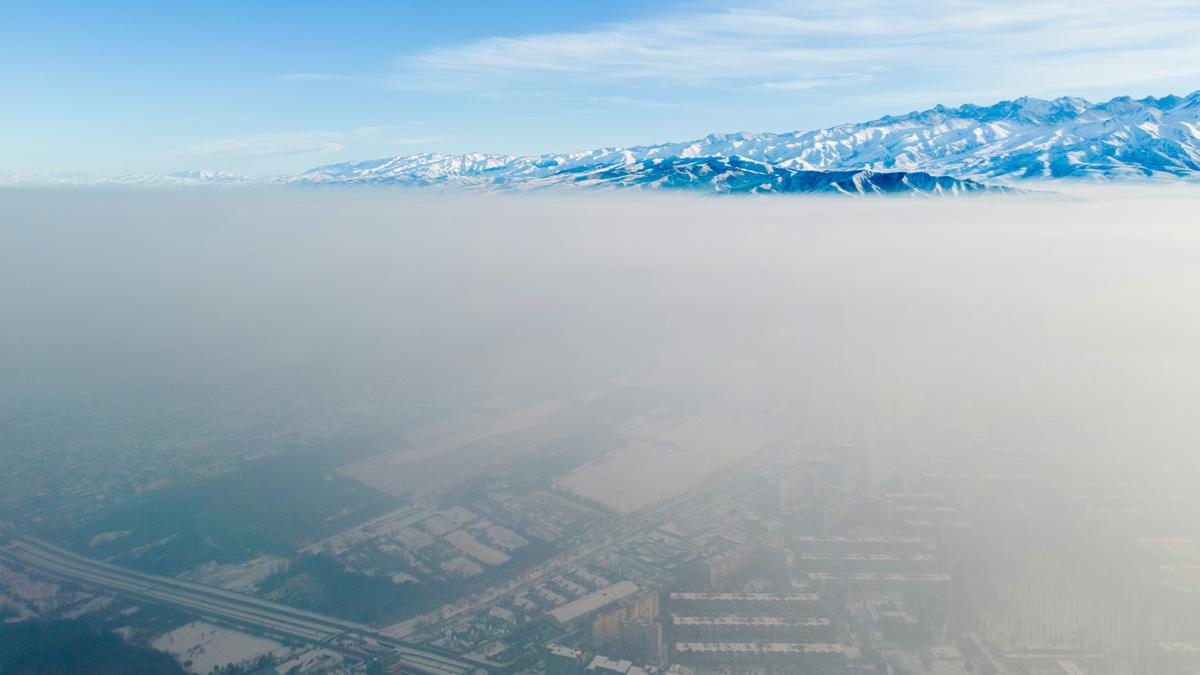
In winter, the temperature in Dras in Ladakh drops to -20º C, making it the coldest place in India. On the other side of the world, Fairbanks, the capital city of Alaska, holds a similar record in the U.S., its temperature hovering around -22.4º C in winter. But the two cities have drastically different air quality. Unlike Dras, where the air is remarkably healthy, Fairbanks is among the U.S.’s worst performing cities. One estimate ranked it tenth in a list of the country’s most air-polluted cities. Another ranked it first for particle pollution.
Particle pollution, also called ‘particulate matter’ (PM), is a mix of solid particles and liquid droplets suspended in the air. PM can be classified into two broad categories: PM10-2.5 and PM2.5. PM10-2.5 refers to particles whose diameter ranges between 2.5 and 10 micrometres (µm, equal to one millionth of a metre) and PM2.5 refers to particles that are less than 2.5 µm in diameter.
PM2.5 particles are also called ultrafine particles. They are considered to be particularly dangerous: they enter the lungs through the nose and throat; once in, they reduce lung function, aggravate asthma, and — for people with lung or heart disease — pave the way for premature death.
Pollution and temperature
In 2009, authorities from the Division of Air Quality in Alaska declared Fairbanks to be a “PM2.5 nonattainment area”: that is, the amount of PM2.5 in the city exceeded the limit of 35 µg per cubic metre of air. The main sources of these pollutants were identified to be emissions from wood stoves, the burning of distillate fuel oil, industrial sources, and automobiles, all of which also emit a large amount of sulphur dioxide.
To bring PM2.5 levels below the permissible limits, the Division in a 2022 directive banned the use of fuel with sulphur concentrations exceeding 1,000 parts per million in Fairbanks. Now, a study led by researchers from the University of Alaska Fairbanks and the Georgia Institute of Technology, both in the U.S., has found that the ban may not be entirely effective because the chemistry of PM2.5 particles changes in cold weather.
In their study, published in the journal Science Advanceson September 4, the researchers found that lower sulphate concentrations in air combined with low temperatures (around -35℃) made the PM particles less acidic. This in turn increased the production of hydroxymethanesulphonate — another component of PM2.5 — in the air.
Rodney J. Weber, a professor at the School of Earth and Atmospheric Sciences, Georgia Institute of Technology, and one of the corresponding authors of the study, told this reporter that the study’s findings have implications for the “effectiveness of emission controls to reduce pollution levels”.
Aerosol chemistry
In a 2022 study, James Campbell, the lead author of the current study and a doctoral scholar at the University of Alaska Fairbanks, showed that a large amount of hydroxymethanesulphonate formed during winters in Fairbanks when formaldehyde and sulphur dioxide reacted in the presence of liquid water.
Campbell’s finding was surprising because hydroxymethanesulphonate formation has been traditionally thought to occur in clouds and fog, not in aerosols, because the former have more liquid water.
Hydroxymethanesulphonate formation also requires more acidic conditions whereas the sulphite ions (SO32-) required for its formation are present in adequate amounts only when the air is less acidic. The higher density of water droplets in clouds and fog absorb more water-soluble gases, rendering them less acidic than most aerosols, the authors wrote in their paper.
What, then, explained the formation of large amounts of hydroxymethanesulphonate particles in Fairbanks during the winter?
To investigate, the researchers combined measurements obtained previously from the Alaskan Layered Pollution and Chemical Analysis (ALPACA) project with thermodynamic modelling. For the latter, they used computational models to calculate the amount of various ions and gases in aerosol particles in a given air mass.
Whither hydroxymethanesulphonate?
At very low temperatures, water typically freezes to ice. But sometimes, in a process called supercooling, the temperature of a liquid can drop well below its freezing point without it turning solid.
The researchers wrote in their paper that aerosol particles exist in a supercooled state during Fairbanks winters. As a result they contain liquid water, which allows hydroxymethanesulphonate to form within these particles. The researchers also reported that the acidity of aerosol particles in Fairbanks changes rapidly during the winter from low to high, making the conditions more favourable for the formation of hydroxymethanesulphonate.
The rapid shift in the acidity of PM2.5 in many places is largely the handiwork of the relative concentration of two ions: sulphate (SO24-) and ammonium (NH4+). Sulphate ions increase the acidity of aerosol particles while the latter, a base, neutralises the acidity. Two ammonium ions are required to neutralise the acidity contributed by each sulphate ion.
If there were to be an equal number of sulphate and ammonium ions in an aerosol particle, it would be more acidic. But since the 2022 ban on high-sulphur fuel in Fairbanks, the concentration of ammonium ions in PM2.5 particles increased relative to that of sulphate ions. This lowered the acidity.
Further, ammonium in aerosols can exist in its gaseous form, ammonia, and in its ionic form dissolved in the liquid water in the aerosol. In normal conditions, the two forms exist in equilibrium, where the rates of conversion of ammonium to ammonia and ammonia to ammonium are equal.
But since Fairbanks’s winters register very low temperatures, fewer ammonium ions are able to jump to the gaseous state. And as the concentration of ammonium ions within the aerosol particle builds up, its acidity drops further, making it a fertile site for hydroxymethanesulphonate production.

Relevance to the Global South
According to Prof. Weber, the Georgia Tech atmospheric scientist, the study’s results are “broadly applicable to cold regions, but also provide new insights into aerosol thermodynamics.”
Shahzad Gani, an assistant professor at the Centre for Atmospheric Sciences in IIT Delhi, told this reporter the study indexes a “major shift” in our understanding of how “secondary aerosol formation can happen in fine particles even in extremely cold, dark conditions.” Secondary aerosol refers to molecules like hydroxymethanesulphonate that are formed from parent molecules in chemical reactions.
“These findings have important implications for understanding how air quality-relevant aerosols form in extremely cold urban and industrial regions,” he added.
At the same time, he clarified the study’s relevance to “many areas of the Global South is limited, except for some high-altitude regions like the Andes or Himalayas.” He said he is looking forward to future research in other cold regions that could help validate the findings of the study and expand its implications to the Global South.
Meanwhile, he added, the study compels scientists to confront how temperature changes might affect chemical pathways related to air quality and climate, especially in a world that is being rapidly reshaped by global warming.
Sayantan Datta is a science journalist and a faculty member at Krea University.
Published – December 17, 2024 05:30 am IST