




Much like life itself, sport is all about innovation. Unlike life, it is also about making things more interesting, if not always better. Changing times demand adaptations, flexibility, the willingness to think out of the box and the courage to take a punt, even if it means displeasing the pundits and the connoisseurs, the traditionalists who frown upon modernism.
International cricket has embarked on a journey of twirls, if not twists, since the early 1970s. Until then, the only format in which countries clashed with each other was in the longer version. Timeless Tests were in vogue until 1939 and the start of World War II. In fact, between 1877, when the first Test was played, and 1939, there were 99 timeless Tests, of which two ended in draws owing to visiting teams having to catch a ship back home. The longest Test lasted eight days, Australia defeating England by five wickets at the Melbourne Cricket Ground in 1929.
It’s impossible now to even imagine a Test match lasting that long. Most games finish on day three, occasionally, a game drifts into the fourth day. Five-day finishes are a rarity and batathons even less so, maybe because batting techniques have transformed, maybe because the bowlers have become smarter, maybe because the influence of the limited-overs versions is a deterrent towards batting time and a pronounced onus on defence, which was the norm when not losing was considered more important than seeking victory.
The first limited-overs international was born out of necessity when the opening three days of the Australia-England Test at the MCG in January 1971 were washed out. The match was played across 40 overs per side, the hosts winning by five wickets.
Soon, these games became more frequent and the first men’s World Cup was played in England in 1975, across 60 overs. By then, the women had already contested a World Cup, also in England, in 1973. It took a decade for the matches to be standardised to 50 overs per side, and the one-day version was quickly assimilated into the cricketing ecosystem until the early 2000s, when the need for instant gratification and dwindling attendances at domestic matches in England led to the birth of the T20 revolution.
Instant appeal
The guarantee of a result in a little over three hours, the sight of the ball disappearing deep into the stands, of zing bails and flashing stumps, appealed instantly to the masses. Men and women, boys and girls, young and old, all thronged the venues and before long, the 20-over game spread its wings until finding a flourishing nesting place in India through the Indian Premier League. Soon, other variants surfaced – the T10, The Hundred in England…
Test cricket retained its core shape until November 2015, when Australia and New Zealand played the first day-night Test at the Adelaide Oval. The match was an unqualified hit. The prospect of a Test starting at 2.30 in the afternoon and going deep into the evening, with the final session played entirely under floodlights, appealed to the masses. The fast bowlers were energised, seeing as how much help there was for them in the last two hours. The batters were challenged, no longer able to just plonk their front foot down the track and hit through the line, an offshoot of the T20 diktat. And the fans loved it, the shiny pink ball with its pronounced black seam an instant object of attraction, mystery, intrigue.
Pink ball.
| Photo Credit:
Getty Images
Even at that early stage, it was evident that the day-night Test wouldn’t be a permanent stop on the calendar, it wouldn’t replace the red-ball, day game by any stretch of the imagination. Too many factors were stacked against that possibility, not least the prevalence of dew in many parts of the world and the fear that a distinct bias towards the ball would eventually put audiences off. And that’s how it has panned out, unsurprisingly.
In the last nine years, only 23 Tests have been played with a pink ball, the colour chosen because the authorities felt it was the closest variation of red they could arrive at without compromising on visibility issues.
The pink ball is harder than its red or white counterpart. It retains its shine for longer, because it has multiple layers of lacquer to ensure it doesn’t get discoloured easily or quickly. It therefore has a different feel to it and those who don’t play day-night Tests even once a year on an average find it a greater puzzle than those who do. Australia have played the most number of pink-ball Tests, 13, of which eight have been staged at the Adelaide Oval. With good reason, too.
Perfect record
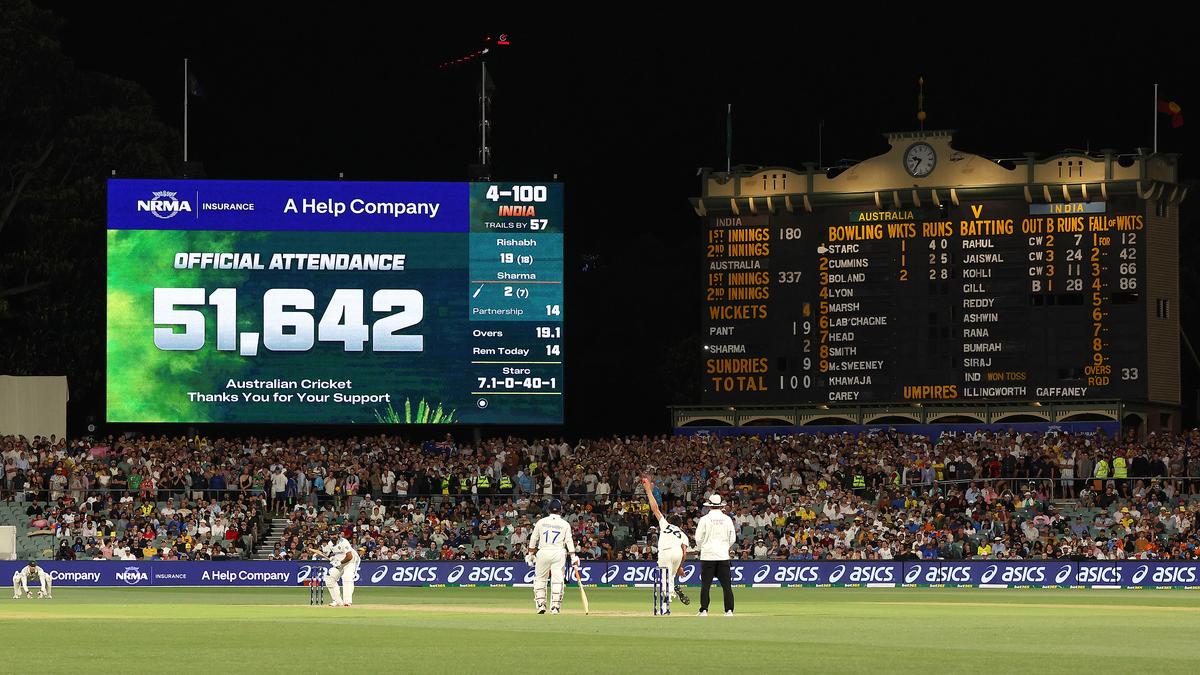
Sunday’s 10-wicket defeat of India extended Australia’s perfect record in day-night Tests at the Oval, where they have hardly been stretched. For India, it was their fifth tryst with the pink ball and only the second overseas. The previous too had been in Adelaide, in December 2020 when they were shot out for 36 in their second innings in natural light on the third morning, their lowest total in Test cricket but also the springboard for their astonishing fightback that earned them an epochal series triumph.
This particular Test lasted a little over 14 and a half hours and ended before the first long break on the third afternoon, yet it smashed several crowd records. Saturday’s day two attracted 51,642 fans, the third highest for a single day of Test cricket at the ground, this on the back of an official attendance of 50,186 the previous day. In all, the total match attendance was 135,012, comfortably the most for a match involving India at the Adelaide Oval, smashing the previous record of 113,009 in 2014-15 when, in his first game as Test captain in a stand-in capacity, Virat Kohli almost took India to a historic win with his second hundred of the game.
“It is clearly the most popular Test of our summer, the day-night game,” Greg Chappell, the former Australia captain and India coach, observed during a conversation with this writer on Saturday. “Just look at the number of people, the spectacle. It also challenges the batters more than other Tests, which isn’t necessarily a bad thing.”
The atmosphere in Adelaide in the lead-up to and during each day’s play – a pity that it only lasted two and a quarter days – was electric, to say the least. Fans trooped in from different parts of the country, a Friday start ensuring that the weekend party could begin organically.
The beeline towards the various stands was organised but purposeful, families trooping in alongside other demographic groups, kids doing their thing between watching the action, the elders helping themselves to beverages of various strength and hue throughout the afternoon and evening and getting more and more boisterous as the night skies darkened.
For India’s players, used to such atmospheres largely in T20 games, this must have been a fabulous experience even if they ended up on the wrong side of the result. For once, the support for the home team outnumbered that for the Indians – a far cry from even Perth and first Test, when it appeared as if the Indians were the hosts – which must have been an unusual situation to be in for most of the players.
Too much prep work
The pink ball doesn’t come without its challenges for the protagonists. It entails too much prep work for what generally is three or at best four days of play – only five of the 23 Tests have spilled over to day five – once a year in Australia’s case, and once in much longer for the Indians. Australian wicketkeeper Alex Carey, who played his maiden day-night Test, spoke of depth perception issues, Rohit Sharma alluded to the difficulties of sighting the pink ball against a white sightscreen without using it as an excuse for India’s batting collapses.
Two days before the Test, K.L. Rahul held forth on the difficulties several Indian batters encountered at the nets trying to pick the ball from the bowlers’ hand. None of them game-changing because, as Rohit pithily pointed out, professional cricketers are expected to adapt to various situations and asks from time to time, but not ideal from the players’ perspective. But no one was complaining – not the Indians, and certainly not the victorious Australians, who are quite the masters now of the pink-ball skirmish.
Wicked pleasure
Even the most harried batter will acknowledge, though, that there is a kind of wicked pleasure to be derived in the night session when the ball seams around as if possessed, transforming the most accomplished willow-wielder into a jumpy, sometimes nervy bundle of uncertainty, especially when the said harried batter is in the field watching his bowlers inflicting the damage.
In some ways, each day of the pink-ball Test is a day of two halves – the first sort of three hours or so when, in natural light, the ball doesn’t misbehave prodigiously, and then the twilight period segueing into the night when pink triggers the blues.
It’s enthralling, entrancing, mesmeric. It’s something that is hard to imagine unless you are at the ground, savouring the thrill, enjoying the atmosphere, soaking in the ambience, becoming one with the audience.
Its greatest charm lies in its novelty and that’s how it must remain. Test cricket exclusively under lights and only with a pink ball will be a stretch, but when it comes around once a year, sit back, relax and cherish it. After all, it truly is one of a kind.
Published – December 09, 2024 11:04 pm IST