



Scientists are constantly engineering new materials that exhibit exotic properties. Moiré materials are a deceptively simple.
Take a material made of a single type of atom, like a block of graphite. Slice off a thin layer from the top so that you have a two-dimensional sheet of carbon atoms bonded together (graphene). Place one sheet on top of another. Finally, twist the top sheet by a small angle.
You now have a moiré material.
These materials have unusual electronic and quantum properties. The one made of graphene has even been found to be a superconductor.
In a recent study in Nature, scientists reported that moiré materials made from semiconductor materials can also be superconducting, a property once considered to be exclusive to the graphene system.
Exploring why semiconductor moiré materials behave differently from graphene in terms of superconductivity is key to advancing our understanding of quantum materials. This in turn can pave the way for new materials with more unusual properties — and unusual applications.
The moiré pattern
The researchers explored superconductivity in twisted bilayer tungsten diselenide (tWSe₂), a moiré material created by stacking two layers of tungsten diselenide, a semiconductor, and rotating one layer by a small angle.
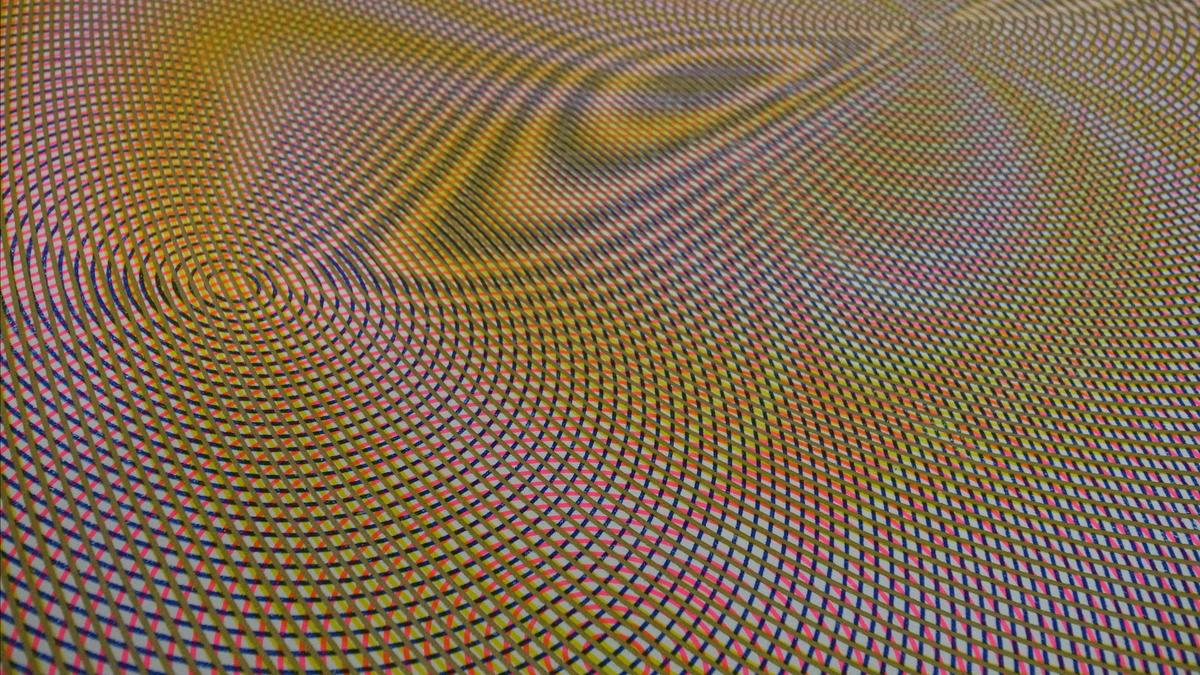
Even though the two layers of a moiré material have the same arrangement of atoms, the misalignment caused by the small twist produces a completely different pattern when seen from the top (see image above). This is called the moiré pattern.
In moiré materials, the moiré pattern gives rise to new behaviours that are not present in the individual 2D materials alone. This is because the twist leads to the formation of flat bands in the electronic structure of the material.
Flat bands to superconductivity
The electronic structure of a material describes how electrons in the material behave. The energy bands are a way to visualise the energy the electrons possess and how fast they move within the material.
Imagine the energy bands to be a ladder: each step (or band) represents the range of energies an electron can have. As you go up the ladder, the electron possesses more and more energy and momentum, meaning it will move faster.
A flat band means that the energy values of the electrons across the ladder are nearly constant, creating a flatregion within the band. In this scenario, all the electrons have the same energy, unlike in typical materials where the energy levels are spread out over a range.
Also in typical materials, electrons gain or lose kinetic energy when they move across different energy levels, which affects their speed and momentum. But in moiré materials, because the bands are flat, the electrons experience very little variation in energy.
As a result, the electrons move slowly and are said to be heavy. These slower-moving electrons are more likely to interact with each other, creating strong electron-electron interactions that aren’t seen in typical materials.
These interactions can lead to the formation of Cooper pairs, where two electrons pair up across a short distance and move around as a single unit. This pairing is central to the phenomenon of superconductivity. (Leon Cooper, for whom the pairs are named, passed away on October 23.)
Their coordinated movement helps them avoid scattering, a process where electrons collide with atoms or impurities in the material and deviate from their path, causing electrical resistance. On the other hand, Cooper pairs can travel through the material without scattering, leading to zero resistance and energy loss, and thus superconductivity.
The devil in the twist
The researchers used tWSe₂ with a twist angle of 3.65º to form a moiré material.
Then they examined how the electrons behaved when the material’s electronic states were half-filled, a configuration strongly associated with superconductivity in moiré materials. (These states refer to the steps on the energy ladder: each state can accommodate a fixed number of electrons.)
They also examined the behaviour of the electrons when the energy gap between the sublattices within the material is small, since this influences the superconducting properties. Sublattices are smaller grids of groups of atoms within the material.
The researchers found that tWSe2 was a robust conductor with a transition temperature of around –272.93º C. The transition temperature is the critical value below which a material enters the superconducting state, exhibiting zero electrical resistance.
The temperature observed is on par with those found in high-temperature superconductors. Conventional superconductors transition at around –250º C.
The superconductivity in tWSe2 occurs precisely when the electronic states are half-filled. The team also found that the moiré material could transition to an insulating (non-conducting) state by altering the electronic properties of the material.
The material had a coherence length about 10-times longer than other moiré materials, meaning that its superconducting state is not fragile.
The study also revealed that superconductivity in the moiré material occurred only in certain regions, determined by the filling of the electronic states. In its non-superconducting state, tWSe2 had the properties of a strongly correlated metal, where the strong electron interactions play a pivotal role in determining the material’s overall behaviour.
Stability in unity
Previous research with tWSe2 has shown potential superconducting states, but it was unstable when researchers cycled it between room temperature and the transition temperature. The material couldn’t maintain its superconducting properties because it was unstable.
According to the new study, tWSe2 actually has a robust superconducting state — and one that’s different from how the property emerges in graphene-based moiré materials. For tWSe2, superconductivity is driven by electron-electron interactions and half-band filling, while graphene-based systems depend on flat bands and electron-lattice interactions.
As a result, while graphene-based systems become superconducting at higher temperatures, tWSe2 is more stable.
This study creates a new avenue to explore superconductivity in semiconductor-based systems. It also offers valuable insights into the material’s electronic structure changes when its 2D layers are twisted.
Tejasri Gururaj is a freelance science writer and journalist with a master’s degree in physics.
Published – November 28, 2024 05:30 am IST