


Skip to content
  • Facebook
  • X
  • Linkedin
  • WhatsApp
  • YouTube
  • Associate Journalism
  • About Us
  • Privacy Policy
  • 033-46046046
  • editor@artifex.news
Artifex.News

Artifex.News

Stay Connected. Stay Informed.

  • Breaking News
  • World
  • Nation
  • Sports
  • Business
  • Science
  • Entertainment
  • Lifestyle
  • Toggle search form
  • 4 Members Of Family Dead In Suspected Suicide-Murder Case In Kurukshetra
    4 Members Of Family Dead In Suspected Suicide-Murder Case In Kurukshetra Nation
  • Sri Lankan PM Dinesh Gunawardena meets Chinese President Xi Jinping
    Sri Lankan PM Dinesh Gunawardena meets Chinese President Xi Jinping World
  • Access Denied
    Access Denied Nation
  • Pakistan media, fans still awaiting visas for World Cup
    Pakistan media, fans still awaiting visas for World Cup Sports
  • Access Denied Sports
  • Asia Cup 2023: “It’s A Tough Match” – Shashi Tharoor Predicts India vs Pakistan Game Result
    Asia Cup 2023: “It’s A Tough Match” – Shashi Tharoor Predicts India vs Pakistan Game Result Sports
  • Mother Of Man Hit By Porsche Driven By Pune Teen
    Mother Of Man Hit By Porsche Driven By Pune Teen Nation
  • Access Denied Business
New moiré superconductor opens the door to new quantum materials

New moiré superconductor opens the door to new quantum materials

Posted on November 28, 2024 By admin


Scientists are constantly engineering new materials that exhibit exotic properties. Moiré materials are a deceptively simple.

Take a material made of a single type of atom, like a block of graphite. Slice off a thin layer from the top so that you have a two-dimensional sheet of carbon atoms bonded together (graphene). Place one sheet on top of another. Finally, twist the top sheet by a small angle.

You now have a moiré material.

These materials have unusual electronic and quantum properties. The one made of graphene has even been found to be a superconductor.

In a recent study in Nature, scientists reported that moiré materials made from semiconductor materials can also be superconducting, a property once considered to be exclusive to the graphene system.

Exploring why semiconductor moiré materials behave differently from graphene in terms of superconductivity is key to advancing our understanding of quantum materials. This in turn can pave the way for new materials with more unusual properties — and unusual applications.

The moiré pattern

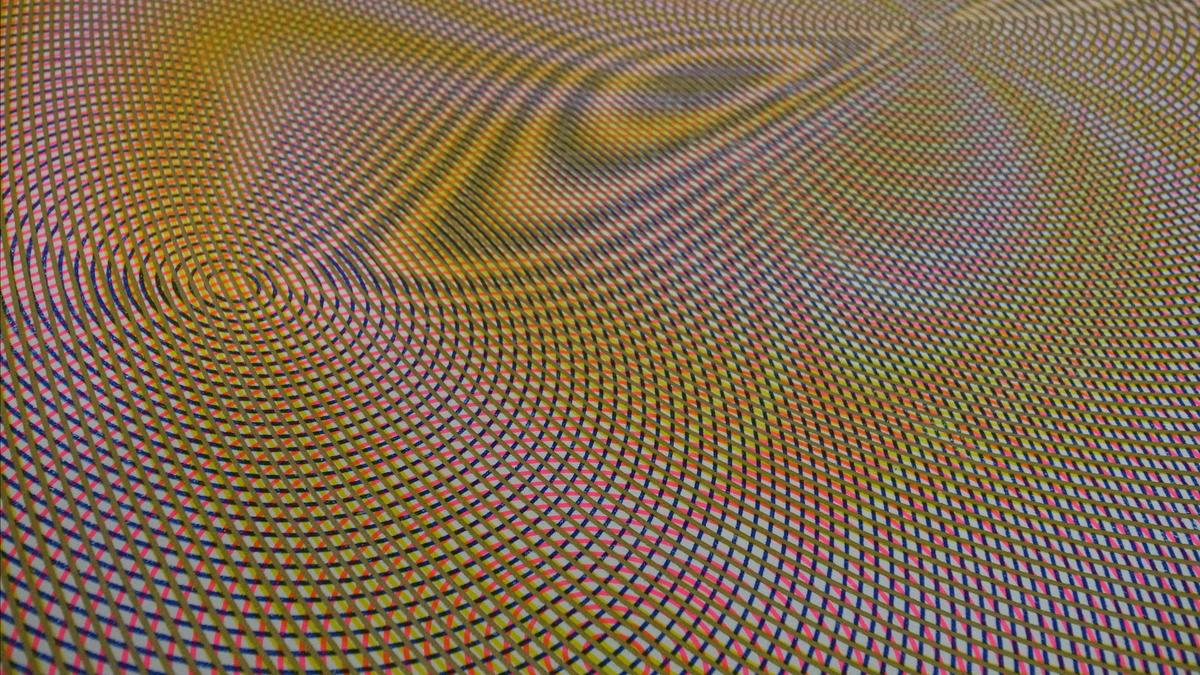
The researchers explored superconductivity in twisted bilayer tungsten diselenide (tWSe₂), a moiré material created by stacking two layers of tungsten diselenide, a semiconductor, and rotating one layer by a small angle.

Even though the two layers of a moiré material have the same arrangement of atoms, the misalignment caused by the small twist produces a completely different pattern when seen from the top (see image above). This is called the moiré pattern.

In moiré materials, the moiré pattern gives rise to new behaviours that are not present in the individual 2D materials alone. This is because the twist leads to the formation of flat bands in the electronic structure of the material.

Flat bands to superconductivity

The electronic structure of a material describes how electrons in the material behave. The energy bands are a way to visualise the energy the electrons possess and how fast they move within the material.

Imagine the energy bands to be a ladder: each step (or band) represents the range of energies an electron can have. As you go up the ladder, the electron possesses more and more energy and momentum, meaning it will move faster.

A flat band means that the energy values of the electrons across the ladder are nearly constant, creating a flatregion within the band. In this scenario, all the electrons have the same energy, unlike in typical materials where the energy levels are spread out over a range.

Also in typical materials, electrons gain or lose kinetic energy when they move across different energy levels, which affects their speed and momentum. But in moiré materials, because the bands are flat, the electrons experience very little variation in energy.

As a result, the electrons move slowly and are said to be heavy. These slower-moving electrons are more likely to interact with each other, creating strong electron-electron interactions that aren’t seen in typical materials.

These interactions can lead to the formation of Cooper pairs, where two electrons pair up across a short distance and move around as a single unit. This pairing is central to the phenomenon of superconductivity. (Leon Cooper, for whom the pairs are named, passed away on October 23.)

Their coordinated movement helps them avoid scattering, a process where electrons collide with atoms or impurities in the material and deviate from their path, causing electrical resistance. On the other hand, Cooper pairs can travel through the material without scattering, leading to zero resistance and energy loss, and thus superconductivity.

The devil in the twist

The researchers used tWSe₂ with a twist angle of 3.65º to form a moiré material.

Then they examined how the electrons behaved when the material’s electronic states were half-filled, a configuration strongly associated with superconductivity in moiré materials. (These states refer to the steps on the energy ladder: each state can accommodate a fixed number of electrons.)

They also examined the behaviour of the electrons when the energy gap between the sublattices within the material is small, since this influences the superconducting properties. Sublattices are smaller grids of groups of atoms within the material.

The researchers found that tWSe2 was a robust conductor with a transition temperature of around –272.93º C. The transition temperature is the critical value below which a material enters the superconducting state, exhibiting zero electrical resistance.

The temperature observed is on par with those found in high-temperature superconductors. Conventional superconductors transition at around –250º C.

The superconductivity in tWSe2 occurs precisely when the electronic states are half-filled. The team also found that the moiré material could transition to an insulating (non-conducting) state by altering the electronic properties of the material.

The material had a coherence length about 10-times longer than other moiré materials, meaning that its superconducting state is not fragile.

The study also revealed that superconductivity in the moiré material occurred only in certain regions, determined by the filling of the electronic states. In its non-superconducting state, tWSe2 had the properties of a strongly correlated metal, where the strong electron interactions play a pivotal role in determining the material’s overall behaviour.

Stability in unity

Previous research with tWSe2 has shown potential superconducting states, but it was unstable when researchers cycled it between room temperature and the transition temperature. The material couldn’t maintain its superconducting properties because it was unstable.

According to the new study, tWSe2 actually has a robust superconducting state — and one that’s different from how the property emerges in graphene-based moiré materials. For tWSe2, superconductivity is driven by electron-electron interactions and half-band filling, while graphene-based systems depend on flat bands and electron-lattice interactions.

As a result, while graphene-based systems become superconducting at higher temperatures, tWSe2 is more stable.

This study creates a new avenue to explore superconductivity in semiconductor-based systems. It also offers valuable insights into the material’s electronic structure changes when its 2D layers are twisted.

Tejasri Gururaj is a freelance science writer and journalist with a master’s degree in physics.

Published – November 28, 2024 05:30 am IST


Source link

Science

Post navigation

Previous Post: Attacks on minorities in Bangladesh: Indian-American body urges Biden, Trump to intervene
Next Post: Joe Biden Preparing $725 Million Weapons Package For Ukraine: Report

Related Posts

  • Scientists pen letter to Principal Scientific Adviser demanding ‘transparency’ on Vigyan Puraskar
    Scientists pen letter to Principal Scientific Adviser demanding ‘transparency’ on Vigyan Puraskar Science
  • The Science Quiz | The psychology of colours
    The Science Quiz | The psychology of colours Science
  • TIDCO bets big on space sector, signs MoU with IN-SPACe
    TIDCO bets big on space sector, signs MoU with IN-SPACe Science
  • Indian Immunologicals rolls out India’s first gE deleted DIVA marker vaccine against IBR
    Indian Immunologicals rolls out India’s first gE deleted DIVA marker vaccine against IBR Science
  • SpaceX launches two lunar landers toward moon for U.S., Japanese companies
    SpaceX launches two lunar landers toward moon for U.S., Japanese companies Science
  • Webb Telescope Discovers Earliest-known ‘dead’ galaxy
    Webb Telescope Discovers Earliest-known ‘dead’ galaxy Science

More Related Articles

Fossils, genomes clash as scientists debate the mosquito’s origins Fossils, genomes clash as scientists debate the mosquito’s origins Science
How do hummingbirds drink nectar at frenetic speed? How do hummingbirds drink nectar at frenetic speed? Science
Pfizer reports patient death in Duchenne gene therapy study Pfizer reports patient death in Duchenne gene therapy study Science
Top climate scientist declares 2C climate goal ‘dead’ Top climate scientist declares 2C climate goal ‘dead’ Science
Climate, land-use change reduced flows in 70% of China’s river stations Climate, land-use change reduced flows in 70% of China’s river stations Science
Chunk of India’s forests ‘missing’ after 27-year-delay to file reports | Analysis Chunk of India’s forests ‘missing’ after 27-year-delay to file reports | Analysis Science
SiteLock

Archives

  • May 2026
  • April 2026
  • March 2026
  • February 2026
  • January 2026
  • December 2025
  • November 2025
  • October 2025
  • September 2025
  • August 2025
  • July 2025
  • June 2025
  • May 2025
  • April 2025
  • March 2025
  • February 2025
  • January 2025
  • December 2024
  • November 2024
  • October 2024
  • September 2024
  • August 2024
  • July 2024
  • June 2024
  • May 2024
  • April 2024
  • March 2024
  • February 2024
  • January 2024
  • December 2023
  • November 2023
  • October 2023
  • September 2023
  • August 2023
  • July 2023
  • June 2023
  • May 2023
  • April 2023
  • March 2023
  • February 2023
  • January 2023
  • December 2022
  • November 2022
  • October 2022
  • September 2022
  • August 2022
  • July 2022
  • June 2022
  • May 2022

Categories

  • Business
  • Nation
  • Science
  • Sports
  • World

Recent Posts

  • Iran war ‘not over,’ uranium must be removed: Netanyahu
  • Stock markets slip more than 1% as U.S. rejects Iran’s response to peace deal
  • Thailand’s former PM Thaksin released from prison
  • Australian tennis ‘true legend’ Anderson dies aged 91
  • Not wrong to give telecom powers to L-G as he is in charge of security: Jammu and Kashmir CM

Recent Comments

  1. Robertnof on UP Teacher Who Asked Students To Slap Muslim Classmate
  2. GarlandLex on UP Teacher Who Asked Students To Slap Muslim Classmate
  3. Williamdox on UP Teacher Who Asked Students To Slap Muslim Classmate
  4. CharlesVOX on UP Teacher Who Asked Students To Slap Muslim Classmate
  5. RaymondMuh on UP Teacher Who Asked Students To Slap Muslim Classmate
  • Not MS Dhoni, Virat Kohli Called Rohit Sharma A “Captain’s Nightmare”. R Ashwin Reveals Why
    Not MS Dhoni, Virat Kohli Called Rohit Sharma A “Captain’s Nightmare”. R Ashwin Reveals Why Sports
  • Daily Quiz: On Sir Donald Bradman
    Daily Quiz: On Sir Donald Bradman Sports
  • Here’s How To Do It Online
    Here’s How To Do It Online Nation
  • Access Denied World
  • T20 World Cup win: Kirti Azad slams Surya Kumar Yadav, Jay Shah for temple visit with trophy
    T20 World Cup win: Kirti Azad slams Surya Kumar Yadav, Jay Shah for temple visit with trophy Sports
  • Access Denied
    Access Denied Nation
  • Zambia find shows humans have built with wood for 476,000 years
    Zambia find shows humans have built with wood for 476,000 years Science
  • Access Denied
    Access Denied Nation

Editor-in-Chief:
Mohammad Ariff,
MSW, MAJMC, BSW, DTL, CTS, CNM, CCR, CAL, RSL, ASOC.
editor@artifex.news

Associate Editors:
1. Zenellis R. Tuba,
zenelis@artifex.news
2. Haris Daniyel
daniyel@artifex.news

Photograher:
Rohan Das
rohan@artifex.news

Artifex.News offers Online Paid Internships to college students from India and Abroad. Interns will get a PRESS CARD and other online offers.
Send your CV (Subjectline: Paid Internship) to internship@artifex.news

Links:
Associate Journalism
About Us
Privacy Policy

News Links:
Breaking News
World
Nation
Sports
Business
Entertainment
Lifestyle

Registered Office:
72/A, Elliot Road, Kolkata - 700016
Tel: 033-22277777, 033-22172217
Email: office@artifex.news

Editorial Office / News Desk:
No. 13, Mezzanine Floor, Esplanade Metro Rail Station,
12 J. L. Nehru Road, Kolkata - 700069.
(Entry from Gate No. 5)
Tel: 033-46011099, 033-46046046
Email: editor@artifex.news

Copyright © 2023 Artifex.News Newsportal designed by Artifex Infotech.