


Skip to content
  • Facebook
  • X
  • Linkedin
  • WhatsApp
  • YouTube
  • Associate Journalism
  • About Us
  • Privacy Policy
  • 033-46046046
  • editor@artifex.news
Artifex.News

Artifex.News

Stay Connected. Stay Informed.

  • Breaking News
  • World
  • Nation
  • Sports
  • Business
  • Science
  • Entertainment
  • Lifestyle
  • Toggle search form
  • SpaceX Polaris Dawn Crew Makes History With First-Ever Private Spacewalk
    SpaceX Polaris Dawn Crew Makes History With First-Ever Private Spacewalk World
  • Quiz: Lands kept apart, or together, by a sliver
    Quiz: Lands kept apart, or together, by a sliver Science
  • Manmohan Singh missed the reforms bus as PM: FM Nirmala Sitharaman
    Manmohan Singh missed the reforms bus as PM: FM Nirmala Sitharaman Business
  • Dushyant Chautala, Ex BJP Ally, Loses His Uchana Kalan Seat In Haryana Polls
    Dushyant Chautala, Ex BJP Ally, Loses His Uchana Kalan Seat In Haryana Polls Nation
  • Access Denied
    Access Denied Nation
  • Unseen Video Of Virat Kohli-Rohit Sharma Moment At Start Of T20 World Cup Final Is Viral
    Unseen Video Of Virat Kohli-Rohit Sharma Moment At Start Of T20 World Cup Final Is Viral Sports
  • Access Denied
    Access Denied Nation
  • Arsenal on the verge of Premier League title after beating Burnley
    Arsenal on the verge of Premier League title after beating Burnley Sports
 Is it possible to dig all the way through the earth to the other side?

 Is it possible to dig all the way through the earth to the other side?

Posted on November 26, 2024 By admin


When I was a kid, I liked to dig holes in my backyard in Cincinnati (in Ohio). My grandfather joked that if I kept digging, I would end up in China.

In fact, if I had been able to dig straight through the planet, I would have come out in the Indian Ocean, about 1,800 km west of Australia. That’s the antipode, or opposite point on the earth’s surface, from my town.

But I only had a garden spade to move the earth. When I hit rock, less than 1 m below the surface, I couldn’t go deeper.

Now, I’m a geophysicist and know a lot more about the earth’s structure. It has three main layers.

First: the outer skin, called the crust, is a very thin layer of light rock. Its thickness compared to the earth’s diameter is similar to how thick an apple’s skin is to its diameter. When I dug holes as a kid, I was scratching away at the very top of the earth’s crust.

Second: the mantle, which lies beneath the crust, is much thicker, like the flesh of the apple. It’s made of strong, heavy rock that flows up to a few inches per year as hotter rock rises away from the earth’s centre and cooler rock sinks toward it.

Third: the core, at the earth’s centre, is made of super-hot liquid and solid metal. Temperatures here are 2,500 to 5,200 degrees C.

The earth’s outer layers exert pressure on the layers underneath, and these forces increase steadily with depth, just as they do in the ocean – think of how pressure in your ears gets stronger as you dive deeper underwater.

That’s relevant for digging through the earth, because when a hole is dug or drilled, the walls along the sides of the hole are under tremendous pressure from the overlying rock, and also unstable because there’s empty space next to them. Stronger rocks can support bigger forces, but all rocks can fail if the pressure is great enough.

When digging a pit, one way to prevent the walls from collapsing inward under pressure is to make them less steep, so they slant outward like the sides of a cone. A good rule of thumb is to make the hole three times wider than its depth.

Unstable walls

The deepest open pit in the earth is the Bingham Canyon Mine in Utah, which was dug with excavators and explosives in the early 1900s to mine copper ore. The pit of the mine is 1.2 km deep and 4 km wide.

Since the mine is more than three times wider than it is deep and the walls are sloped, the pit’s walls are not too steep or unstable. Still, in 2013, one of the slopes collapsed, causing two huge landslides that released 145 million tons of crushed rock to the bottom of the pit. Luckily, no one was hurt, but the landslides caused hundreds of millions of dollars in damage.

Suppose you were to try digging through the earth, and that the planet was all solid. (We know that it’s not, but this is the simplest scenario.) The depth of a hole all the way through the planet would be equivalent to the earth’s diameter, which is just a name for a line that passes straight through the centre of a circle. So your hole would need to be about three times as wide as the diameter of the earth in order for it to be stable.

Clearly, this is an impossible task that would completely alter the planet’s shape.

Digging versus drilling

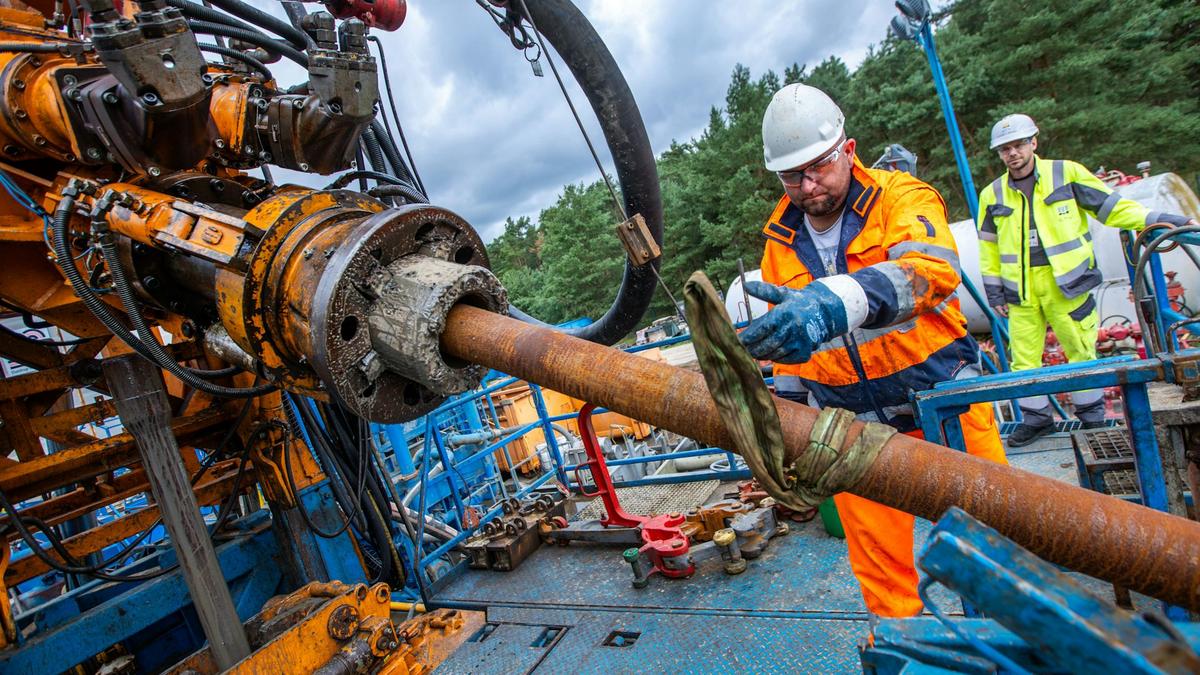
Drilling can go deeper more quickly than digging because less material needs to be moved, and the smaller surface area of a borehole can be engineered to withstand more force. Energy companies routinely drill as far as 5 km beneath the surface to find oil and gas.

The deepest hole in the earth is the Kola Superdeep Borehole in northwestern Russia, which extends 12.2 km deep. Deep boreholes like this one can tell scientists a lot about the earth’s interior. However, the Kola project was eventually abandoned due to drilling challenges, such as temperatures too hot for the equipment to function, equipment failures and high costs.

Drilling is a tedious process. A rotary drill bit at the end of a hollow, mud-filled pipe grinds rock, penetrating just a couple inches per minute for very hard rocks. Assuming steady progress at this rate, it would take hundreds of years to drill through the Earth.

As the bit drills deeper, it takes more time to replace broken parts. And the miles of drill pipe can become so heavy that they cannot be twisted or pulled out of the hole.

Pressure is also an issue. Borehole walls are under tremendous pressure and prone to failing. The slow movement of the earth’s mantle would eventually cause a borehole to bend and collapse. Magma, gases and liquid metal deep in the earth, under tremendous pressure, could explode upward through the borehole toward the surface.

Current drilling technologies just aren’t fast enough or durable enough to drill through the earth’s mantle and core. But we can still marvel at accomplishments like the Kola Superdeep Borehole and Bingham Canyon Mine, and dream of digging up rocks from even greater depths.

Andrew Gase is assistant professor of geoscience, Boise State University, Idaho, USA. This article is republished from The Conversation.

The Conversation

Published – November 26, 2024 02:21 pm IST



Source link

Science

Post navigation

Previous Post: PAN 2.0 Project: All you need to know
Next Post: Who Is DB Cooper? New Evidence May Finally Crack 53-Year-Old Hijacker Mystery

Related Posts

  • Why is red the colour of danger?
    Why is red the colour of danger? Science
  • Drogue parachute deployment tests for Gaganyaan mission successful: ISRO
    Drogue parachute deployment tests for Gaganyaan mission successful: ISRO Science
  • Sci-Five | The Hindu Science Quiz: On Radioactivity
    Sci-Five | The Hindu Science Quiz: On Radioactivity Science
  • Science Quiz: Unusual sources of energy
    Science Quiz: Unusual sources of energy Science
  • Science Quiz | The science of taste
    Science Quiz | The science of taste Science
  • Assam study sheds new light on sun’s surface tremors
    Assam study sheds new light on sun’s surface tremors Science

More Related Articles

Extreme heat threatens global food systems, UN agencies warn Extreme heat threatens global food systems, UN agencies warn Science
Arjuna asteroid 2025 PN7 is earth’s latest quasi-satellite Arjuna asteroid 2025 PN7 is earth’s latest quasi-satellite Science
DRDO achieves breakthrough in hypersonic missile development with long-duration scramjet test DRDO achieves breakthrough in hypersonic missile development with long-duration scramjet test Science
Things to know about the Nobel Prizes Things to know about the Nobel Prizes Science
Could quakes explain why gold nuggets are found in quartz veins? Could quakes explain why gold nuggets are found in quartz veins? Science
Possible pathway for Long COVID pathogenesis uncovered Possible pathway for Long COVID pathogenesis uncovered Science
SiteLock

Archives

  • September 2026
  • August 2026
  • July 2026
  • June 2026
  • May 2026
  • April 2026
  • March 2026
  • February 2026
  • January 2026
  • December 2025
  • November 2025
  • October 2025
  • September 2025
  • August 2025
  • July 2025
  • June 2025
  • May 2025
  • April 2025
  • March 2025
  • February 2025
  • January 2025
  • December 2024
  • November 2024
  • October 2024
  • September 2024
  • August 2024
  • July 2024
  • June 2024
  • May 2024
  • April 2024
  • March 2024
  • February 2024
  • January 2024
  • December 2023
  • November 2023
  • October 2023
  • September 2023
  • August 2023
  • July 2023
  • June 2023
  • May 2023
  • April 2023
  • March 2023
  • February 2023
  • January 2023
  • December 2022
  • November 2022
  • October 2022
  • September 2022
  • August 2022
  • July 2022
  • June 2022
  • May 2022

Categories

  • Business
  • Nation
  • Science
  • Sports
  • World

Recent Posts

  • Chandni Chowk’s Town Hall to be developed as ‘Global Heritage Centre’: CM
  • Missing measure in India’s magnet mission
  • Dengue cases in Tamil Nadu decline for third consecutive year as per government data
  • 3 dead, three missing in Nilambur flash flood
  • Meloni plans to ban burqas and niqabs in Italian schools, cap foreign students in classrooms

Recent Comments

  1. Josephjab on UP Teacher Who Asked Students To Slap Muslim Classmate
  2. LarryKef on UP Teacher Who Asked Students To Slap Muslim Classmate
  3. Jasonnekly on UP Teacher Who Asked Students To Slap Muslim Classmate
  4. Jasonnekly on UP Teacher Who Asked Students To Slap Muslim Classmate
  5. Frankenrib on UP Teacher Who Asked Students To Slap Muslim Classmate
  • Lando Norris Dominates Singapore Grand Prix To Cut Max Verstappen’s F1 Title Lead
    Lando Norris Dominates Singapore Grand Prix To Cut Max Verstappen’s F1 Title Lead Sports
  • Access Denied Sports
  • Gelephu Mindfulness City is a lifetime opportunity, says Bhutan PM Tshering Tobgay
    Gelephu Mindfulness City is a lifetime opportunity, says Bhutan PM Tshering Tobgay World
  • In-form India would be extremely difficult to beat in T20 WC: Michael Klinger
    In-form India would be extremely difficult to beat in T20 WC: Michael Klinger Sports
  • IND vs AUS fifth Test | India all out for 157, set Australia 162-run target
    IND vs AUS fifth Test | India all out for 157, set Australia 162-run target Sports
  • Stud Poker, Moonveil and Galahad catch the eye
    Stud Poker, Moonveil and Galahad catch the eye Sports
  • Russia says strike that wounded TV crew in Lebanon not ‘accidental’
    Russia says strike that wounded TV crew in Lebanon not ‘accidental’ World
  • What Are The Most Important Gold IRA Pros And Cons?
    What Are The Most Important Gold IRA Pros And Cons? Business

Editor-in-Chief:
Mohammad Ariff,
MSW, MAJMC, BSW, DTL, CTS, CNM, CCR, CAL, RSL, ASOC.
editor@artifex.news

Associate Editors:
1. Zenellis R. Tuba,
zenelis@artifex.news
2. Haris Daniyel
daniyel@artifex.news

Photograher:
Rohan Das
rohan@artifex.news

Artifex.News offers Online Paid Internships to college students from India and Abroad. Interns will get a PRESS CARD and other online offers.
Send your CV (Subjectline: Paid Internship) to internship@artifex.news

Links:
Associate Journalism
About Us
Privacy Policy

News Links:
Breaking News
World
Nation
Sports
Business
Entertainment
Lifestyle

Registered Office:
72/A, Elliot Road, Kolkata - 700016
Tel: 033-22277777, 033-22172217
Email: office@artifex.news

Editorial Office / News Desk:
No. 13, Mezzanine Floor, Esplanade Metro Rail Station,
12 J. L. Nehru Road, Kolkata - 700069.
(Entry from Gate No. 5)
Tel: 033-46011099, 033-46046046
Email: editor@artifex.news

Copyright © 2023 Artifex.News Newsportal designed by Artifex Infotech.