

Skip to content
  • Facebook
  • X
  • Linkedin
  • WhatsApp
  • Associate Journalism
  • About Us
  • Privacy Policy
  • 033-46046046
  • editor@artifex.news
Artifex.News

Artifex.News

Stay Connected. Stay Informed.

  • Breaking News
  • World
  • Nation
  • Sports
  • Business
  • Science
  • Entertainment
  • Lifestyle
  • Toggle search form
  • President launches India’s first homegrown CAR T-cell therapy for cancer treatment, calls it ‘new hope’ Science
  • 2 Killed, 8 Passengers Injured In Road Accident In UP’s Ayodhya: Cops Nation
  • Jaiswal among ICC Men’s Player of the Month nominees for February Sports
  • Ukraine Says Destroyed Russian Military Boat In Black Sea World
  • Hurricane Norma makes landfall near resorts of Los Cabos on Mexico’s Baja California peninsula World
  • Army After Rahul Gandhi’s Claim Nation
  • Sachin Tendulkar Congratulates Spanish Tennis Star Carlos Alcaraz For Winning Wimbledon 2024 Sports
  • Sandeshkhali, West Bengal: “Trinamool Government Has Surpassed CPM’s Rule In Atrocities”: BJP on Sandeshkhali Nation

Scientists uncover a magnetic misunderstanding about Uranus

Posted on November 12, 2024 By admin


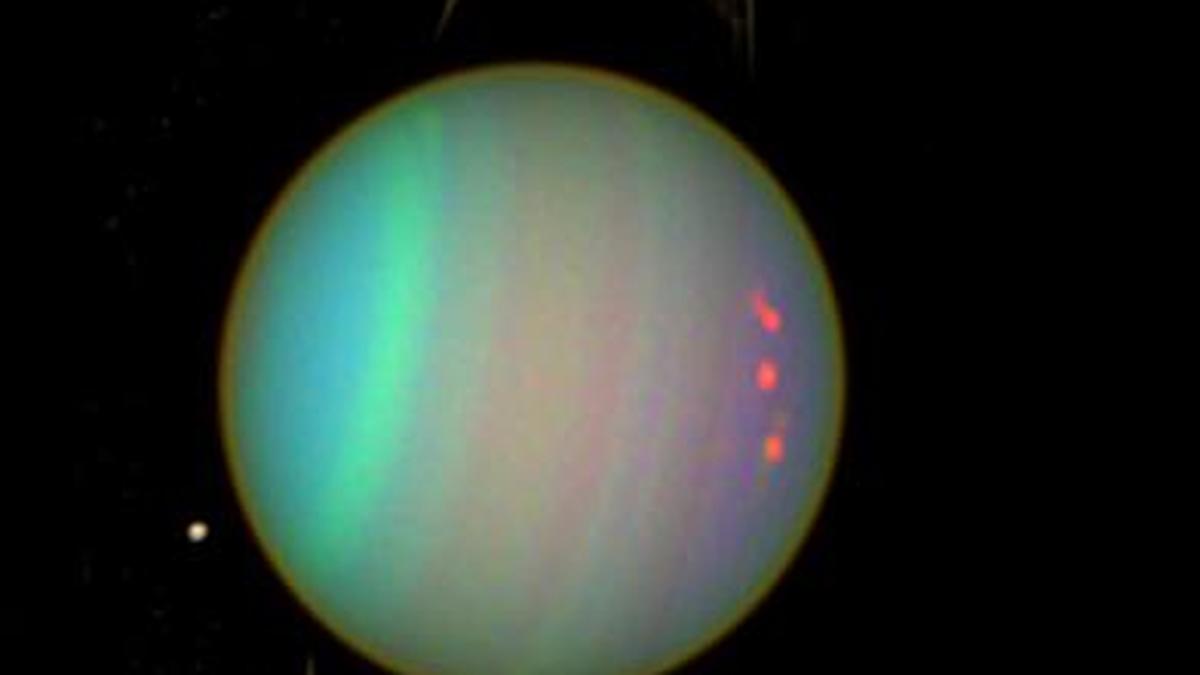
This NASA Hubble Space Telescope Advanced Camera for Surveys image, released on January 22, 2004, of Uranus reveals the planet’s faint rings and several of its satellites.
| Photo Credit: AFP/NASA

In 1781, German-born British astronomer William Herschel made Uranus the first planet discovered with the aid of a telescope. This frigid planet, our solar system’s third largest, remains a bit of an enigma 243 years later. And some of what we thought we knew about it turns out to be off the mark.

Much of the knowledge about Uranus was gleaned when NASA’s robotic spacecraft Voyager 2 conducted a five-day flyby in 1986. But scientists have now discovered that the probe visited at a time of unusual conditions – an intense solar wind event – that led to misleading observations about Uranus, and specifically its magnetic field.

The solar wind is a high-speed flow of charged particles emanating from the sun. The researchers took a fresh look at eight months of data from around the time of Voyager 2’s visit and found that it encountered Uranus just a few days after the solar wind had squashed its magnetosphere – the planet’s protective magnetic bubble – to about 20% of its usual volume.

“We found that the solar wind conditions present during the flyby only occur 4% of the time. The flyby occurred during the maximum peak solar wind intensity in that entire eight-month period,” said space plasma physicist Jamie Jasinski of NASA’s Jet Propulsion Laboratory, lead author of the study published on Monday in the journal Nature Astronomy.

“We would have observed a much bigger magnetosphere if Voyager 2 had arrived a week earlier,” Jasinski said.

Such a visit likely would have shown that the Uranus magnetosphere is similar to those of Jupiter, Saturn and Neptune, the solar system’s other giant planets, the researchers said. A magnetosphere is a region of space surrounding a planet where the planet’s magnetic field dominates, creating a protective zone against solar and cosmic particle radiation.

The Voyager 2 observations left a misimpression about the magnetosphere of Uranus as lacking in plasma and possessing uncommonly intense belts of highly energetic electrons.

Plasma – the fourth state of matter after solids, liquids and gases – is a gas whose atoms have been split into high-energy subatomic particles. Plasma is a common feature in the magnetosphere of other planets so its low concentration observed around Uranus was puzzling.

“The plasma environment of any planetary magnetosphere is usually formed of plasma from the solar wind, plasma from any moons present inside the magnetosphere and plasma from the atmosphere of the planet,” Jasinski said.

“At Uranus, we did not see plasma from the solar wind or from the moons. And the plasma that was measured was very tenuous,” Jasinski said.

Uranus, blue-green in color due to the methane contained in an atmosphere comprised mostly of hydrogen and helium, has a diameter of about 31,500 miles (50,700 km). It is big enough to fit 63 Earths inside it. Among the solar system’s eight planets, only Jupiter and Saturn are larger.

Its unusual tilt makes Uranus appear to orbit the sun like a rolling ball. Uranus, which orbits almost 20 times further from the sun than Earth does, has 28 known moons and two sets of rings.

The Voyager 2 observations had suggested that its two largest moons – Titania and Oberon – often orbit outside the magnetosphere. The new study indicates they tend to stay inside the protective bubble, making it easier for scientists to magnetically detect potential subsurface oceans.

“Both are thought to be prime candidates for hosting liquid water oceans in the Uranian system due to their large size relative to the other major moons,” Jet Propulsion Laboratory planetary scientist and study co-author Corey Cochrane said.

Scientists are eager to learn whether subsurface oceans on moons in the outer solar system have conditions suitable to support life. NASA on Oct. 14 launched a spacecraft on a mission to Jupiter’s moon Europa to address that very question.

“A future mission to Uranus is crucial to understanding not only the planet and magnetosphere, but also its atmosphere, rings and moons,” Jasinski said.

Published – November 12, 2024 08:36 am IST


Source link

Science

Post navigation

Previous Post: Israeli ministers send mixed signals over Lebanon ceasefire
Next Post: Aston Villa’s Morgan Rogers Receives First England Call-Up After Mass Withdrawal

Related Posts

  • How do SIM cards work? | Explained Science
  • Nipah infection possible in more places in Southeast Asia, says Nature article Science
  • The Science Quiz | The Turkey-Syria earthquakes Science
  • Curcumin has no anti-inflammatory effect in rheumatoid arthritis, a trial shows Science
  • Year after Titan’s fatal dive, explorers vow to pursue ocean mysteries Science
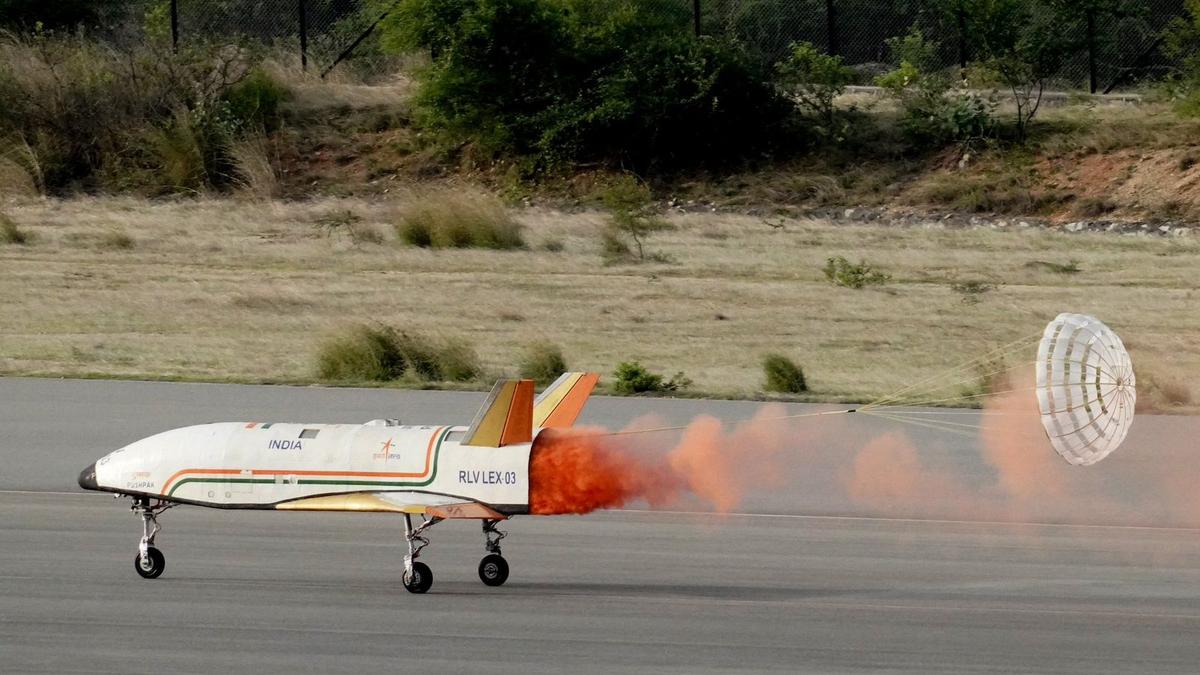
  • ISRO successfully conducts third and final ‘Pushpak’ Reusable Launch Vehicle landing experiment Science

More Related Articles

Ancient genomes reveal legacies of human sacrifice and mediaeval epidemics Science
Send robots into space rather than people, says Britain’s Astronomer Royal Science
Is placental oxygen level linked to foetal brain development? Science
How an Indian can go to space for just $2.50 Science
Earliest-known galaxy, spotted by Webb telescope, is a beacon to cosmic dawn Science
Explained | What the fate of Luna 25 means for Russia Science
SiteLock

Archives

  • November 2024
  • October 2024
  • September 2024
  • August 2024
  • July 2024
  • June 2024
  • May 2024
  • April 2024
  • March 2024
  • February 2024
  • January 2024
  • December 2023
  • November 2023
  • October 2023
  • September 2023
  • August 2023
  • July 2023
  • June 2023
  • May 2023
  • April 2023
  • March 2023
  • February 2023
  • January 2023
  • December 2022
  • November 2022
  • October 2022
  • September 2022
  • August 2022
  • July 2022
  • June 2022
  • May 2022

Categories

  • Business
  • Nation
  • Science
  • Sports
  • World

Recent Posts

  • “Always Be Tied To This Team”: Ex-CSK Star’s Wife’s Note After IPL Auction Drama
  • War-Hit Ukraine Sees Influx Of Western War Tourists
  • Canada is already examining tariffs on certain U.S. items following Trump’s tariff threat
  • Norway Diplomat On Adani Case
  • Rapper “Diddy” Denied Bail In Sex Trafficking, Racketeering Case

Recent Comments

  1. dfb{{98991*97996}}xca on UP Teacher Who Asked Students To Slap Muslim Classmate
  2. "dfbzzzzzzzzbbbccccdddeeexca".replace("z","o") on UP Teacher Who Asked Students To Slap Muslim Classmate
  3. 1}}"}}'}}1%>"%>'%> on UP Teacher Who Asked Students To Slap Muslim Classmate
  4. bfg6520<s1﹥s2ʺs3ʹhjl6520 on UP Teacher Who Asked Students To Slap Muslim Classmate
  5. pHqghUme9356321 on UP Teacher Who Asked Students To Slap Muslim Classmate
  • Shubman Gill-led new-look Team India lands in Harare for T20Is against Zimbabwe Sports
  • 16 Nobel Prize-winning economists say Trump policies will fuel inflation World
  • Cricket World Cup 2023: “Unfortunate What Happened…” – KL Rahul Provides Key Injury Update On Hardik Pandya Ahead Of England Clash Sports
  • Parthiv Patel Dismisses Hardik Pandya’s Test Comeback Rumours, Says “Practising With Red Ball Only Because…” Sports
  • On Ex Congress Leader Switching To BJP, Sachin Pilot Says… Nation
  • Farmer Leaders Give Rail Roko Call For March 10, To Reach Delhi On March 6 Nation
  • More than a dozen people feared dead in a massive fire at an apartment building in Hanoi World
  • Case Against Friend Of Woman Who Died While Reversing Car In Maharashtra Nation

Editor-in-Chief:
Mohammad Ariff,
MSW, MAJMC, BSW, DTL, CTS, CNM, CCR, CAL, RSL, ASOC.
editor@artifex.news

Associate Editors:
1. Zenellis R. Tuba,
zenelis@artifex.news
2. Haris Daniyel
daniyel@artifex.news

Photograher:
Rohan Das
rohan@artifex.news

Artifex.News offers Online Paid Internships to college students from India and Abroad. Interns will get a PRESS CARD and other online offers.
Send your CV (Subjectline: Paid Internship) to internship@artifex.news

Links:
Associate Journalism
About Us
Privacy Policy

News Links:
Breaking News
World
Nation
Sports
Business
Entertainment
Lifestyle

Registered Office:
72/A, Elliot Road, Kolkata - 700016
Tel: 033-22277777, 033-22172217
Email: office@artifex.news

Editorial Office / News Desk:
No. 13, Mezzanine Floor, Esplanade Metro Rail Station,
12 J. L. Nehru Road, Kolkata - 700069.
(Entry from Gate No. 5)
Tel: 033-46011099, 033-46046046
Email: editor@artifex.news

Copyright © 2023 Artifex.News Newsportal designed by Artifex Infotech.