




Skip to content
  • Facebook
  • X
  • Linkedin
  • WhatsApp
  • Associate Journalism
  • About Us
  • Privacy Policy
  • 033-46046046
  • editor@artifex.news
Artifex.News

Artifex.News

Stay Connected. Stay Informed.

  • Breaking News
  • World
  • Nation
  • Sports
  • Business
  • Science
  • Entertainment
  • Lifestyle
  • Toggle search form
  • India vs Bangladesh: Groundsman’s Gesture For Virat Kohli Ahead Of Kanpur Test Goes Viral. Watch Sports
  • Germany bans group accused of Iran links and Hezbollah support, carries out raids World
  • Assam Rifles Says Power Outage At Posts After Row With Mizoram Minister Nation
  • “Pace Is In My Mind But…”: India’s 156.7 Kmph Pace Sensation Reveals Key To Succeed In International Cricket Sports
  • India to increases grants by 50% for community development projects in Sri Lanka: Official World
  • Did Umpires Cost RCB 2 Runs vs KKR? Fans Claim So, With Video Evidence Sports
  • In New Faux Pas, Mani Shankar Aiyar Says “Alleged” 1962 Chinese Invasion Nation
  • Eminent technology experts from India named to new AI advisory body announced by UN Secretary-General World

Astronomers just found complex carbon molecules in space – a step closer to deciphering the origins of life

Posted on October 30, 2024 By admin


A team led by researchers at MIT in the United States has discovered large molecules containing carbon in a distant interstellar cloud of gas and dust.
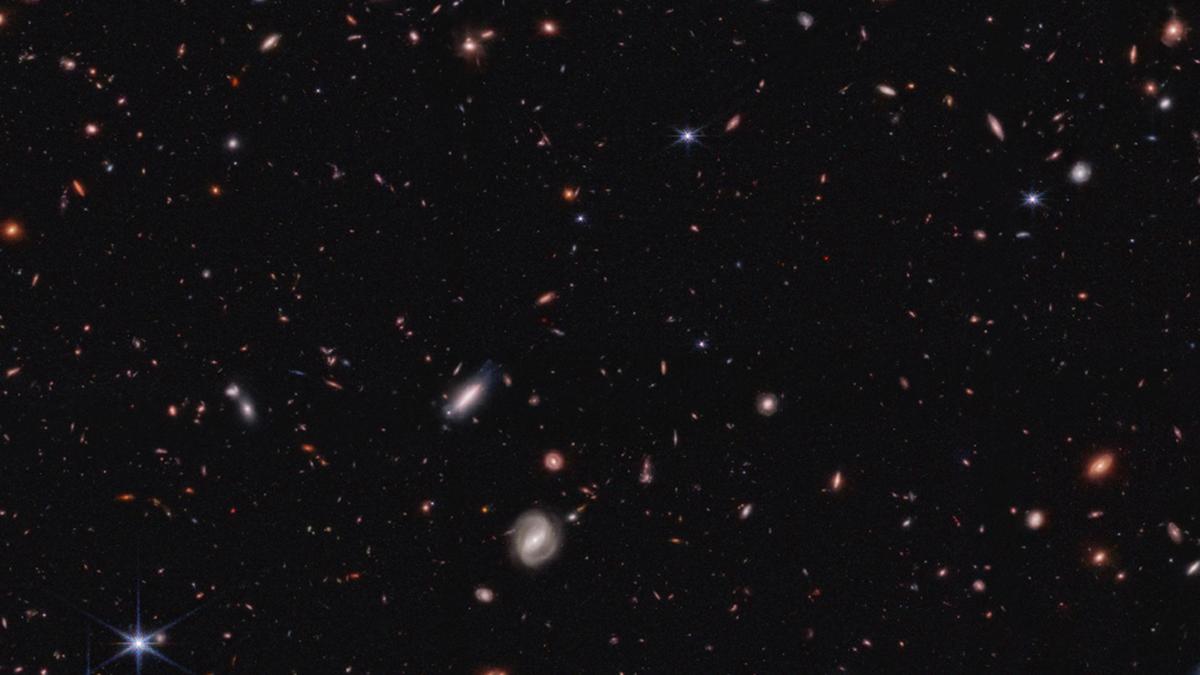
| Photo Credit: Space Telescope Science Institute Office of Public Outreach

A team led by researchers at MIT in the United States has discovered large molecules containing carbon in a distant interstellar cloud of gas and dust.

This is exciting for those of us who keep lists of known interstellar molecules in the hope that we might work out how life arose in the universe.

But it’s more than just another molecule for the collection. The result, reported today in the journal Science, shows that complex organic molecules (with carbon and hydrogen) likely existed in the cold, dark gas cloud that gave rise to our Solar System.

Furthermore, the molecules held together until after the formation of Earth. This is important for our understanding of the early origins of life on our planet.

Difficult to destroy, hard to detect

The molecule in question is called pyrene, a polycyclic aromatic hydrocarbon or PAH for short. The complicated-sounding name tells us these molecules are made of rings of carbon atoms.

Carbon chemistry is the backbone of life on Earth. PAHs have long been known to be abundant in the interstellar medium, so they feature prominently in theories of how carbon-based life on Earth came to be.

We know there are many large PAHs in space because astrophysicists have detected signs of them in visible and infrared light. But we didn’t know which PAHs they might be in particular.

Pyrene is now the largest PAH detected in space, although it’s what is known as a “small” or simple PAH, with 26 atoms. It was long thought such molecules could not survive the harsh environment of star formation when everything is bathed in radiation from the newborn suns, destroying complex molecules.

In fact, it was once thought molecules of more than two atoms could not exist in space for this reason, until they were actually found. Also, chemical models show pyrene is very difficult to destroy once formed.

Last year, scientists reported they found large amounts of pyrene in samples from the asteroid Ryugu in our own Solar System. They argued at least some of it must have come from the cold interstellar cloud that predated our Solar System.

So why not look at another cold interstellar cloud to find some? The problem for astrophysicists is that we don’t have the tools to detect pyrene directly – it’s invisible to radio telescopes.

Using a tracer

The molecule the team has detected is called 1-cyanopyrene, what we call a “tracer” for pyrene. It is formed from pyrene interacting with cyanide, which is common in interstellar space.

The researchers used the Green Bank Telescope in West Virginia to look at the Taurus molecular cloud or TMC-1, in the Taurus constellation. Unlike pyrene itself, 1-cyanopyrene can be detected by radio telescopes. This is because 1-cyanopyrene molecules act as small radio-wave emitters – tiny versions of earthly radio stations.

As scientists know the proportions of 1-cyanopyrene compared to pyrene, they can then estimate the amount of pyrene in the interstellar cloud.

The amount of pyrene they found was significant. Importantly, this discovery in the Taurus molecular cloud suggests a lot of pyrene exists in the cold, dark molecular clouds that go on to form stars and solar systems.

The complex birth of life

We are gradually building a picture of how life on Earth evolved. This picture tells us that life came from space – well, at least the complex organic, pre-biological molecules needed to form life did.

That pyrene survives the harsh conditions associated with the birth of stars, as shown by the findings from Ryugu, is an important part of this story.

Simple life – consisting of a single cell – appeared in Earth’s fossil record almost immediately (in geological and astronomical terms) after the planet’s surface had cooled enough to not vaporise complex molecules. This happened more than 3.7 billion years ago in Earth’s approximately 4.5 billion history.

For simple organisms to then appear so quickly in the fossil record, there’s just not enough time for chemistry to start with mere simple molecules of two or three atoms.

The new discovery of 1-cyanopyrene in the Taurus molecular cloud shows complex molecules could indeed survive the harsh conditions of our Solar System’s formation. As a result, pyrene was available to form the backbone of carbon-based life when it emerged on the early Earth some 3.7 billion years ago.

This discovery also links to another important finding of the last decade – the first chiral molecule in the interstellar medium, propylene oxide. We need chiral molecules to make the evolution of simple lifeforms work on the surface of the early Earth.

So far, our theories that molecules for early life on Earth came from space are looking good.

This article is republished from The Conversation under a Creative Commons license. Read the original article here.

Published – October 30, 2024 03:59 pm IST



Source link

Science Tags:astronomy news, carbon molecules in space, complex carbon molecules found in space, science news

Post navigation

Previous Post: Paul Scholes Warns Manchester United Not To Rush Into Ruben Amorim Appointment
Next Post: Rs 30 Crore Bid In IPL For Rishabh Pant? India Star Backed For Mega Offer Ahead of Retention Day Deadline

Related Posts

  • Daily Quiz, August 12, 2024: On Vikram Sarabhai’s life beyond ISRO Science
  • Hidden dangers of irrational use of antibiotics on microbiome Science
  • Tiny animals use stolen genes to fight infections – and could fight antibiotic resistance too Science
  • New breast cancer genes found in women of African ancestry, may improve risk assessment Science
  • Nature to retract major Ranga Dias superconductivity paper: reports Science
  • We are sharing state-of-the-art expertise with ISRO for Gaganyaan mission: French Space Agency Chief  Science

More Related Articles

The Science Quiz | The science of spice and vice versa Science
NASA spacecraft launched to mysterious and rare metal asteroid in first mission of its kind Science
Sci-Five | The Hindu Science Quiz: On Ozone Science
Mandyam Srinivasan of bee studies fame faces misconduct allegations Science
Can ‘good sounds’ help coral islands recover from bleaching? Science
Plastic-eating fungi could be glimmer of hope in cutting ocean pollution Science
SiteLock

Archives

  • October 2024
  • September 2024
  • August 2024
  • July 2024
  • June 2024
  • May 2024
  • April 2024
  • March 2024
  • February 2024
  • January 2024
  • December 2023
  • November 2023
  • October 2023
  • September 2023
  • August 2023
  • July 2023
  • June 2023
  • May 2023
  • April 2023
  • March 2023
  • February 2023
  • January 2023
  • December 2022
  • November 2022
  • October 2022
  • September 2022
  • August 2022
  • July 2022
  • June 2022
  • May 2022

Categories

  • Business
  • Nation
  • Science
  • Sports
  • World

Recent Posts

  • Ayodhya Sparkles With Over 25 Lakh Diyas On Deepotsav
  • CSK's 5 IPL Retentions CSK Revealed, Includes MS Dhoni. It Will Cost Rs…
  • U.S. presidential election 2024 | What matters to the Indian American voter?
  • Gold Prices Record High Of Rs 82,400 As Diwali Sparks Demand
  • U.S. presidential election 2024 | Hanging on to the American Dream

Recent Comments

  1. dfb{{98991*97996}}xca on UP Teacher Who Asked Students To Slap Muslim Classmate
  2. "dfbzzzzzzzzbbbccccdddeeexca".replace("z","o") on UP Teacher Who Asked Students To Slap Muslim Classmate
  3. 1}}"}}'}}1%>"%>'%> on UP Teacher Who Asked Students To Slap Muslim Classmate
  4. bfg6520<s1﹥s2ʺs3ʹhjl6520 on UP Teacher Who Asked Students To Slap Muslim Classmate
  5. pHqghUme9356321 on UP Teacher Who Asked Students To Slap Muslim Classmate
  • Cost of meals rose by 71% in five years, salaries by just 37%: Data Business
  • Manu Bhaker Criticised For Walking The Ramp At Lakme Fashion Week. Shooter’s Straight Response: “Haters Will Hate, Lovers Will…” Sports
  • Delhi Shop-Owner Kills Man For Not Purchasing Grocery From Him: Cops Nation
  • Gives India Next Level Deterrence Capability Nation
  • Senior Citizen Arrested For Sexually Abusing 3-Year-Old In Bengal’s Katwa Nation
  • Sharath Kamal, Manika Batra Headline India’s Table Tennis Squad For Asian Championships Sports
  • Rishi Sunak’s Battle Lines For UK Election Campaign: “Economy, Immigration” World
  • Bangladesh New Interim PM Muhammad Yunus Heads Home, To Be Sworn In Today World

Editor-in-Chief:
Mohammad Ariff,
MSW, MAJMC, BSW, DTL, CTS, CNM, CCR, CAL, RSL, ASOC.
editor@artifex.news

Associate Editors:
1. Zenellis R. Tuba,
zenelis@artifex.news
2. Haris Daniyel
daniyel@artifex.news

Photograher:
Rohan Das
rohan@artifex.news

Artifex.News offers Online Paid Internships to college students from India and Abroad. Interns will get a PRESS CARD and other online offers.
Send your CV (Subjectline: Paid Internship) to internship@artifex.news

Links:
Associate Journalism
About Us
Privacy Policy

News Links:
Breaking News
World
Nation
Sports
Business
Entertainment
Lifestyle

Registered Office:
72/A, Elliot Road, Kolkata - 700016
Tel: 033-22277777, 033-22172217
Email: office@artifex.news

Editorial Office / News Desk:
No. 13, Mezzanine Floor, Esplanade Metro Rail Station,
12 J. L. Nehru Road, Kolkata - 700069.
(Entry from Gate No. 5)
Tel: 033-46011099, 033-46046046
Email: editor@artifex.news

Copyright © 2023 Artifex.News Newsportal designed by Artifex Infotech.