

Skip to content
  • Facebook
  • X
  • Linkedin
  • WhatsApp
  • YouTube
  • Associate Journalism
  • About Us
  • Privacy Policy
  • 033-46046046
  • editor@artifex.news
Artifex.News

Artifex.News

Stay Connected. Stay Informed.

  • Breaking News
  • World
  • Nation
  • Sports
  • Business
  • Science
  • Entertainment
  • Lifestyle
  • Toggle search form
  • Access Denied Sports
  • Access Denied
    Access Denied Nation
  • Gaza Truce Talks On Amid Outcry Over Aid Workers’ Death
    Gaza Truce Talks On Amid Outcry Over Aid Workers’ Death World
  • City Union Bank eyes 16-17% growth in two years
    City Union Bank eyes 16-17% growth in two years Business
  • Israel-Hamas ceasefire LIVE updates: Israel and Hamas have agreed to a deal for a ceasefire in Gaza, hostage release
    Israel-Hamas ceasefire LIVE updates: Israel and Hamas have agreed to a deal for a ceasefire in Gaza, hostage release World
  • India Termed “Complacent” By Ex-Coach Ravi Shastri For Which It “Paid Heavy Price”
    India Termed “Complacent” By Ex-Coach Ravi Shastri For Which It “Paid Heavy Price” Sports
  • Canada, Justin Trudeau: “Was Threatened By Khalistanis In Canada”: Targeted Envoy To NDTV
    Canada, Justin Trudeau: “Was Threatened By Khalistanis In Canada”: Targeted Envoy To NDTV World
  • Congress’s Charanjit Channi Gets Poll Body Notice Over J&K Attack “Poll Stunt” Remark
    Congress’s Charanjit Channi Gets Poll Body Notice Over J&K Attack “Poll Stunt” Remark Nation
What are melanistic tigers? | Explained

What are melanistic tigers? | Explained

Posted on November 1, 2024 By admin


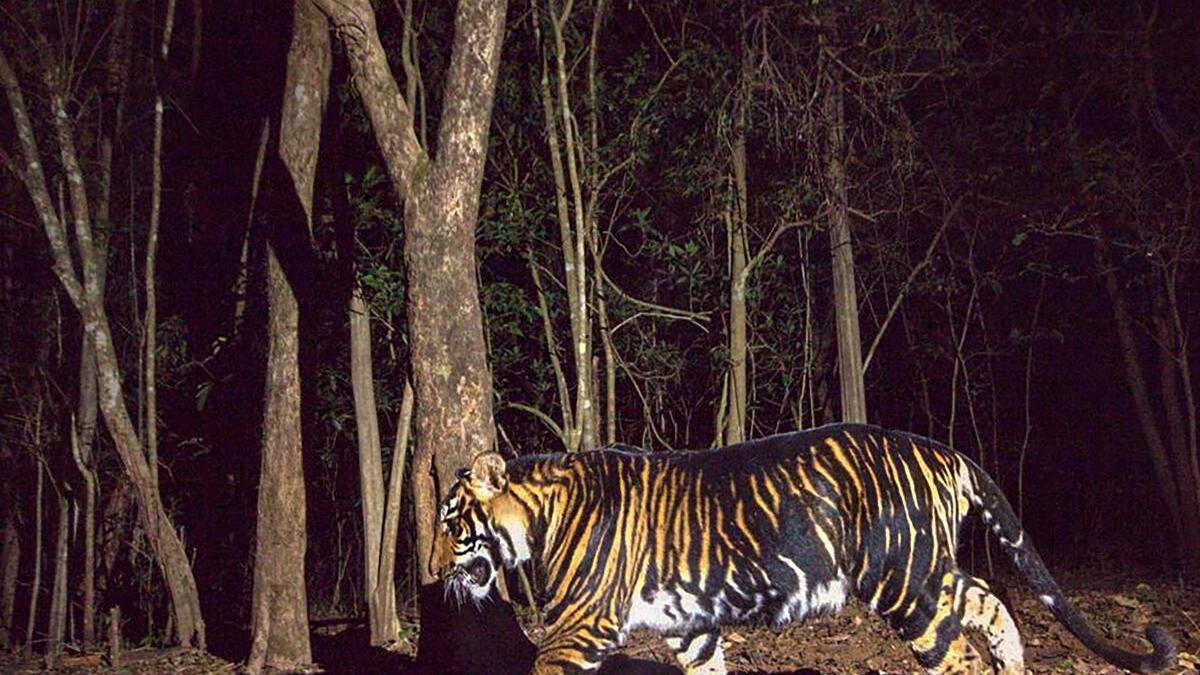
Melanistic tiger in Similipal of Odisha.
| Photo Credit: PTI

The story so far: A tigress from the Tadoba-Andhari Tiger Reserve, Maharashtra, was sent 800 km away to the Similipal Tiger Reserve on Sunday (October 28, 2024) so as to diversify the genetic pool of the tiger population in Odisha. She is part of a plan by the Odisha government to tackle inbreeding in the tiger population that has resulted in increasing numbers of the once elusive black tigers or pseudo-melanistic tigers. 

Aged two years and seven months, the tigress was released into an enclosure where she is kept for observation. She will be later released in the South Division of Similipal. 

According to Susant Nanda, Principal Chief Conservator of Forest (Wildlife), the presence of so many melanistic tigers in Similipal is not a cause of concern. However, he stressed that the tigress will bring in different genetic matter which would remedy the inbreeding situation.

What are pseudo-melanistic tigers?

As far as appearances go, pseudo-melanistic (pseudo: false; melanistic: dark coloured) tigers appear to have a black coat with white and orange stripes occasionally peaking through. Their pelt looks almost the inverse of a normal tiger. 

Till the 1700s, these tigers were considered mythical. One of the first pieces of evidence of a black tiger was a watercolour painting by a British artist and writer named James Forbes.
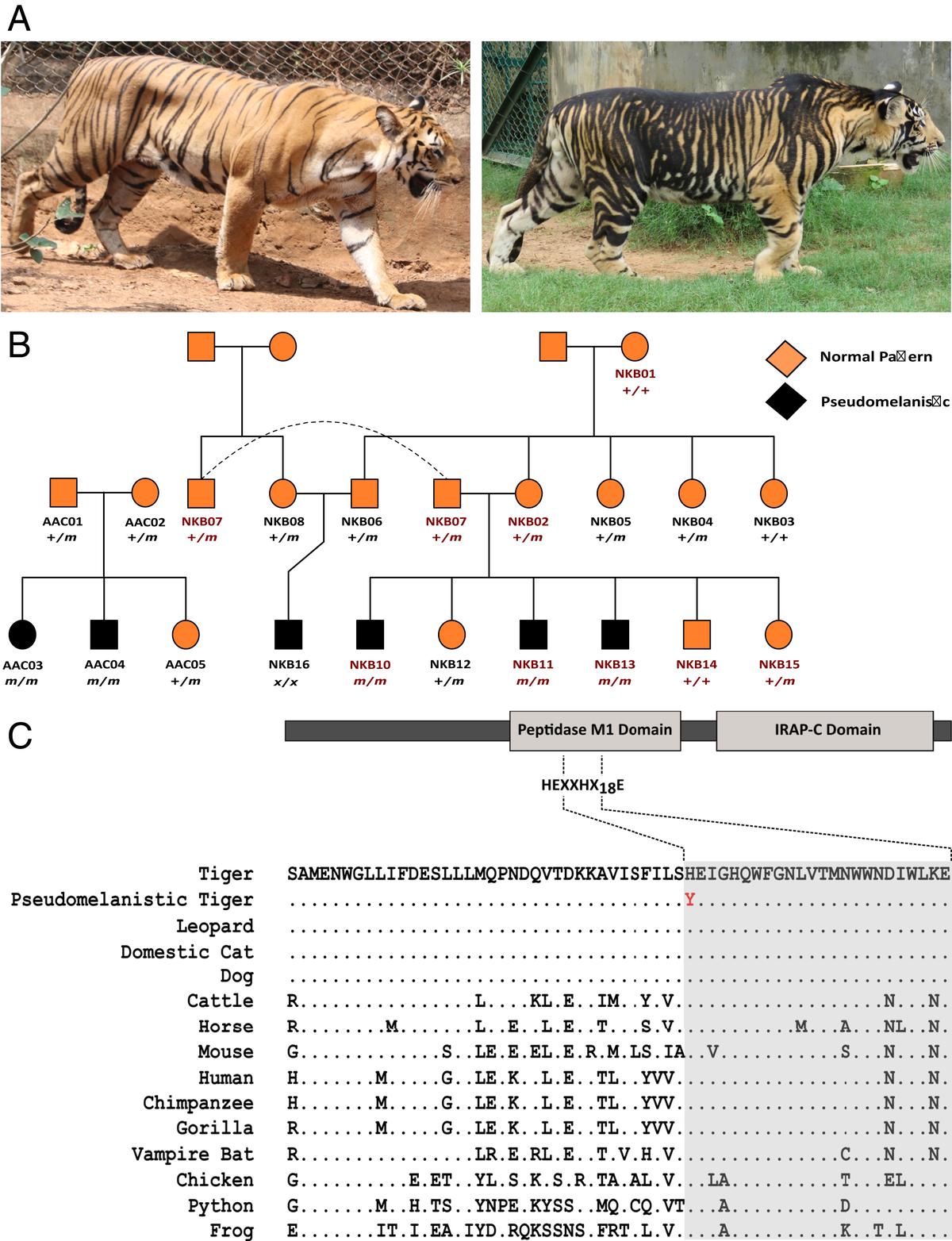
Identifying the genetic basis of pseudomelanism in captive tigers. (A) Normal tiger (Left) versus pseudomelanistic tiger (Right). An increase in the surface area of the coat covered by darker stripes gives the pseudomelanistic tiger a darker, blotchy appearance. (B) The pedigree of the captive tigers sampled for this study. 

Identifying the genetic basis of pseudomelanism in captive tigers. (A) Normal tiger (Left) versus pseudomelanistic tiger (Right). An increase in the surface area of the coat covered by darker stripes gives the pseudomelanistic tiger a darker, blotchy appearance. (B) The pedigree of the captive tigers sampled for this study. 
| Photo Credit:
Proceedings of the National Academy of Sciences

Even two centuries later, there were only sightings recorded by locals and British hunters. This is until 1970, when a tigress at the Oklahoma City Zoo gave birth to a cub with bizarre patterns. The cub was killed soon after by the mother. In the 1990s, an unusual tiger pelt was seized from poachers in New Delhi which finally confirmed the existence of this rare tiger.

The most recent sighting of the black tiger was in 2017-18 in the Similipal Tiger Reserve. 

How do the tigers get their colours?

The pseudo-melanistic tiger is a colour variant of the Bengal tiger. Its strange coat is a result of a mutation in a particular gene. This genetic quirk cause their stripes to widen and spread across the orange or tawny coat and at times give the appearance of being completely black.
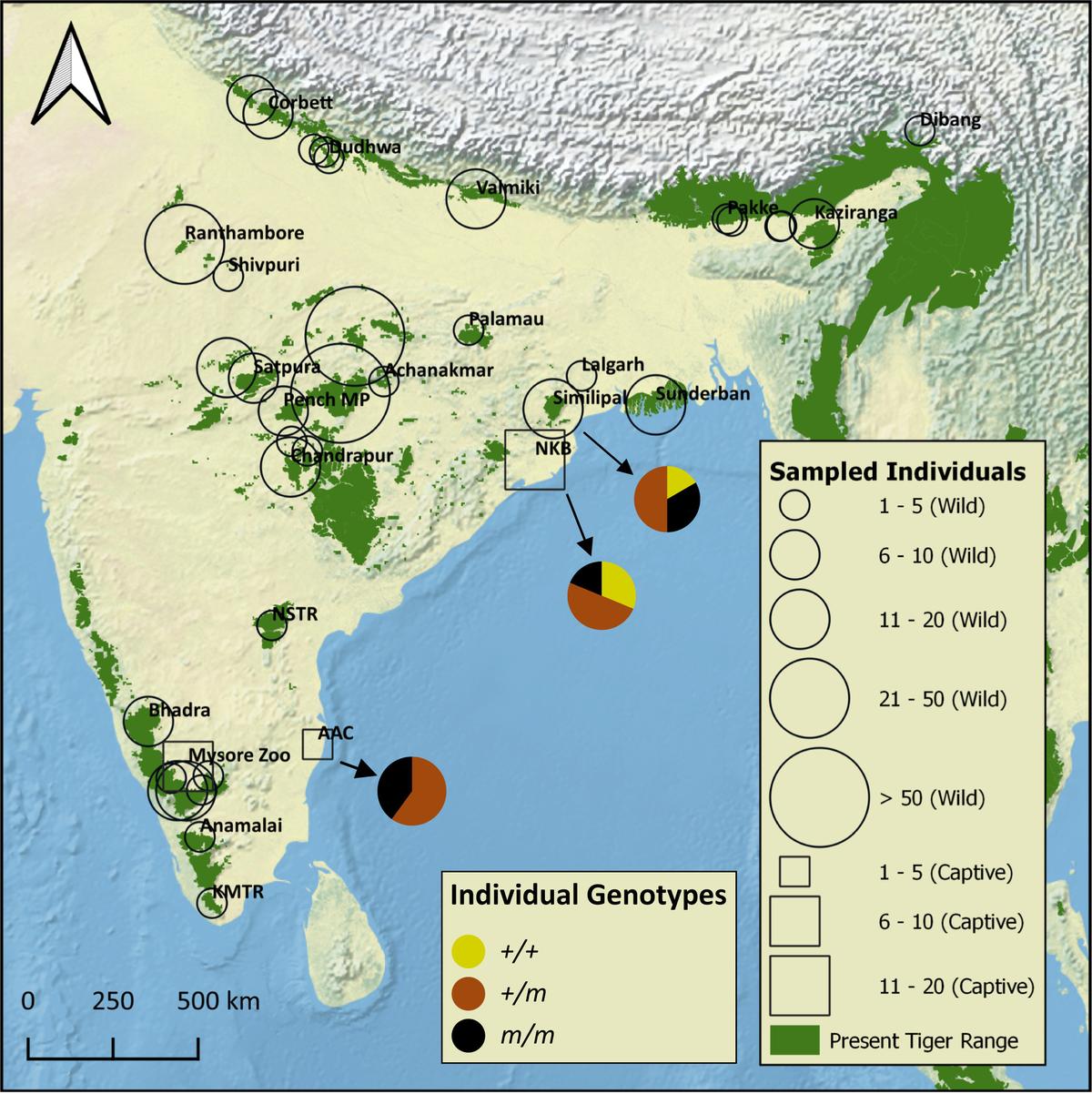
Distribution of the genotyped individuals. A total of 428 individuals were genotyped at the Taqpep c.1360C > T mutation site. Wild tigers are shown with a circular marker, and captive tigers (NKB, AAC, and Mysore Zoo) are shown with a square marker. The size of the square/circle indicates the number of individuals genotyped from a given area. In addition to the 399 Bengal tigers shown on the map, we genotyped 12 Amur, 12 Malayan, and five Sumatran tigers from Armstrong et al.

Distribution of the genotyped individuals. A total of 428 individuals were genotyped at the Taqpep c.1360C > T mutation site. Wild tigers are shown with a circular marker, and captive tigers (NKB, AAC, and Mysore Zoo) are shown with a square marker. The size of the square/circle indicates the number of individuals genotyped from a given area. In addition to the 399 Bengal tigers shown on the map, we genotyped 12 Amur, 12 Malayan, and five Sumatran tigers from Armstrong et al.
| Photo Credit:
Proceedings of the National Academy of Sciences

A comparison between tiger populations showed that apart from the Similipal population, the mutation of the gene is extremely rare or even non-existent. The only other black tigers that have been found beyond the Similipal population are in captivity—Nandankanan Zoological Park at Bhubaneswar and Arignar Anna Zoological Park at Chennai—whose ancestry could be traced back to the Similipal population. 
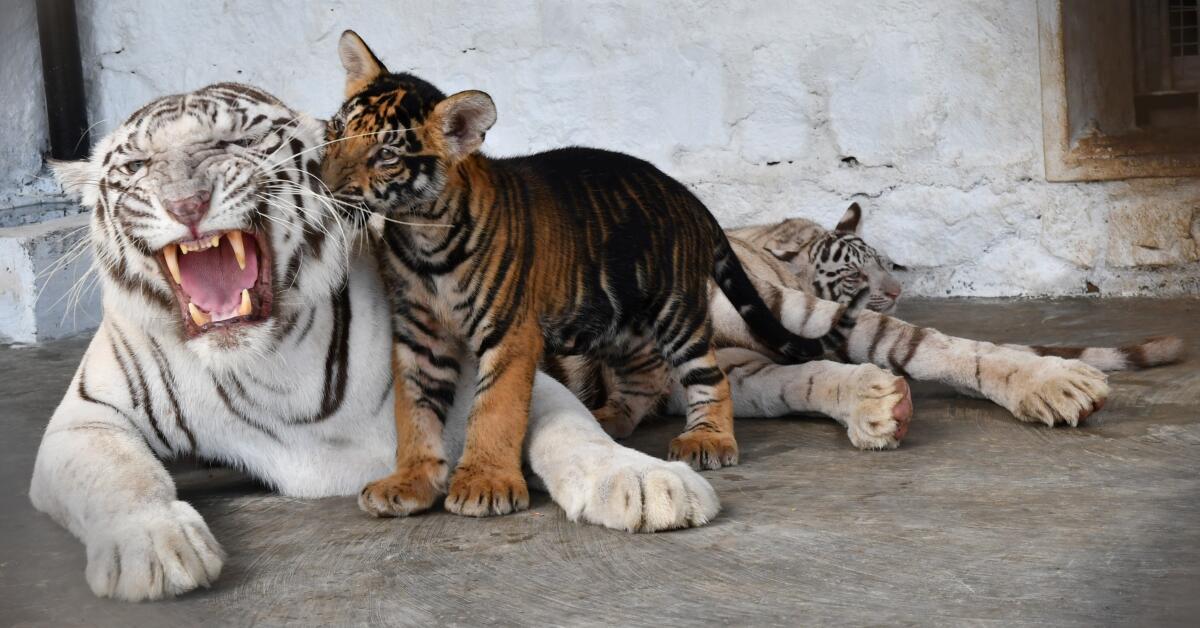
Pseudo-melanistic tiger cub at the Arignar Anna Zoological Park.

Pseudo-melanistic tiger cub at the Arignar Anna Zoological Park.
| Photo Credit:
B Velankanni Raj

The mutated gene

A 2021 study by the National Centre for Biological Sciences (NCBS), Bengaluru, published in the Proceedings of the National Academy of Sciences, looked at the gene which gave the black tigers their colour. 

The team, led by Uma Ramakrishnan, found that the mutation of the Transmembrane Aminopeptidase Q or Taqpep gene was responsible change in colour. This gene gives other cat species their markings too. For instance, tabbies with darker or more blotchy stripes have this mutated gene. A King cheetah’s wider and darker spots are also because of the mutated gene. 
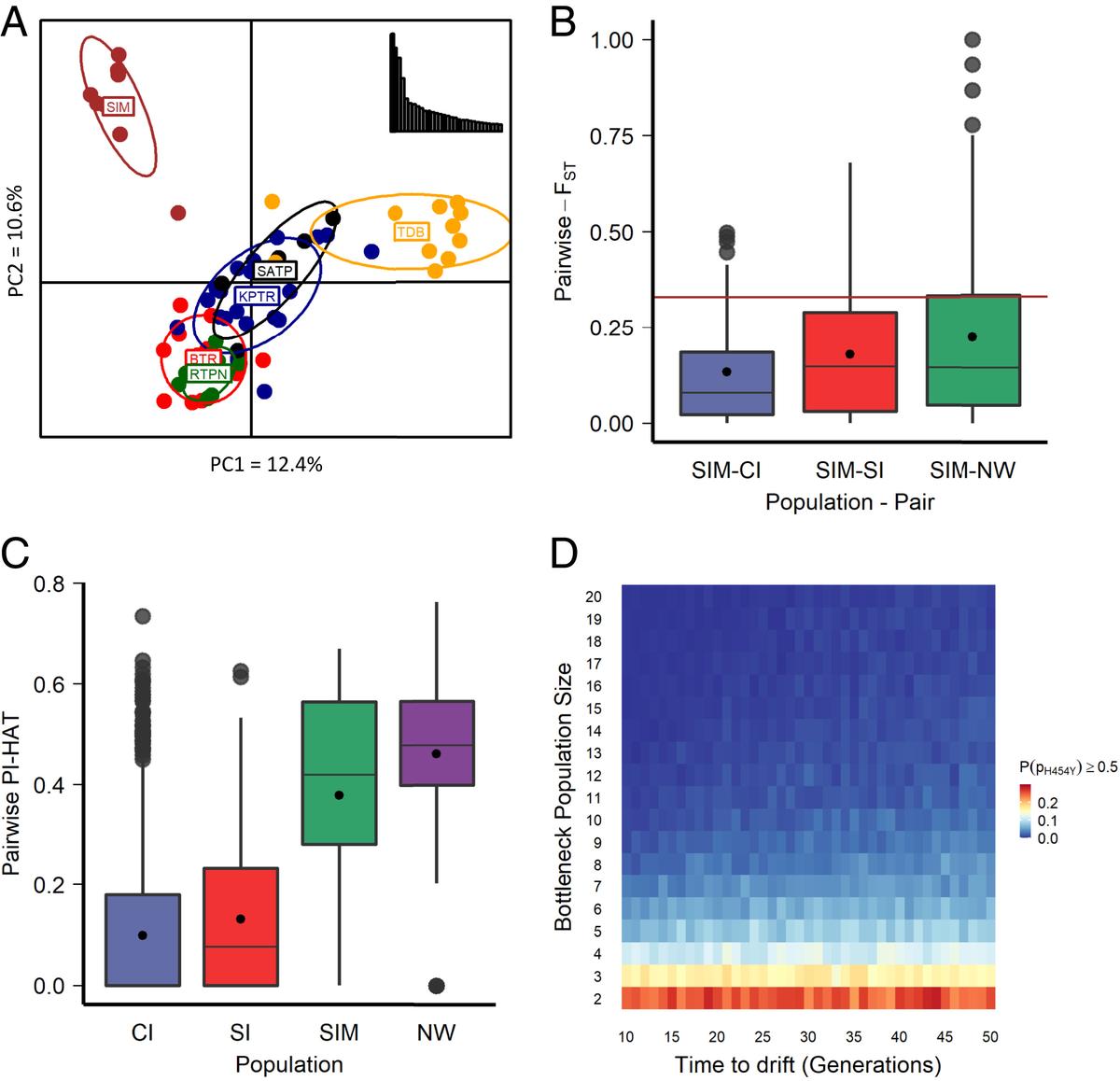
Population genetic analyses of Similipal tigers suggest genetic differentiation of Similipal from other tiger populations, indicating ongoing drift, and simulations suggest past bottlenecks might be responsible for a high frequency of Taqpep p.H454Y in Similipal.

Population genetic analyses of Similipal tigers suggest genetic differentiation of Similipal from other tiger populations, indicating ongoing drift, and simulations suggest past bottlenecks might be responsible for a high frequency of Taqpep p.H454Y in Similipal.
| Photo Credit:
Proceedings of the National Academy of Sciences

The anomalies in colour and patterns are caused due to a missense mutation in the Taqpep gene. This mutation changes the amino acid Cytosine (C) to Thymine (T) in position 1360 of the gene sequence.

The prevalence of this particular mutation is abnormally high in the Similipal Tiger Reserve population. According to the 2021 study, the frequency of the mutated gene occurred at 0.58 or a tiger born in this population had a 60% chance of carrying this mutated gene. 

Why are the mutations more common in Similipal?

A majority of the tigers found in Odisha are in the Similipal Tiger Reserve. The All Odisha Tiger Estimation (AOTE-2023-24) says a total of 30 tigers were found in Odisha’s forests of which 27 of them are in Similipal.

Of these 27, atleast 13 adult tigers (seven females and six males) were found to be pseudo-melanistic. No other wild habitat in the world has pseudo-melanistic tigers.

To find out why the concentration of pseudo-melanistic tigers is so high, researchers dug further. The genetic analysis of the tigers along with computer simulations showed that the reason for such high mutation was genetics and not adaptation as previously theorised. The Similipal tiger population is cut off from the other populations by a great distance and has been isolated for an extended period of time.

This has led to inbreeding in an already small founding population leading to higher chances of the mutated gene being passed down. The study also attributed the phenomenon of genetic drift which suggests that a mutation may appear in high frequency or die out all together depending on pure chance.

Published – November 01, 2024 06:00 am IST


Source link

Science Tags:black tigers, do black tigers exist, Pseudo-melanistic tigers, Pseudo-melanistic tigers of odisha, Pseudo-melanistic tigers of Similipal

Post navigation

Previous Post: What are melanistic tigers? | Explained
Next Post: BSF recovers China-made drone in Punjab’s Amritsar

Related Posts

  • Why does sadness cause us to shed tears?
    Why does sadness cause us to shed tears? Science
  • Cows can use tools, and one Austrian cow has now shown it clearly
    Cows can use tools, and one Austrian cow has now shown it clearly Science
  • Digital tools are changing how we remember and forget information
    Digital tools are changing how we remember and forget information Science
  • Six decades since Thumba launch, slew of private cos prep for flight
    Six decades since Thumba launch, slew of private cos prep for flight Science
  • How will Gaganyaan astronauts return safely to earth? | Explained
    How will Gaganyaan astronauts return safely to earth? | Explained Science
  • Sci-Five | The Hindu Science Quiz: On Eusociality
    Sci-Five | The Hindu Science Quiz: On Eusociality Science

More Related Articles

Launch to ISS delayed again over weather: NASA Launch to ISS delayed again over weather: NASA Science
Reducing ammonia emissions through targeted fertilizer management Reducing ammonia emissions through targeted fertilizer management Science
Hope for pancreatic cancer as new drug, daraxonrasib, shows promise Hope for pancreatic cancer as new drug, daraxonrasib, shows promise Science
Eka-aluminium is gallium – The Hindu Eka-aluminium is gallium – The Hindu Science
Shining a light on the life of C.V. Raman Shining a light on the life of C.V. Raman Science
Sci-Five | The Hindu Science Quiz: On Soil Sci-Five | The Hindu Science Quiz: On Soil Science
SiteLock

Archives

  • May 2026
  • April 2026
  • March 2026
  • February 2026
  • January 2026
  • December 2025
  • November 2025
  • October 2025
  • September 2025
  • August 2025
  • July 2025
  • June 2025
  • May 2025
  • April 2025
  • March 2025
  • February 2025
  • January 2025
  • December 2024
  • November 2024
  • October 2024
  • September 2024
  • August 2024
  • July 2024
  • June 2024
  • May 2024
  • April 2024
  • March 2024
  • February 2024
  • January 2024
  • December 2023
  • November 2023
  • October 2023
  • September 2023
  • August 2023
  • July 2023
  • June 2023
  • May 2023
  • April 2023
  • March 2023
  • February 2023
  • January 2023
  • December 2022
  • November 2022
  • October 2022
  • September 2022
  • August 2022
  • July 2022
  • June 2022
  • May 2022

Categories

  • Business
  • Nation
  • Science
  • Sports
  • World

Recent Posts

  • French hantavirus patient is critically ill, on artificial lung as total cases grow to 11
  • Tata Power Q4 PAT up 8%, revenue down 8%, dividend at ₹2.50 per share
  • Why no FIR by Rajasthan SOG in NEET paper leak case, asks Congress
  • AIADMK rebel MLAs to back TVK in Tamil Nadu floor test
  • NEET-UG examination 2026: One suspect arrested from Nashik

Recent Comments

  1. StanleyPeapy on UP Teacher Who Asked Students To Slap Muslim Classmate
  2. RonaldLam on UP Teacher Who Asked Students To Slap Muslim Classmate
  3. RaymondKiree on UP Teacher Who Asked Students To Slap Muslim Classmate
  4. Lavernedrums on UP Teacher Who Asked Students To Slap Muslim Classmate
  5. Raymonddow on UP Teacher Who Asked Students To Slap Muslim Classmate
  • Shoaib Akhtar’s Theory Proven Wrong As Pakistan Qualify For 2026 T20 WC Despite Poor Display. Reason Is…
    Shoaib Akhtar’s Theory Proven Wrong As Pakistan Qualify For 2026 T20 WC Despite Poor Display. Reason Is… Sports
  • Access Denied World
  • From abortion to bobcat hunting: U.S. vote not just for President
    From abortion to bobcat hunting: U.S. vote not just for President World
  • “Anything Can Happen:” Azam Khan As Cops Shift Him, Son Abdullah Azam To Different Jails
    “Anything Can Happen:” Azam Khan As Cops Shift Him, Son Abdullah Azam To Different Jails Nation
  • Granules gets U.S. FDA nod for copy of AstraZeneca’s heartburn drug 
    Granules gets U.S. FDA nod for copy of AstraZeneca’s heartburn drug  Business
  • Paresthesia: The Science of ‘Sleeping Limbs’
    Paresthesia: The Science of ‘Sleeping Limbs’ Science
  • Access Denied Business
  • Access Denied Sports

Editor-in-Chief:
Mohammad Ariff,
MSW, MAJMC, BSW, DTL, CTS, CNM, CCR, CAL, RSL, ASOC.
editor@artifex.news

Associate Editors:
1. Zenellis R. Tuba,
zenelis@artifex.news
2. Haris Daniyel
daniyel@artifex.news

Photograher:
Rohan Das
rohan@artifex.news

Artifex.News offers Online Paid Internships to college students from India and Abroad. Interns will get a PRESS CARD and other online offers.
Send your CV (Subjectline: Paid Internship) to internship@artifex.news

Links:
Associate Journalism
About Us
Privacy Policy

News Links:
Breaking News
World
Nation
Sports
Business
Entertainment
Lifestyle

Registered Office:
72/A, Elliot Road, Kolkata - 700016
Tel: 033-22277777, 033-22172217
Email: office@artifex.news

Editorial Office / News Desk:
No. 13, Mezzanine Floor, Esplanade Metro Rail Station,
12 J. L. Nehru Road, Kolkata - 700069.
(Entry from Gate No. 5)
Tel: 033-46011099, 033-46046046
Email: editor@artifex.news

Copyright © 2023 Artifex.News Newsportal designed by Artifex Infotech.