






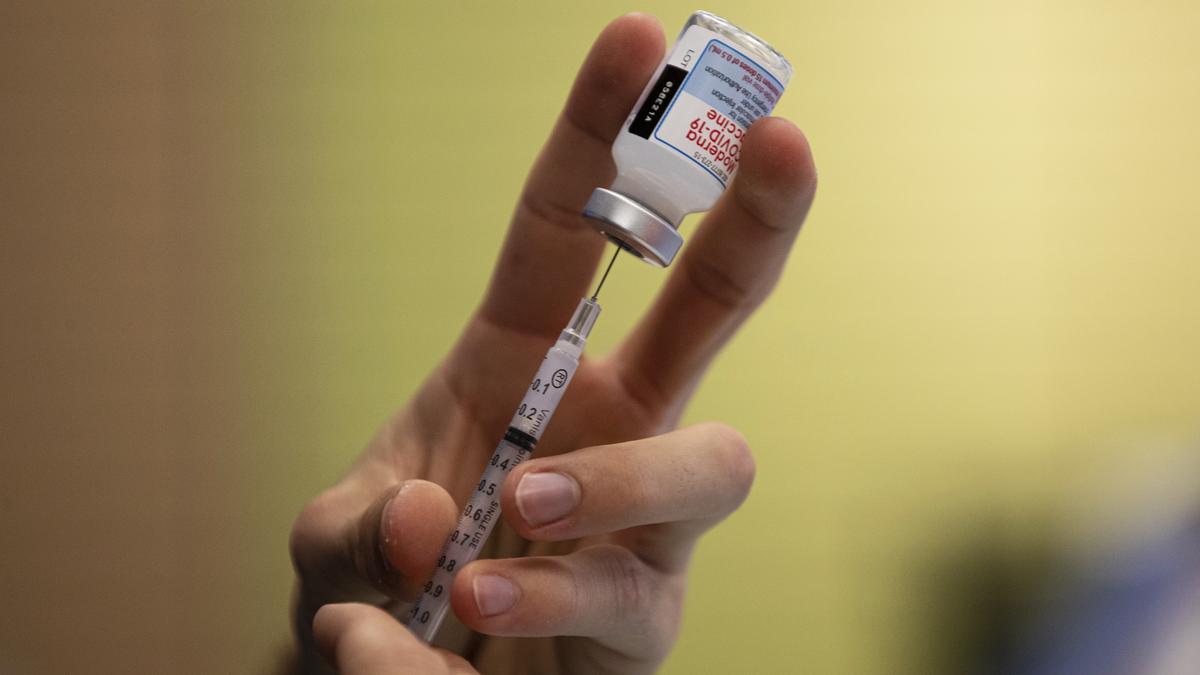
A health worker prepared a dose of a Moderna COVID-19 vaccine in Barboursville in the U.S., November 4, 2021.
| Photo Credit: Sholten Singer/AP
The ideal vaccine offers nearly complete protection against infection and mild disease in just one dose. It is simple to administer and doesn’t have any adverse effects. The protective immunity lasts a lifetime.
Are these expectations too idealistic?
In practical scenarios, no single vaccine provides such advantages. The key challenges vaccine developers face are the vaccines’ durability, the lack of immune correlates of protection, and the inability to protect against infection and transmission. But the greatest challenge among these three bottlenecks is the inability of vaccines to confer long-lasting protection.

Recently, the authors reviewed 34 licensed vaccines for the duration of protection against different infectious diseases. Only five offer long-lasting protection.
How do vaccines confer lasting protection?
The immunity that follows an infection — natural or vaccine-induced — is mainly the result of the body generating antibodies. A specific type of immune cell known as a plasma cell, which comes from B-cells in the lymph nodes, secretes these antibodies.
Not all B-cells and plasma cells are of the same type. Most of them have a short life span: they produce antibodies for a few weeks and die. As a result the concentration of antibodies in the body declines after a few weeks. But in the lymph nodes, a key lymphatic region, a germinal centre (GC) undergoes a long selection and maturation process known as affinity maturation to produce memory B-cells. GCs are the engines of antibody evolution and the mainstay of immune cells that provide lasting immunity. The name memory B-cells refers to these cells’ capacity to memorise the antigen’s characteristics over an extended period of time. When the antigen or microbe reentres the body, the memory B-cells swiftly identify it and start producing antigen-specific plasma cells. This rapidly boosts the antibody concentration and protects the individual against the disease.
Some plasma cells, known as long-lasting plasma cells (LLPCs), also migrate to the bone marrow and survive for an extended duration, promoting the production of antibodies in this time. A vaccine’s ability to confer long-term protection thus depends on its ability to induce the production of LLPCs. The goal of all vaccine developers is for their vaccines to generate these cells in the bone marrow.
But while most vaccines generate memory B-cells, not all of them turn into LLPCs. Special signals from the B-cell receptors are required for this to happen. Cross-linking between these receptors (called BCR cross-linking) and the antigen present in the vaccine triggers the release of T-cells. Thus the type of antigen in the vaccine, which is also capable of triggering cross-linking, dictates the creation of LLPCs.
New evidence on LLPCs
A new study in Nature Medicine provided further evidence of the significance of LLPCs. Researchers studied the presence of different subsets of antibody-secreting cells (ASCs): LLPCs and short-lived ASCs (which include non-LLPCs) in the bone marrows of 19 healthy volunteers aged 20-65 years, within 2.5-33 months of receiving a COVID-19 mRNA shot.
They compared this data with the presence of LLPCs and non-LLPCs specific to tetanus and influenza.
All 19 individuals had received a quadrivalent influenza vaccine within 1-12 months of the time of each bone marrow aspirate. All had also received childhood vaccinations against tetanus, with recent boosters ranging from one month to 24 years from the time of bone marrow aspirates. (Aspirate refers to a way to extract semi-liquid bone marrow.)
The results were striking. While the aspirates demonstrated high and relatively comparable frequencies of non-LLPCs specific to the COVID-19, influenza, tetanus vaccines, there were hardly any LLPCs specific to COVID-19 even as LLPCs specific to influenza and tetanus were present.
In other words, LLPCs are responsible for durable immunity. Their absence in the bone marrow is responsible for the rapid waning of both vaccine- and infection-induced protection against COVID-19. The results were similar for ASCs secreting different immunoglobulins (IgG and IgA).
The results echo a previous study of bone marrow aspirates from 20 unvaccinated people infected with COVID-19. It revealed they were “deficient” LLPCs specific to the SARS-CoV-2 virus compared to LLPCs produced by a tetanus shot.
Why mRNA vaccines for COVID-19 failed to generate LLPCs in the bone marrow is now a crucial question. The answer likely lies in the unique surface structure of the SARS-CoV-2 virus, which features spikes that serve as the primary target for most COVID-19 vaccines. The researchers have expressed belief the widely spaced spikes of SARS-CoV-2 (around 20-25 nanometres apart) prevent BCR crosslinking and the production of LLPCs.
The most popular COVID-19 vaccines during the pandemic were mRNA vaccines. Some other vaccines, including that against the human papillomavirus, utilise the virus-like particle (VLP) platform. Here, the vaccine presents the virus’s spikes more effectively to the body’s cells, facilitating better BCR cross-linking.
Thus, the distance between spike proteins on the surface of SARS-CoV-2 viral particles may prevent the production of LLPCs after an infection or a vaccine dose. This could then explain why the protection conferred by COVID-19 vaccines, whose effect is based on the spike proteins, wanes rapidly.
Some other researchers are quite sceptical of this explanation and don’t believe the spacing of spikes has anything to do with the durability of vaccines, however.

The way forward
The generation of LLPCs along with memory B- and T-cells is crucial for the long-term effectiveness of any vaccine. Understanding how the release of these key immune cells can be triggered in different populations and how their effects can be modulated in animal models and humans is essential to design better vaccines.
Therefore, the future of vaccines protecting against challenging or emerging infectious diseases lies in the design of new immunogens, their release mechanisms, and the mechanisms of action of various adjuvants.
Puneet Kumar is a clinician, Kumar Child Clinic, New Delhi. Vipin M. Vashishtha is director and paediatrician, Mangla Hospital and Research Center, Bijnor.
Published – October 30, 2024 05:30 am IST