



Skip to content
  • Facebook
  • X
  • Linkedin
  • WhatsApp
  • YouTube
  • Associate Journalism
  • About Us
  • Privacy Policy
  • 033-46046046
  • editor@artifex.news
Artifex.News

Artifex.News

Stay Connected. Stay Informed.

  • Breaking News
  • World
  • Nation
  • Sports
  • Business
  • Science
  • Entertainment
  • Lifestyle
  • Toggle search form
  • Security forces in northwest Pakistan kill 23 TTP militants
    Security forces in northwest Pakistan kill 23 TTP militants World
  • Economic survey sees robust growth in agriculture, allied sectors
    Economic survey sees robust growth in agriculture, allied sectors Business
  • G7 Nations Commit To Promoting India-Middle East-Europe Economic Corridor
    G7 Nations Commit To Promoting India-Middle East-Europe Economic Corridor Nation
  • Chandrayaan-3 | With moon now in India’s orbit, focus shifts to Pragyan rover
    Chandrayaan-3 | With moon now in India’s orbit, focus shifts to Pragyan rover Science
  • White House Valentine Post Targets Migrants
    White House Valentine Post Targets Migrants World
  • For First Time, Sweepers, Peons In Paramilitary Force CRPF Get Promotion
    For First Time, Sweepers, Peons In Paramilitary Force CRPF Get Promotion Nation
  • U.S., Taiwan sign 0 billion trade deal, cutting tariffs on Taiwanese goods
    U.S., Taiwan sign $250 billion trade deal, cutting tariffs on Taiwanese goods World
  • Access Denied Business
New research shows most space rocks crashing into Earth come from a single source

New research shows most space rocks crashing into Earth come from a single source

Posted on October 22, 2024 By admin


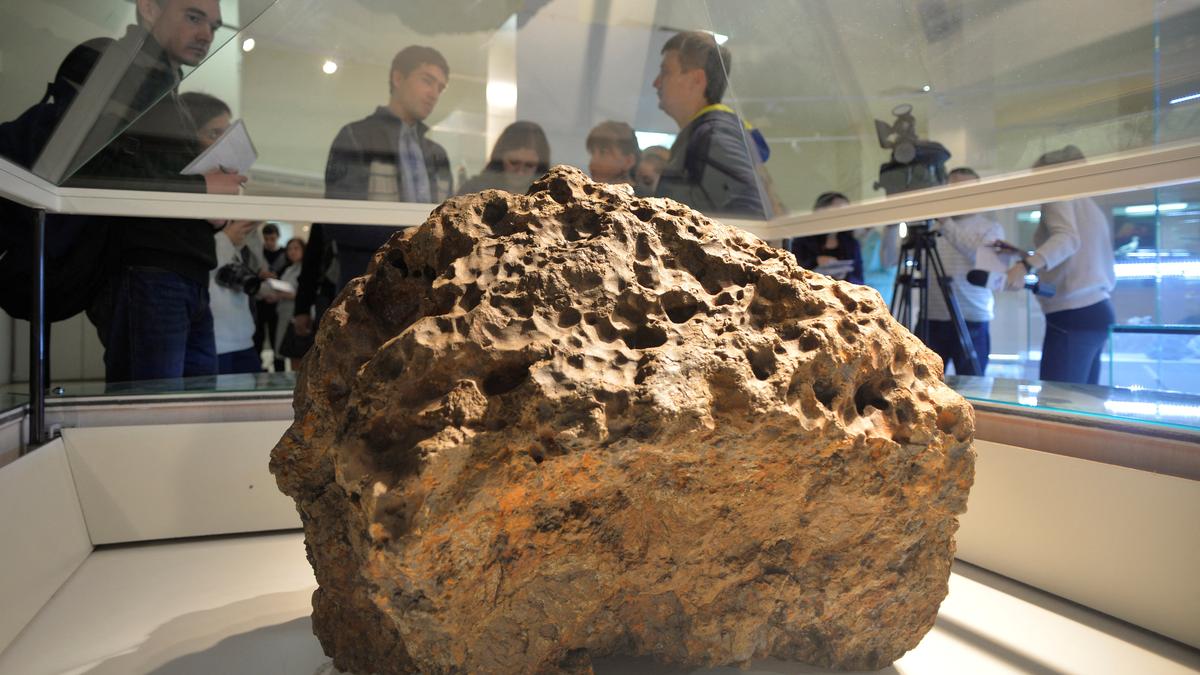
Reporters gather around a piece of a meteorite, which according to local authorities and scientists was lifted from the bottom of the Chebarkul Lake, placed on display in a local museum in Chelyabinsk, October 18, 2013. Each year, roughly 17,000 of these fireballs not only enter Earth’s atmosphere, but survive the perilous journey to the surface.
| Photo Credit: Reuters

The sight of a fireball streaking across the sky brings wonder and excitement to children and adults alike. It’s a reminder that Earth is part of a much larger and incredibly dynamic system.

Each year, roughly 17,000 of these fireballs not only enter Earth’s atmosphere, but survive the perilous journey to the surface. This gives scientists a valuable chance to study these rocky visitors from outer space.

Scientists know that while some of these meteorites come from the Moon and Mars, the majority come from asteroids. But two separate studies published in Nature today have gone a step further. The research was led by Miroslav Brož from Charles University in the Czech Republic, and Michaël Marsset from the European Southern Observatory in Chile.

The papers trace the origin of most meteorites to just a handful of asteroid breakup events – and possibly even individual asteroids. In turn, they build our understanding of the events that shaped the history of the Earth – and the entire solar system.

What is a meteorite?

Only when a fireball reaches Earth’s surface is it called a meteorite. They are commonly designated as three types: stony meteorites, iron meteorites, and stony-iron meteorites.

Stony meteorites come in two types.

Also Read | Ancient meteorite was ‘giant fertilizer bomb’ for life on Earth

The most common are the chondrites, which have round objects inside that appear to have formed as melt droplets. These comprise 85% of all meteorites found on Earth.

Most are known as “ordinary chondrites”. They are then divided into three broad classes – H, L and LL – based on the iron content of the meteorites and the distribution of iron and magnesium in the major minerals olivine and pyroxene. These silicate minerals are the mineral building blocks of our Solar System and are common on Earth, being present in basalt.

“Carbonaceous chondrites” are a distinct group. They contain high amounts of water in clay minerals, and organic materials such as amino acids. Chondrites have never been melted and are direct samples of the dust that originally formed the solar system.

The less common of the two types of stony meteorites are the so-called “achondrites”. These do not have the distinctive round particles of chondrites, because they experienced melting on planetary bodies.

The asteroid belt

Asteroids are the primary sources of meteorites.

Most asteroids reside in a dense belt between Mars and Jupiter. The asteroid belt itself consists of millions of asteroids swept around and marshalled by the gravitational force of Jupiter.

The interactions with Jupiter can perturb asteroid orbits and cause collisions. This results in debris, which can aggregate into rubble pile asteroids. These then take on lives of their own.

It is asteroids of this type which the recent Hayabusa and Osiris-REx missions visited and returned samples from. These missions established the connection between distinct asteroid types and the meteorites that fall to Earth.

S-class asteroids (akin to stony meteorites) are found on the inner regions of the belt, while C-class carbonaceous asteroids (akin to carbonaceous chondrites) are more commonly found in the outer regions of the belt.

But, as the two Nature studies show, we can relate a specific meteorite type to its specific source asteroid in the main belt.

One family of asteroids

The two new studies place the sources of ordinary chondrite types into specific asteroid families – and most likely specific asteroids. This work requires painstaking back-tracking of meteoroid trajectories, observations of individual asteroids, and detailed modelling of the orbital evolution of parent bodies.

The study led by Miroslav Brož reports that ordinary chondrites originate from collisions between asteroids larger than 30 kilometres in diameter that occurred less than 30 million years ago.

The Koronis and Massalia asteroid families provide appropriate body sizes and are in a position that leads to material falling to Earth, based on detailed computer modelling. Of these families, asteroids Koronis and Karin are likely the dominant sources of H chondrites. Massalia (L) and Flora (LL) families are by far the main sources of L- and LL-like meteorites.

Also Read | Asteroid that doomed the dinosaurs originated beyond Jupiter

The study led by Michaël Marsset further documents the origin of L chondrite meteorites from Massalia.

It compiled spectroscopic data – that is, characteristic light intensities which can be fingerprints of different molecules – of asteroids in the belt between Mars and Jupiter. This showed that the composition of L chondrite meteorites on Earth is very similar to that of the Massalia family of asteroids.

The scientists then used computer modelling to show an asteroid collision that occurred roughly 470 million years ago formed the Massalia family. Serendipitously, this collision also resulted in abundant fossil meteorites in Ordovician limestones in Sweden.

In determining the source asteroid body, these reports provide the foundations for missions to visit the asteroids responsible for the most common outerspace visitors to Earth. In understanding these source asteroids, we can view the events that shaped our planetary system.

Trevor Ireland receives funding from the Australian Research Council for research into the samples returned by the Hayabusa and Osiris-REx missions. He is a past President of the Meteoritical Society, the international organisation responsible for classification and cataloguing meteorites.This article is republished from The Conversation.

Published – October 22, 2024 04:19 pm IST


Source link

Science Tags:astronomy news, science news, what are meteors?, where do meteorites come from?

Post navigation

Previous Post: “Better If He Hadn’t Bowled”: Ravichandran Ashwin’s ‘Fifth Bowler’ Status In 2nd Test Baffles Ex India Opener
Next Post: Sensex, Nifty tumble over 1% on weak global cues, foreign fund exodus

Related Posts

  • We are sharing state-of-the-art expertise with ISRO for Gaganyaan mission: French Space Agency Chief 
    We are sharing state-of-the-art expertise with ISRO for Gaganyaan mission: French Space Agency Chief  Science
  • What sleep deprivation does to your brain and body
    What sleep deprivation does to your brain and body Science
  • Plankton balloon to six times their size to reach ocean surface
    Plankton balloon to six times their size to reach ocean surface Science
  • Subclinical TB is the reason for slow drop in TB incidence, says Soumya Swaminathan
    Subclinical TB is the reason for slow drop in TB incidence, says Soumya Swaminathan Science
  • Japan Moon lander put to sleep after surviving lunar night
    Japan Moon lander put to sleep after surviving lunar night Science
  • How do bacteria resist antibiotics?
    How do bacteria resist antibiotics? Science

More Related Articles

Artemis astronauts to study the Moon’s surface using mainly their eyes Artemis astronauts to study the Moon’s surface using mainly their eyes Science
Do songbirds socialise during migration? Do songbirds socialise during migration? Science
Indigenous clocks delay ISRO’s plans to replace defunct Navic satellites Indigenous clocks delay ISRO’s plans to replace defunct Navic satellites Science
Watch: Is climate change driving people out of the Sunderbans? Watch: Is climate change driving people out of the Sunderbans? Science
Genomic clues suggest humans’ ancestors nearly went extinct 9L years ago Genomic clues suggest humans’ ancestors nearly went extinct 9L years ago Science
The Science Quiz: Happy Children’s Day The Science Quiz: Happy Children’s Day Science
SiteLock

Archives

  • May 2026
  • April 2026
  • March 2026
  • February 2026
  • January 2026
  • December 2025
  • November 2025
  • October 2025
  • September 2025
  • August 2025
  • July 2025
  • June 2025
  • May 2025
  • April 2025
  • March 2025
  • February 2025
  • January 2025
  • December 2024
  • November 2024
  • October 2024
  • September 2024
  • August 2024
  • July 2024
  • June 2024
  • May 2024
  • April 2024
  • March 2024
  • February 2024
  • January 2024
  • December 2023
  • November 2023
  • October 2023
  • September 2023
  • August 2023
  • July 2023
  • June 2023
  • May 2023
  • April 2023
  • March 2023
  • February 2023
  • January 2023
  • December 2022
  • November 2022
  • October 2022
  • September 2022
  • August 2022
  • July 2022
  • June 2022
  • May 2022

Categories

  • Business
  • Nation
  • Science
  • Sports
  • World

Recent Posts

  • Five convicted in connection with Matthew Perry’s death
  • Hotel staff assaulted, case registered
  • IPL 2026 | RCB opts to field in rain-delayed clash against KKR
  • Africa must drop ‘victim mentality’: mogul Tony Elumelu
  • Suspended SI held for sexually assaulting woman on pretext of marriage

Recent Comments

  1. StanleyPeapy on UP Teacher Who Asked Students To Slap Muslim Classmate
  2. Bryandut on UP Teacher Who Asked Students To Slap Muslim Classmate
  3. NathanJobre on UP Teacher Who Asked Students To Slap Muslim Classmate
  4. DavidNup on UP Teacher Who Asked Students To Slap Muslim Classmate
  5. JeffryFok on UP Teacher Who Asked Students To Slap Muslim Classmate
  • Access Denied Sports
  • Meta Shuts Down Misinformation Monitoring Tool In Poll Year
    Meta Shuts Down Misinformation Monitoring Tool In Poll Year World
  • Access Denied
    Access Denied Nation
  • American consumers are pushing back against high inflation — and they are winning
    American consumers are pushing back against high inflation — and they are winning World
  • Cuba says Rubio lying about oil blockade
    Cuba says Rubio lying about oil blockade World
  • Gujarat’s Sakkarbaug Zoo Welcomes A Pair Of White Tigers
    Gujarat’s Sakkarbaug Zoo Welcomes A Pair Of White Tigers Nation
  • Sarfaraz Khan vs KL Rahul: Net Session Hints At Who Will Be Picked For 2nd Test vs New Zealand
    Sarfaraz Khan vs KL Rahul: Net Session Hints At Who Will Be Picked For 2nd Test vs New Zealand Sports
  • Access Denied Business

Editor-in-Chief:
Mohammad Ariff,
MSW, MAJMC, BSW, DTL, CTS, CNM, CCR, CAL, RSL, ASOC.
editor@artifex.news

Associate Editors:
1. Zenellis R. Tuba,
zenelis@artifex.news
2. Haris Daniyel
daniyel@artifex.news

Photograher:
Rohan Das
rohan@artifex.news

Artifex.News offers Online Paid Internships to college students from India and Abroad. Interns will get a PRESS CARD and other online offers.
Send your CV (Subjectline: Paid Internship) to internship@artifex.news

Links:
Associate Journalism
About Us
Privacy Policy

News Links:
Breaking News
World
Nation
Sports
Business
Entertainment
Lifestyle

Registered Office:
72/A, Elliot Road, Kolkata - 700016
Tel: 033-22277777, 033-22172217
Email: office@artifex.news

Editorial Office / News Desk:
No. 13, Mezzanine Floor, Esplanade Metro Rail Station,
12 J. L. Nehru Road, Kolkata - 700069.
(Entry from Gate No. 5)
Tel: 033-46011099, 033-46046046
Email: editor@artifex.news

Copyright © 2023 Artifex.News Newsportal designed by Artifex Infotech.