



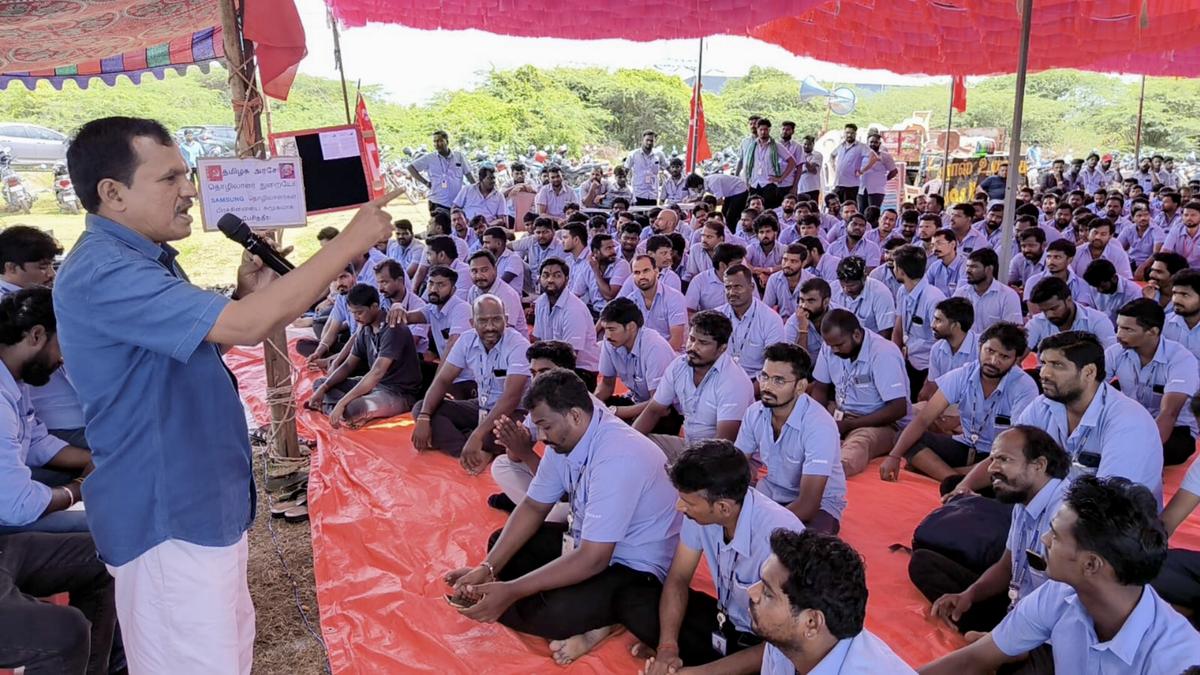
The realisation of their fundamental right to form a registered trade union to collectively bargain for better terms of employment is at the heart of the protests by Samsung India workers’ at Sriperumbudur in Tamil Nadu. They want to meet the South Korean giant on equal terms across the negotiating table to jointly frame a collective agreement regulating their work conditions.
The State government responded by forming a ‘workmen committee’ to resolve the problem and resorted to police violence to quell the workers’ strike which began on September 9. Labour law expert and Madras High Court lawyer, senior advocate R. Vaigai, pointed out that the State’s action was akin to putting the cart before the horse. Legally, she said, the registration of the trade union named Samsung India Workers Union (SIWU) under the Trade Unions Act, 1926 should have preceded the formation of the workmen committee. The unleashing of the police, rather than following the tenets of the 1926 law to register the trade union and facilitate a democratic atmosphere for collective bargaining under the Industrial Disputes Act of 1947, gives the impression that the government is on the side of the Samsung management. On the other hand, the State government and Samsung have alleged that SIWU is backed by the Centre of Trade Unions (CITU). Samsung has further objected to the inclusion of its name in SIWU.
On the right to form a union
The Supreme Court in B.R. Singh versus Union of India in 1989 upheld the right to form associations or unions as a fundamental right under Article 19(1)(c) of the Constitution. The State or the courts could “reasonably” restrict the formation of unions, associations, cooperative societies under Article 19(4) of the Constitution only if there is danger to public order, morality, sovereignty or integrity of India. The restrictions must be based on logic and not arbitrary. The necessity to form unions is obviously for voicing the demands and grievances of labour. “Trade unionists act as mouthpieces of labour,” the court noted.
Also read | Don’t blow Samsung workers’ issue out of proportion, CITU told
It is the obligation of the State, acting through the Registrar of Trade Unions, as the regulatory authority under the 1926 Act, to register trade unions and give individual workers their voice. The benefits of registration under the 1926 Act include immunity from both civil and criminal action. Section 4 of the Act notes that even seven members could apply for registration of their union. Under Section 6, the Registrar has to merely examine whether a trade union’s rules conform with the rules of the Act. Speaking to Frontline, A. Soundararajan, CITU Tamil Nadu Secretary, has accused the State of “blocking SIWU’s registration”.
On collective bargaining
The Madras High Court, in Rangaswami versus Registrar of Trade Unions, succinctly defined the history and object of the Trade Unions Act as “the organisation of labour to enable collective bargaining”. ‘Collective bargaining’ is defined in Article 2 of the International Labour Organization (ILO) Collective Bargaining Convention of 1981 as negotiations between employees and employers or their organisations to determine working conditions and terms of employment. The product of successful collective bargaining is a collective agreement. Collective bargaining is statutorily recognised in the Industrial Disputes Act. The Act provides that in case of failure of collective bargaining, the State steps in to refer the matter to a conciliation officer. The case is further referred to a labour court or an industrial tribunal if the conciliation officer does not succeed.
The roots of collective bargaining trace back to the late 18th and early 19th century when the coal miners struggled for basic conditions. Collective bargaining has protected workers’ rights post the economic depression of the 1930s and the Second World War to evolve as a norm along with the emergence of the democratic form of governance globally. In India, traces of collective bargaining could be found in the 1918 Ahmedabad Mills strike led by Mahatma Gandhi in which he initiated the formation of a committee of arbitrators drawn from both the workers, who were seeking a wage raise after the revocation of their plague allowance, and their employers.
Eminent labour law scholar Sir Otto Kahn Freund referred to the level playing field offered by collective bargaining with the expression, “power stands against power”. Susan Hayter, in an ILO document, termed freedom of association and the right to collective bargaining as fundamental workers’ rights. Former U.S. President Franklin D. Roosevelt in a Senate address in 1937 said the “denial or observance of this right means the difference between despotism and democracy”. The National Labour Relations Act or the Wagner Act in the U.S. marked the refusal of an employer to bargain with a workers’ union as an ‘unfair labour practice’. The same spirit is reflected in the Fifth Schedule of India’s 1947 Act, which lists an employer’s refusal to “bargain collectively, in good faith, with recognised trade unions” as an unfair labour practice. The celebrated U.S. Supreme Court case, National Labor Relations Board versus Jones & Laughlin Steel Corp held that employees have a fundamental right to organise and select representatives of their own choosing for collective bargaining. The court said any act on the part of the employer to prevent the “free exercise of this right” would amount to discrimination and coercion to be condemned by the competent legislative authority.
The Indian Supreme Court has recognised the importance of collective bargaining to achieve social justice in modern industrial life (Karnal Leather Karmchari versus Liberty Footwear Company). The court, in Ram Prasad Vishwakarma versus The Chairman, Industrial Tribunal, noted how labour was at a “great disadvantage” before the “days of collective bargaining”.
On the right to strike
The right to strike labour is a legal right recognised with certain restrictions under the Industrial Disputes Act. The Supreme Court described strikes as a “form of demonstration” by workers for their rights. For example, they include various forms like ‘go-slow’, ‘sit-in-work’, ’work-to-the-rule’, ‘absenteeism’, etc. The court has observed the right to demonstrate and, therefore, the right to strike, as important weapons in the armoury of workers. The right is recognised by almost all democratic countries. The ILO considers the right to strike as a corollary of the right to organise.
However, the 1947 Act does not recognise the right to strike as absolute. Section 22 prohibits strikes in breach of contract or without giving employer notice within six weeks before striking or within 14 days of giving such notice; or before the expiry of the date of strike specified in the notice or during the pendency of proceedings before a conciliation officer and seven days after the conclusion of such proceedings. In the All India Bank Employees case, the Supreme Court said the right to form an association was a “guaranteed” one, but the methods used by the unions to achieve their purposes must adhere to the existing industrial laws of the land.
The criticism against the involvement of CITU in the workers’ efforts to register a labour union is countermanded by the provisions of the Trade Unions Act itself. Section 6(e) of the Act provides for not only the admission of “ordinary members” from the workforce of a facility in a trade union but also the inclusion of “honorary or temporary members” as office-bearers to form the executive of the union. Section 16 of the same Act permits the constitution of a separate fund for “political purposes”. Under this provision, a registered trade union may constitute a separate fund, from contributions separately levied, to promote the “civic and political interests of its members”. The section allows these funds to be used to even pay for a candidate to contest elections to any legislative body constituted under the Constitution. The fundamental right to free speech of the workers includes their right to political expression.
On the ‘workmen committee’
While the State Industries Minister claimed the discussions with the committee had led to a resolution, The Hindu quoted the striking workers saying the ‘workmen committee’ was composed of employees who backed the company.
Section 3 of the 1947 Act covers the constitution of a ‘works committee’. The statute empowers the appropriate government to direct the employer to form a ‘works committee’ consisting of an equal number of representatives of employers and workers engaged in the establishment. The workers in the committee have to be chosen “in consultation with their trade union, if any, registered under the Indian Trade Unions Act, 1926”. The provision is also replicated in the yet-to-be implemented Industrial Relations Code of 2020. Hence, the law mandates the registration of a trade union before the formation of a works committee.
What is in a name?
Samsung India has complained to the Labour Commissioner that the use of the name ‘Samsung’ in the SIWU was a violation of the Trade Marks Act, 1999.
Section 29(5) of the 1999 Act states that a registered trade mark is infringed if it is used as the name or the part of a trade name or the name or part of the name of a business concern. Trade unions are not trade or business concerns dealing in goods or services. Section 2(h) of the 1926 Act defines ‘trade union’ as a “combination” primarily formed to regulate relations between/among workers and employers. U.S. courts have evolved the principle of ‘nominative fair use’ which involves utilising as much of the distinguishing design elements of a brand logo to reasonably associate the union and the company.
Published – October 15, 2024 08:30 am IST