


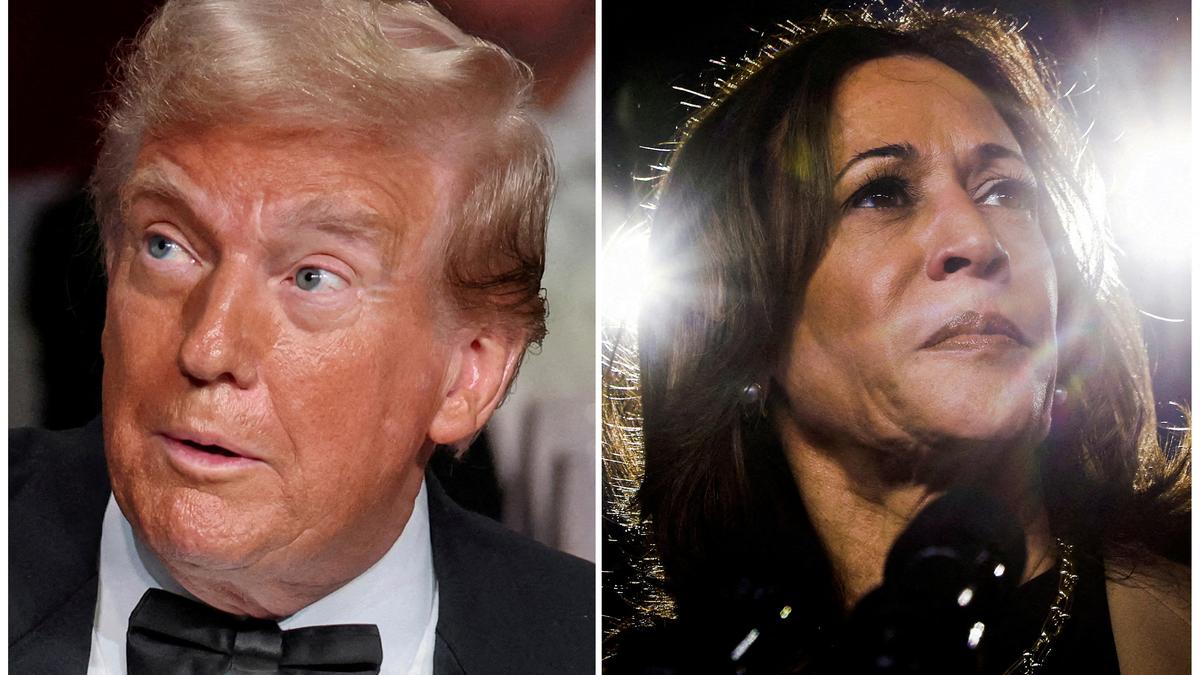
With the U.S. elections to be held on November 5, both the Democrats and the Republicans have amped up their respective campaigns. Considered one of the most significant elections in U.S. history, tensions are high as the nation battles a cost-of-living crisis while simultaneously arming and aiding two wars happening in different parts of the world.
One of the major issues on which voters are deciding their mandate is immigration policy. A study by the Pew Research Centre showed that about six-in-ten voters (61%) today say immigration is very important to their vote. It is of particular importance to Republican voters specifically, as 82% of Donald Trump supporters say it is a very important issue compared to 39% of Kamala Harris supporters who think the same.
A look at how immigration policy has evolved in the U.S. over the years.
U.S. Presidential elections 2024: Key dates and events to note
Foundation of the melting pot
Before U.S. independence in 1776, the country was a colony of the British Empire. The U.S. War of Independence was mainly against the regressive policies of King George the Third who restricted trade and free movement. Thus, the U.S. Declaration of Independence, signed and ratified on July 4, 1776, states that King George “has endeavoured to prevent the population of these States; for that purpose obstructing the Laws for Naturalization of Foreigners; refusing to pass others to encourage their migrations hither, and raising the conditions of new Appropriations of Lands”.
Therefore, the ‘population of states’ and ‘migrations hither’ are the foundations of the U.S. and intrinsic to its development and economic progress.
Moreover, the image of the U.S. as a beacon of light for people of all origins with the desire to make their own fortunes or require a safe haven from persecution, chaos or poverty in their home countries, has been emphasised over and over again. The Statue of Liberty, situated in New York, symbolises this sentiment. In its Museum, it is inscribed, “Give me your tired, your poor/ Your huddled masses yearning to breathe free/ The wretched refuse of your teeming shore”. These words gain added significance when one realises that it is through the port of New York that a lot of immigrants from the ‘Old World’ entered into the ‘New World’.
Also Read | U.S. President Biden offers massive immigration relief to non-citizens ahead of election
Anti-immigrant hysteria
Post U.S. independence, keeping true to the spirit of the Declaration, free movement across borders was encouraged. Migration of labour was a necessity as the U.S embarked upon its nation building project.
However, while borders were open, in order to be recognised as a U.S. citizen, a certain set of rules were established, the first of them codified through the Naturalization Act of 1790. This Act was limited to only free White Christian men. It excluded women, indentured servants, non‐whites, and slaves. Thus, while migration was encouraged, the privilege of citizenship was often withheld from a majority of groups. Even Native Americans, the indigenous people of the land, were not given citizenship till the Treaty of the Dancing Rabbit Creek in 1830.
The U.S. experienced its first wave of mass migration in the 1850s, with the crippling potato famine in Ireland and the advent of the gold rush in California. While the sudden influx of primarily Irish and German immigrants did give way to anti-immigrant and especially anti-Catholic sentiment in some parts of the U.S., (the most famous manifestation of this being the Know Nothings party formed exclusively around these xenophobic views), their fervour did not last long.
Parallelly, during the Gold Rush in the 1850s, a lot of Chinese immigrants also entered the nation. These workers, often poor and vulnerable, were taken advantage of by industrial bosses and made to work in unsafe conditions for meagre wages. They were considered cheap labour and found employment as farmhands, domestics, laundry workers, and most famously, railroad workers. It was the Chinese Americans who built the Transcontinental Railroad in the U.S., one of the biggest reasons for its growth as an economic superpower.
However, the fact that Chinese immigrant labour was preferred due to their willingness to work for cheap caused direct competition with white labourers. This led to rioting and protests by the white labour class and trade unions who said the Chinese immigrants were taking their jobs. To quell the riots, the U.S. government in 1882, for the first time, brought in an immigration policy specifying a particular nationality — the Chinese Exclusion Act. It mandated a ban on Chinese immigration for 10 years.
Post the 1870s, after the U.S. Civil War, the country witnessed yet another wave of migrants attracted by the rapid industrialisation. These migrants were mostly from the poorer countries of southern and eastern Europe such as Italy, Poland and Slovenia. As labour competition increased, native-born Americans were worried about the rising poverty and lack of education within these groups. These migrants were seen as reluctant to ‘assimilate into American society’.
Thus, competition in the labour market with Chinese and European immigrants, and fears of cultural isolation led to the U.S. Congress passing the Immigration Act of 1924. The Act introduced a quota system where visas were granted for 2% of the total number of people of each nationality in the U.S. as per the 1890 census. It introduced literary tests for incoming immigrants and increased the taxes collected from them upon arrival. The Act also banned immigration from Asia.
The period after the quota act severely restricted migration to the U.S. It was finally in the 1960s, with the advent of the Civil Rights movement, that the quota system for immigration was finally abolished with the Immigration and Nationality Act, 1965. It took out the nationality clause and opened the doors again for Asian immigration. Post 1965, immigration to the U.S. increased, particularly from Latin American and Asian nations. It also increased the number of illegal immigrants.
Also Read | Hanging on to the American Dream
The 9/11 effect
On September 11, 2001, al-Qaeda carried out four coordinated terrorist attacks on U.S. soil which killed 2,977 people. Subsequent investigations following the attack found that most of the 9/11 hijackers were able to obtain a visa from a U.S. consulate without detection. Moreover, some were in the country at the time of the attack with expired visas. This presented the U.S. government with the task of addressing both failures in intelligence and gaps in domestic immigration law.
After the attack, U.S. Congress made significant changes to immigration law and policy. In 2002, the Congress passed the Homeland Security Act, which created the U.S. Department of Homeland Security (DHS) by absorbing the Immigration and Naturalization Service as well as Customs. The Immigration and Customs Enforcement (ICE) was then formed under the DHS. It is the ICE that now primarily deals with border control and security vulnerabilities in immigration.
Here we see both policy and perspective shift on immigration and more specifically illegal immigration. What was earlier a matter of economics, as illegal migrants were seen as burdening the State exchequer, had now entered the realm of national security.
Such a conflation of one’s undocumented status with being a threat to domestic security can be understood by the remarks of former Attorney General John Ashcroft at a conference after the attacks, “Let the terrorists among us be warned: If you overstay your visa — even by one day — we will arrest you…. We will use all our weapons within the law and under the Constitution to protect life and enhance security for America.”
The 9/11 attacks can be seen as the beginning of the current hysteria around immigration to the U.S. Images in the media of ‘hoards’ or ‘swathes’ of immigrants at the U.S.-Mexican border often categorise them as criminals and within other undesirable categories. This is followed by claims of immigrants ‘stealing jobs’, ‘refusing to assimilate’, ‘free-loaders’ and so on; claims that we now know are not in any novel accusations.
The U.S. as a nation has become an economic superpower because of its immigration policy. Be it from William Colgate to the Chinese immigrants who built the Transcontinental Railways to Elon Musk, immigrants have made their mark in various fields and speeded up the process of industrialisation in the U.S.
It would be prudent for the U.S. to regulate immigration with policies which encourage safe travel and offer a path to citizenship.
Published – October 31, 2024 05:47 pm IST