





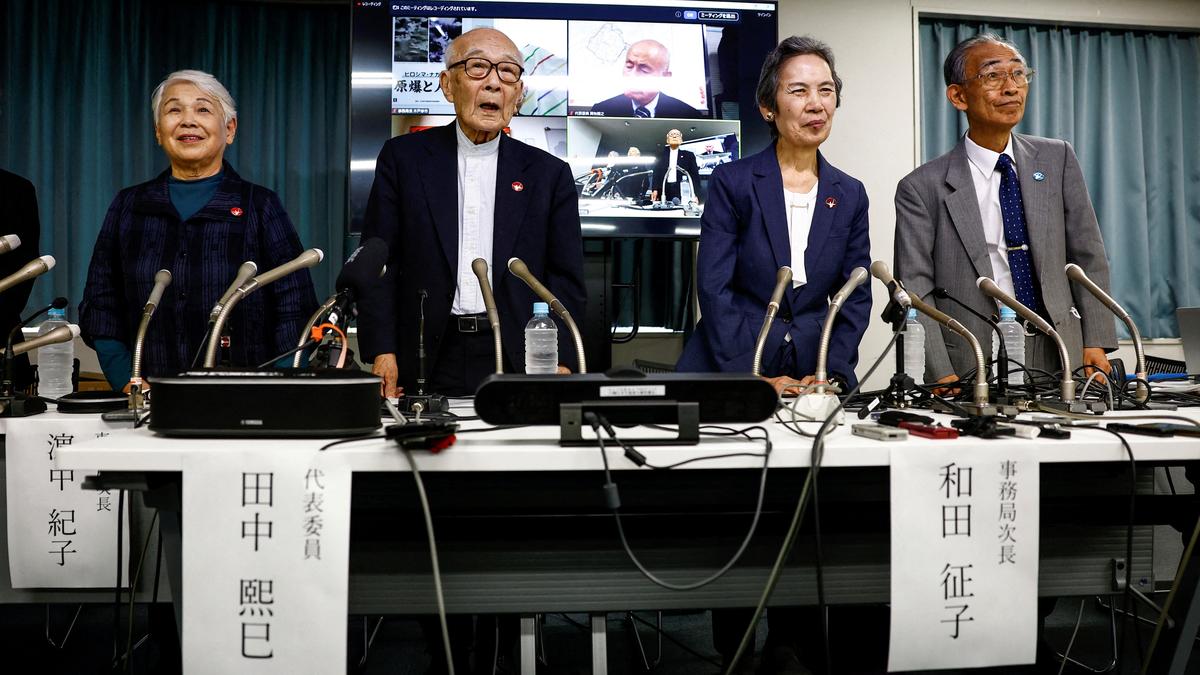
Atomic bomb survivors and members of Nihon Hidankyo, a country-wide organisation of atomic and hydrogen bomb sufferers, including Assistant Secretary General Toshiko Hamanaka, Co-chairperson Terumi Tanaka, Assistant Secretary General Masako Wada, Assistant Secretary General Jiro Hamasumi attend a press conference on the following day of Nihon Hidankyo winning the 2024 Nobel Peace Prize, in Tokyo, on October 12, 2023
| Photo Credit: Reuters
It has been 79 years since the two cities of Hiroshima and Nagasaki were pulverised by two atom bombs, ‘Little Boy’ and ‘Fat Man’, dropped by the U.S. Army Air Forces. This remains the only direct attacks on civilian population using nuclear weapons and the after-effects are a horrifying reminder of their destructive and long-lasting effects. The victims of the attacks, in which an estimated 1,50,000 to 2,46,000 people were killed immediately or due to radiation effects by the end of 1945, include survivors who went on to be known as the ‘hibakusha’ (bomb-affected people). Today, the combined number of ‘hibakusha’ who are alive is officially 1,06,825, according to Japan’s Ministry of Health, Labor and Welfare. Their average age is 85.6 years.
By awarding the Nobel Peace Prize for 2024 to Nihon Hidankyo or the Japan Confederation of Atomic and Hydrogen Bomb Sufferers Organizations, a group formed by hibakusha in 1956, the Norwegian Nobel Committee finally recognised the yeoman efforts taken by the group to improve health and provide medical support to the hibakusha and to strive for the abolition of nuclear weapons, emphasised in their slogan, ‘No more hibakusha’.
Pinching his cheek and holding back tears, Hidankyo co-chair Toshiyuki Mimaki said in a press conference in Hiroshima that the award would give a major boost to the efforts to abolish nuclear weapons and also said that it was governments that waged wars and not citizens who yearned for peace. Speaking to presspersons, he said, “Please abolish nuclear weapons while we are still alive. That is the wish of 1,14,000 hibakusha”. Hidankyo has been nominated for the Peace Prize quite a few times and clearly their humane emphasis on banning nuclear weapons on virtue of being the sufferers of the use of these had catapulted their cause to international attention.
In the first decade since August 1945, many survivors had to go through ordeals such as unknown sickness, fatal illness and penury. There was little scope for organisation during the U.S. occupation following Japan’s defeat in the Second World War, as the occupying force censored publications that focused on the suffering of the hibakusha. The end of the occupation provided the impetus to organise but the ‘Lucky Dragon 5’ incident — in which a Japanese tuna-fishing vessel got exposed to radioactive fallout from a U.S. hydrogen bomb test at Bikini Atoll in the Pacific Ocean — and its aftermath acted as a catalyst for the formation of Hidankyo. Public outrage at the incident spurred the anti-bomb/ ban-the-bomb movement leading to Hidankyo.
Two demands
At the very outset, Hidankyo was able to crystallise two fundamental demands — “the elimination of nuclear weapons” and “relief for the hibakusha”. Demands for relief for the hibakusha were directed at the Japanese government, rather than the aggressors, the U.S. because Japanese rights to damages during the war were waived by the San Francisco Peace Treaty signed between Japan and the Allied forces in 1951. Hidankyo also zeroed on the Japanese government for relief as it considered its members’ sufferings to be a consequence of war pursued by the Imperial Japanese state.
The Japanese government’s response was to enact an ‘Atomic Bomb Medical Law’ in 1957, aimed at improving the “hibakusha’s health with state-sponsored check-ups and medical assistance”, but it stopped short of alleviating their health concerns or living conditions. Okinawan and Korean hibakusha were excluded from this assistance. Hidankyo was also part of the progressive organisation called Gensuikyo that led the ban-the-bomb movement, but Cold War politics and differences between right and left-wing sections of the Gensuikyo led to Hidankyo distancing from it in the mid-1960s.
Hidankyo made several trips across the world — including to India as part of the World Social Forum in 2004 — to inform the people about the horror of nuclear weapons and the damage it caused on the hibakusha besides the fact that it was concealed from the public for more than a decade since August 1945.
In the 1970s, Hidankyo also engaged in oppositional politics and agitations that increased solidarity and support for it from the public. Over time in Japan, several laws were passed that were focussed on healthcare for the hibakusha that went beyond treatment for radiation wounds and illnesses, thanks to the activism of Hidankyo. Scholars have averred that the group’s long struggle helped pressure the Japan government “to admit its war responsibility” and helped turn the country’s political culture towards greater democracy and justice. Yet, despite turning public opinion on nuclear weapons and steadily increasing relief for the hibakusha, Hidankyo could not mould the Japanese government’s position on the U.S.’s “nuclear umbrella”, which continues to this day.
The Peace Prize, by highlighting the struggle of the ageing hibakusha, should hopefully provide the impetus for the world to work further on abolishing nuclear weapons and the strategies that foster their presence.
Published – October 13, 2024 01:18 am IST