






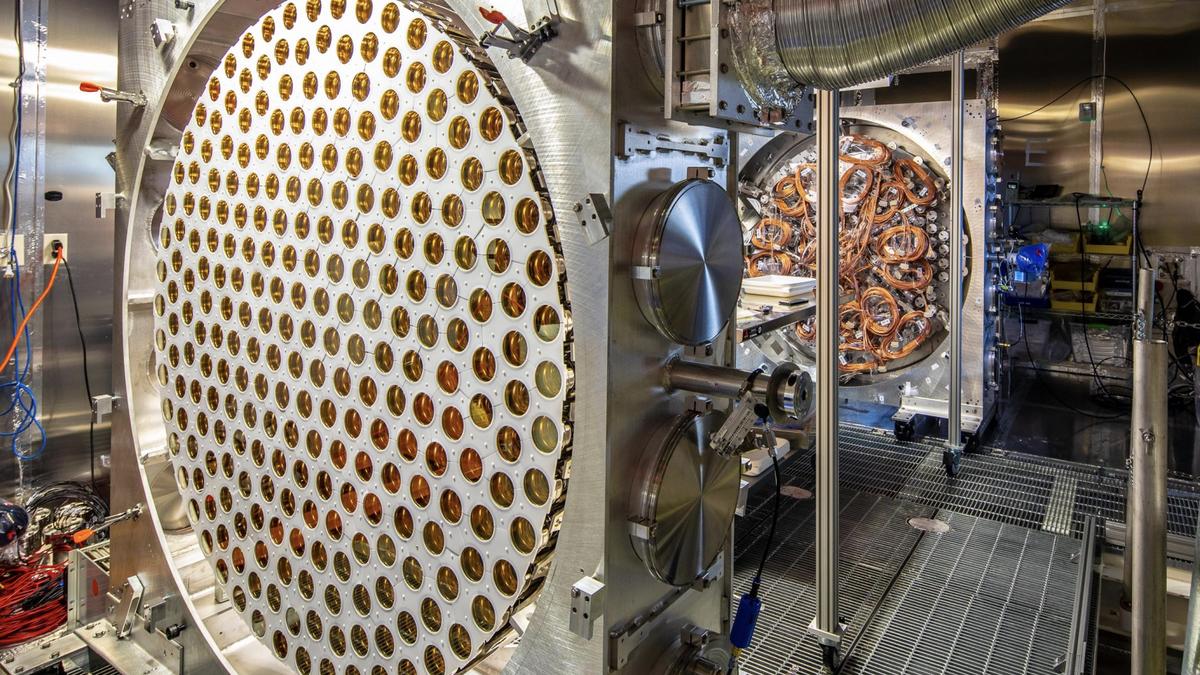
On August 28, two members of an experiment at conferences in Chicago and São Paulo had an announcement to make.
They were representing about 200 of their colleagues involved in the design, building, and operation of the LUX-ZEPLIN (LZ) experiment located 1.5 km below the earth’s surface at the Sanford Underground Research Facility in South Dakota, USA. Their news: their band of scientists had placed the tightest restrictions yet on the identity of the particles that made up dark matter.
It was a null result: it didn’t say what the particle’s identity was but suggested which identities the particle couldn’t have. And it didn’t prompt disappointment from the physics community. Instead, it prompted resignation.
Experiments similar to LZ — such as XENON-nT in Italy, PandaX-4T in China, and dozens of others around the world — have been turning up empty-handed for decades now despite heroic efforts.
Dark matter and its handshake
Dark matter is the invisible stuff making up most of the mass in the universe, responsible for giving the cosmos its current looks. Stars, gas, and planets contribute only 15% to the universe’s mass.
The simplest contender for the make-up of dark matter is a previously unknown type of particle that doesn’t interact with photons, and lives — i.e. without disintegrating, unlike most particles — for at least the age of the universe, about 14 billion years.
This raises a question: does dark matter ever touch us? More precisely, can atomic nuclei and electrons scatter dark matter particles when they come close?
Several theories of dark matter indeed predict this handshake between the visible and invisible. The issue is how we can detect it.
A sail to catch the wind
In 1985, physicists Mark Goodman and Ed Witten proposed a new strategy that has since mushroomed into an entire sub-field of experimental physics. (This is the same Witten of string theory fame. Thus the most theoretical of physicists has spawned an industry of experiments, proving the artificiality of divisions within physics. It is ironic that if dark matter is discovered in an underground laboratory, Witten will be awarded the Nobel Prize for something he has spent the least time on.)
We are all familiar with the pancake shape of the Milky Way galaxy. This disk of stars is embedded in a ball of dark matter about 100,000 lightyears across. In the Solar System, every teaspoon of space contains about two protons’ weight of dark particles. These particles blow as a wind into us from all directions at one-thousandth the speed of light.
Goodman’s and Witten’s (GW) idea was to catch this wind in a “sail” — a chunk of metal placed deep underground to shield against other radiation from space. If a nucleus in the metal were seen to recoil spontaneously, it must be the invisible bump of dark matter.
In Ernest Rutherford’s gold foil experiment, his team shone a well-understood beam at a mysterious target. GW’s idea was the reverse: an enigmatic beam on a familiar target. The goal of the experiment is to measure two quantities: the unknown mass of the dark particle and the unknown rate at which atomic nuclei scatter dark matter particles. Physicists track this rate using a variable called the cross-section.
Consider the passage of light in vacuum, in glass, and in a piece of rock. In the first case a photon travels unimpeded; in the second it travels a good distance before being scattered by an atom; and in the third it is immediately stopped. We then say, for these three cases respectively, that the scattering cross-section is zero, small, and enormous.
Transparency needn’t apply to light alone: any medium can be quantifiably transparent or opaque to any particle type. GW’s proposal would have measured the cross section for dark matter to scatter on nuclei down to 10-38 cm2, already a staggeringly tiny quantity. It would imply that dark matter would have to traverse 10 billion km of rock before being stopped.
‘The neutrino fog’
These mousetraps for dark matter have since come a long way. Where GW proposed the use of a kilogram of metal for a day, today scientists expose tonnes of liquid xenon and argon to the dark-matter wind for years. The advantage of going bigger and running longer is that one can catch dark matter that is ghostlier, i.e. with a smaller cross section. As a result, we can now say with a straight face that we have ruled out dark matter-nucleus cross sections of 10-44 cm2, a million times smaller than the GW limit.
This is just the announcement LZ made in August.
Could we go on making our detectors bigger and probe arbitrarily smaller cross sections? Not quite. Future detectors that will weigh tens to hundreds of tonnes will also register much more noise from the scatters of other ghostly particles, especially neutrinos forged in the Sun’s interior and in the earth’s atmosphere. In fact, PandaX-4T and XENONnT are already reporting this issue. The resignation following LZ’s announcement is partly for this reason: scientists had hoped to reveal dark matter’s identity before facing this “neutrino fog”. Telling dark matter and neutrino signals apart in future searches is a challenge that drives a great deal of research.

Every last drop
Scientists are actively pursuing other avenues of research, too. One is to detect dark particles that are lighter than atomic nuclei, for these would scatter feebly off the target nucleus.
Picture a bug hitting a truck, which would hardly move the vehicle. The goal is to develop technology to perceive the slightest of energy transfers, which involves building detectors using special materials that are currently restricted to the realm of condensed matter physics.
Thus the hunt for dark matter, like that of the Calydonian boar, unites many talents. That is not surprising: the effort to decipher the natural world has always drawn every last drop of human ingenuity.
Nirmal Raj is an assistant professor of theoretical physics at the Centre for High Energy Physics in the Indian Institute of Science, Bengaluru.
Published – September 30, 2024 05:30 am IST