

Skip to content
  • Facebook
  • X
  • Linkedin
  • WhatsApp
  • YouTube
  • Associate Journalism
  • About Us
  • Privacy Policy
  • 033-46046046
  • editor@artifex.news
Artifex.News

Artifex.News

Stay Connected. Stay Informed.

  • Breaking News
  • World
  • Nation
  • Sports
  • Business
  • Science
  • Entertainment
  • Lifestyle
  • Toggle search form
  • Rahul Gandhi’s Big Charge In Telangana
    Rahul Gandhi’s Big Charge In Telangana Nation
  • Access Denied
    Access Denied Nation
  • IND vs NZ first Test: Why India lost to New Zealand in Bengaluru?
    IND vs NZ first Test: Why India lost to New Zealand in Bengaluru? Sports
  • Donald Trump’s aide Peter Navarro criticises India again over Russian oil purchases
    Donald Trump’s aide Peter Navarro criticises India again over Russian oil purchases World
  • FIFA World Cup 2026 | England clinches Group L crown with clean sheet against Panama
    FIFA World Cup 2026 | England clinches Group L crown with clean sheet against Panama Sports
  • Samsung says planning job cuts in some Asian operations
    Samsung says planning job cuts in some Asian operations World
  • Access Denied
    Access Denied Nation
  • Access Denied
    Access Denied Nation
CERN supercollider discovers heaviest particles can entangle

CERN supercollider discovers heaviest particles can entangle

Posted on September 19, 2024 By admin


One of the most surprising predictions of physics is entanglement, a phenomenon where objects can be some distance apart but still linked together. The best-known examples of entanglement involve tiny chunks of light (photons), and low energies.

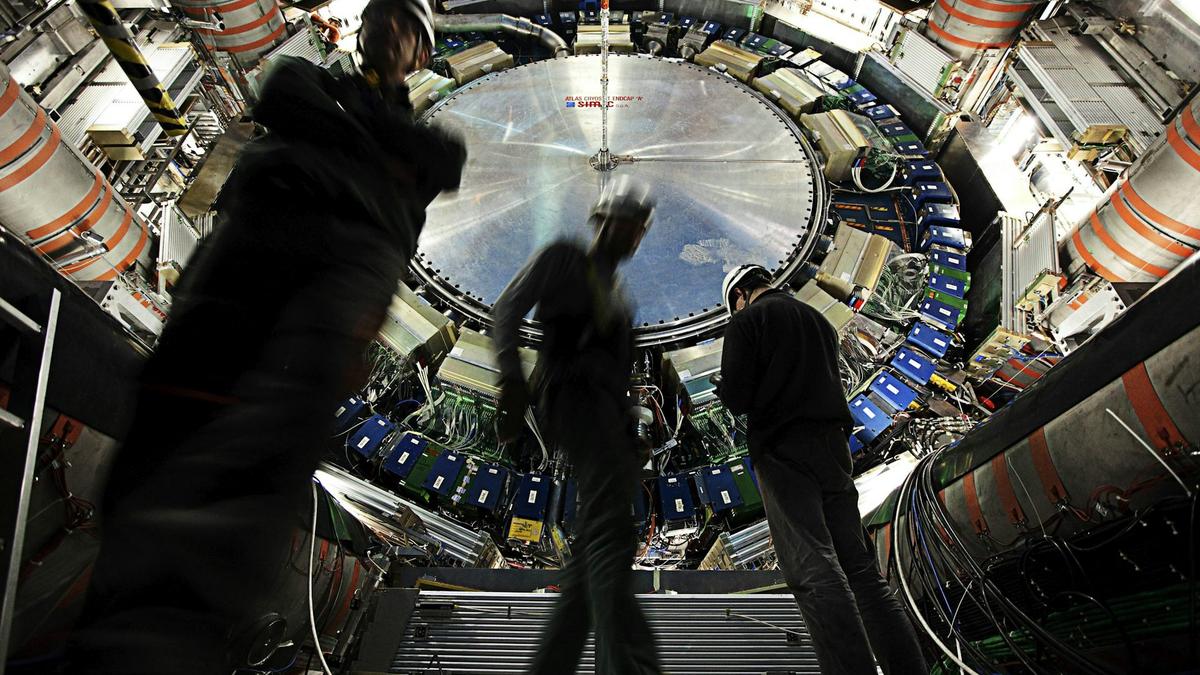
At the Large Hadron Collider in Geneva, the world’s largest particle accelerator, an experiment called ATLAS has just found entanglement in pairs of top quarks: the heaviest particles known to science.

The results are described in a new paper from my colleagues and me in the ATLAS collaboration, published today in Nature.

What is entanglement?

In everyday life, we think of objects as being either “separate” or “connected”. Two balls a kilometre apart are separate. Two balls joined by a piece of string are connected.

When two objects are “entangled”, there is no physical connection between them – but they are not truly separate either. You can make a measurement of the first object, and that is enough to know what the second object is doing, even before you look at it.

The two objects form a single system, even though there is nothing connecting them together. This has been shown to work with photons on opposite sides of a city.

The idea will be familiar to fans of the recent streaming series 3 Body Problem, based on Liu Cixin’s sci-fi novels. In the show, aliens have sent a tiny supercomputer to Earth, to mess with our technology and to allow them to communicate with us. Because this tiny object is entangled with a twin on the alien homeworld, the aliens can communicate with it and control it – even though it is four light-years away.

That part of the story is science fiction: entanglement doesn’t really allow you to send signals faster than light. (It seems like entanglement should allow you to do this, but according to quantum physics this isn’t possible. So far, all of our experiments are consistent with that prediction.)

But entanglement itself is real. It was first demonstrated for photons in the 1980s, in what was then a cutting-edge experiment.

Today you can buy a box from a commercial provider that will spit out entangled pairs of photons. Entanglement is one of the properties described by quantum physics, and is one of the properties that scientists and engineers are trying to exploit to create new technologies, such as quantum computing.

Since the 1980s, entanglement has also been seen with atoms, with some subatomic particles, and even with tiny objects undergoing very, very slight vibrations. These examples are all at low energies.

The new development from Geneva is that entanglement has been seen in pairs of particles called top quarks, where there are vast amounts of energy in a very small space.

So what are quarks?

Matter is made of molecules; molecules are made of atoms; and an atom is made of light particles called electrons orbiting a heavy nucleus in the centre, like the Sun in the centre of the solar system. We already knew this from experiments by about 1911.

We then learned that the nucleus is made up of protons and neutrons, and by the 1970s we discovered that protons and neutrons are made up of even smaller particles called quarks.

There are six types of quark in total: the “up” and “down” quarks that make up protons and neutrons, and then four heavier ones. The fifth quark, the “beauty” or “bottom” quark, is about four-and-a-half times heavier than a proton, and when we found it we thought it was very heavy. But the sixth and final quark, the “top”, is a monster: slightly heavier than a tungsten atom, and 184 times the mass of a proton.

No one knows why the top quark is so massive. The top quark is an object of intense study at the Large Hadron Collider, for exactly this reason. (In Sydney, where I am based, most of our work on the ATLAS experiment is focused on the top quark.)

We think the very large mass may be a clue. Maybe the top quark is so massive because the top quark feels new forces, beyond the four we already know about. Or maybe it has some other connection to “new physics”.

We know that the laws of physics, as we currently understand them, are incomplete. Studying the way the top quark behaves may show us the way to something new.

So does entanglement mean that top quarks are special?

Probably not. Quantum physics says that entanglement is common, and that all sorts of things can be entangled.

But entanglement is also fragile. Many quantum physics experiments are done at ultra-cold temperatures, to avoid “bumping” the system and disturbing it. And so, up to now, entanglement has been demonstrated in systems where scientists can set up the right conditions to make the measurements.

For technical reasons, the top quark’s very large mass makes it a good laboratory for studying entanglement. (The new ATLAS measurement would not have been possible for the other five types of quark.)

But top quark pairs won’t be the basis of a convenient new technology: you can’t pick up the Large Hadron Collider and carry it around. Nevertheless, top quarks do provide a new kind of tool to conduct experiments with, and entanglement is interesting in itself, so we’ll keep looking to see what else we find.

This article is republished from The Conversation under a Creative Commons license. Read the original article.

Published – September 19, 2024 05:29 pm IST



Source link

Science Tags:cern supercollider, entanglement, entanglement of pairs in top quark, quantum computing, quantum mechanics, science news

Post navigation

Previous Post: US’ Delta Airlines Apologizes After Cabin Pressure Problem Injures Passengers
Next Post: In a single finger bone, scientists find signs of Britain’s largest flying animal

Related Posts

  • The Science Quiz | The solar cycle
    The Science Quiz | The solar cycle Science
  • Explained | After Chandrayaan-3, what has ISRO planned?
    Explained | After Chandrayaan-3, what has ISRO planned? Science
  • Escape velocity: On what India’s space sector must focus on
    Escape velocity: On what India’s space sector must focus on Science
  • Avalanches can grow 100-times larger undersea than on land
    Avalanches can grow 100-times larger undersea than on land Science
  • Tea drinking across India – The Hindu
    Tea drinking across India – The Hindu Science
  • What is radioactive decay? – The Hindu
    What is radioactive decay? – The Hindu Science

More Related Articles

Does India need to upgrade its biosecurity measures? | Explained Does India need to upgrade its biosecurity measures? | Explained Science
Stubble burning in Punjab, Haryana contributes only 14% of PM2.5 in Delhi-NCR: study Stubble burning in Punjab, Haryana contributes only 14% of PM2.5 in Delhi-NCR: study Science
Sci-Five | The Hindu Science Quiz: On Indian Institute of Astrophysics Sci-Five | The Hindu Science Quiz: On Indian Institute of Astrophysics Science
Pragyan rover finds an unexpected surprise on the moon: sulphur | Explained Pragyan rover finds an unexpected surprise on the moon: sulphur | Explained Science
New cat species identified in Bolivia, first in over a century New cat species identified in Bolivia, first in over a century Science
ISRO dispatches crew module for first uncrewed mission of Gaganyaan ISRO dispatches crew module for first uncrewed mission of Gaganyaan Science
SiteLock

Archives

  • September 2026
  • August 2026
  • July 2026
  • June 2026
  • May 2026
  • April 2026
  • March 2026
  • February 2026
  • January 2026
  • December 2025
  • November 2025
  • October 2025
  • September 2025
  • August 2025
  • July 2025
  • June 2025
  • May 2025
  • April 2025
  • March 2025
  • February 2025
  • January 2025
  • December 2024
  • November 2024
  • October 2024
  • September 2024
  • August 2024
  • July 2024
  • June 2024
  • May 2024
  • April 2024
  • March 2024
  • February 2024
  • January 2024
  • December 2023
  • November 2023
  • October 2023
  • September 2023
  • August 2023
  • July 2023
  • June 2023
  • May 2023
  • April 2023
  • March 2023
  • February 2023
  • January 2023
  • December 2022
  • November 2022
  • October 2022
  • September 2022
  • August 2022
  • July 2022
  • June 2022
  • May 2022

Categories

  • Business
  • Nation
  • Science
  • Sports
  • World

Recent Posts

  • Bombay High Court permits BMC to cut over 1,200 mangroves for Versova-Madh Island bridge
  • U.S. appeals court rejects Trump policy allowing swift deportations to third countries
  • Trump to meet with Venezuela’s interim President Rodriguez in New York on Sept. 22
  • U.S. troop deaths during Iran war exceed Pentagon count by at least four: report
  • Waste of public money amid economic crisis: U.P. Congress on PM’s birthday celebrations

Recent Comments

  1. Jamesslits on UP Teacher Who Asked Students To Slap Muslim Classmate
  2. MichaelClear on UP Teacher Who Asked Students To Slap Muslim Classmate
  3. Jamesslits on UP Teacher Who Asked Students To Slap Muslim Classmate
  4. Jamesslits on UP Teacher Who Asked Students To Slap Muslim Classmate
  5. MichaelClear on UP Teacher Who Asked Students To Slap Muslim Classmate
  • T20 World Cup IND vs NZ: Sanju Samson credits Sachin Tendulkar’s guidance for success
    T20 World Cup IND vs NZ: Sanju Samson credits Sachin Tendulkar’s guidance for success Sports
  • 4th T20I: Samson-Tilak Guide India To 3-1 Series Win Over South Africa
    4th T20I: Samson-Tilak Guide India To 3-1 Series Win Over South Africa Sports
  • Bajrang Punia Suspended For Four Years By National Anti-Doping Body Due To Violation Of Code
    Bajrang Punia Suspended For Four Years By National Anti-Doping Body Due To Violation Of Code Sports
  • Why have people fallen sick after Chloroquine administration in Andhra Pradesh | Explained
    Why have people fallen sick after Chloroquine administration in Andhra Pradesh | Explained Nation
  • Opposition’s Dreams Shattered, Says PM Narendra Modi On Supreme Court VVPAT Verdict. Congress Responds
    Opposition’s Dreams Shattered, Says PM Narendra Modi On Supreme Court VVPAT Verdict. Congress Responds Nation
  • Sri Lanka ends fuel rationing imposed at height of economic crisis
    Sri Lanka ends fuel rationing imposed at height of economic crisis World
  • Access Denied
    Access Denied Nation
  • Access Denied Business

Editor-in-Chief:
Mohammad Ariff,
MSW, MAJMC, BSW, DTL, CTS, CNM, CCR, CAL, RSL, ASOC.
editor@artifex.news

Associate Editors:
1. Zenellis R. Tuba,
zenelis@artifex.news
2. Haris Daniyel
daniyel@artifex.news

Photograher:
Rohan Das
rohan@artifex.news

Artifex.News offers Online Paid Internships to college students from India and Abroad. Interns will get a PRESS CARD and other online offers.
Send your CV (Subjectline: Paid Internship) to internship@artifex.news

Links:
Associate Journalism
About Us
Privacy Policy

News Links:
Breaking News
World
Nation
Sports
Business
Entertainment
Lifestyle

Registered Office:
72/A, Elliot Road, Kolkata - 700016
Tel: 033-22277777, 033-22172217
Email: office@artifex.news

Editorial Office / News Desk:
No. 13, Mezzanine Floor, Esplanade Metro Rail Station,
12 J. L. Nehru Road, Kolkata - 700069.
(Entry from Gate No. 5)
Tel: 033-46011099, 033-46046046
Email: editor@artifex.news

Copyright © 2023 Artifex.News Newsportal designed by Artifex Infotech.