




Skip to content
  • Facebook
  • X
  • Linkedin
  • WhatsApp
  • YouTube
  • Associate Journalism
  • About Us
  • Privacy Policy
  • 033-46046046
  • editor@artifex.news
Artifex.News

Artifex.News

Stay Connected. Stay Informed.

  • Breaking News
  • World
  • Nation
  • Sports
  • Business
  • Science
  • Entertainment
  • Lifestyle
  • Toggle search form
  • Access Denied World
  • Former SC judge Justice Madan Lokur appointed chairperson of U.N. Internal Justice Council
    Former SC judge Justice Madan Lokur appointed chairperson of U.N. Internal Justice Council World
  • Access Denied World
  • Bank Of England Holds Key Interest Rate At 5.25% After 14 Hikes
    Bank Of England Holds Key Interest Rate At 5.25% After 14 Hikes Business
  • Access Denied
    Access Denied Nation
  • Access Denied
    Access Denied Nation
  • Man, 73, Arrested For Sexually Harassing 9-Year-Old Girl In Maharashtra: Cops
    Man, 73, Arrested For Sexually Harassing 9-Year-Old Girl In Maharashtra: Cops Nation
  • Last Rites Of Ex Army Officer Waibhav Anil Kale Killed In Gaza Performed In Pune
    Last Rites Of Ex Army Officer Waibhav Anil Kale Killed In Gaza Performed In Pune Nation
Exceptional new fish fossil sparks rethink of how earth’s geology drives evolution

Exceptional new fish fossil sparks rethink of how earth’s geology drives evolution

Posted on September 17, 2024 By admin


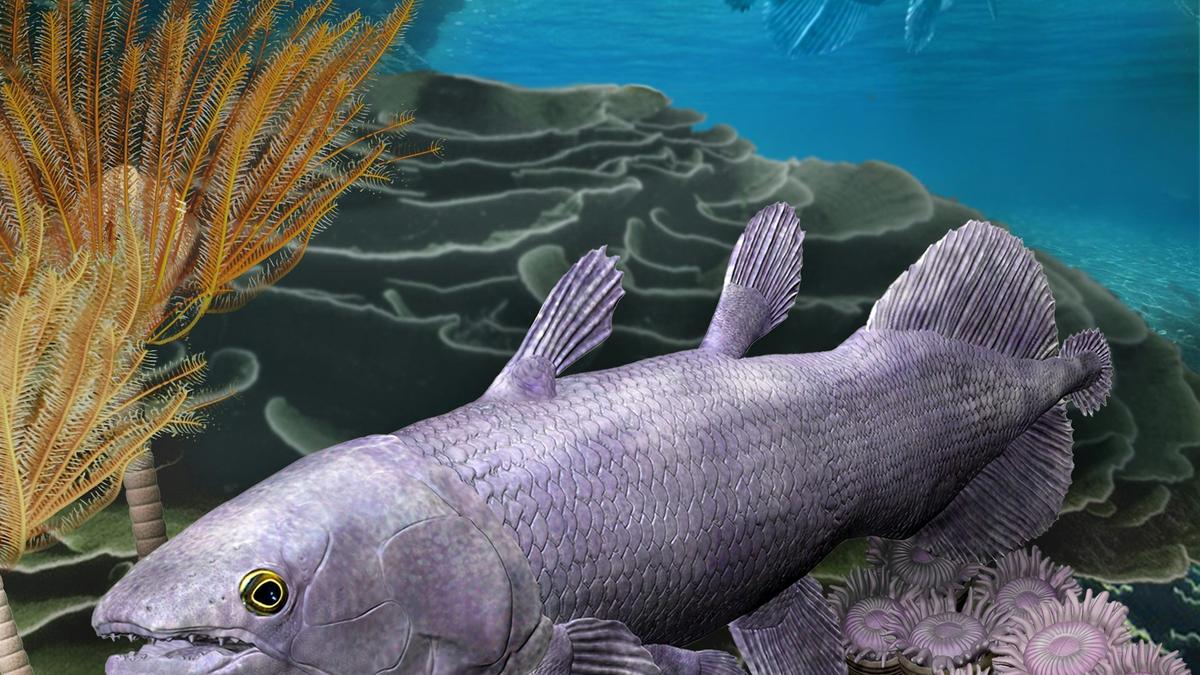
Coelacanths are deep-sea fish that live off the coasts of southern Africa and Indonesia and can reach up to two metres in length. For a long time, scientists believed they were extinct.

In new research published in Nature Communications, we reveal the best-preserved coelacanth fossil ever found from the ancient period hundreds of millions of years ago when these ancient sea-dwellers first evolved. The fossil comes from the Gogo Formation on Gooniyandi Country in northern Western Australia.

We also studied the evolution of all the hundreds of coelacanth species we know from the fossil record to find out what drove the creation of new species across the aeons.

The answer came as a surprise: the greatest influence on coelacanth evolution was not ocean temperature or oxygen levels but tectonic activity. When the vast plates of Earth’s crust were moving around more, new species were more likely to appear.

‘Living fossils’

Coelacanths are “lobe-finned” fish, which means they have robust bones in their fins a bit like the bones in our arms. Scientists believe they are more closely related to tetrapods (animals with backbones and four limbs, such as frogs, emus and humans) than to most other fishes.

Coelacanths have been around for a long time. The oldest known fossils are more than 410 million years old. But because these fossils are mostly fragments, we don’t know a lot about what the earliest coelacanths were like.

Later, during the age of dinosaurs which began around 250 million years ago, coelacanths became more diverse. In total, we have found traces of more than 175 fossil species from all over the globe.

Finally, at the end of the Cretaceous period, 66 million years ago, all signs of coelacanths mysteriously vanished from the fossil record. For a long time, scientists assumed the coelacanths were casualties of the massive asteroid impact that also signed the death warrant of the dinosaurs (along with around three-quarters of all life on Earth).

All that changed in 1938, when fisherpeople in South Africa pulled a large, enigmatic fish from the ocean depths that was like nothing they had seen before. A local museum employee with a keen interest in the natural sciences, Marjorie Courtenay-Latimer, immediately knew the fish was special.

Courtenay-Latimer enlisted her friend J. L. B. Smith, a renowned South African chemist with an interest in ichthyology (the study of fish). Smith identified and named Latimeria, the first living coelacanth known to science.

Discovering this “Lazarus fish” was like stumbling across a live Triceratops dinosaur still roaming the forests of North America today. Even today, coelacanths are often described as “living fossils”.

A new fossil coelacanth

Our team from Flinders University, together with other colleagues from Australia, Canada and Europe, discovered a new species of fossil coelacanth on Gooniyandi Country in northern WA. Around 380 million years ago, the site was a tropical reef teeming with more than 50 species of fish.

Ngamugawi wirngarri, the new fossil coelacanth, is the first fish found in the area to bear a name given to us from the Gooniyandi language. The name means “ancient fish in honour of Wirngarri”, a respected elder of the community.

Ngamugawi is the best three-dimensionally preserved coelacanth from the Devonian Period (359 million to 419 million years ago). This fossil provides a great insight into the early anatomy of this lineage.

Plate tectonics drive coelacanth evolution

Our study of the new species led us to analyse the evolutionary history of all known coelacanths. In doing so, we calculated the rates of evolution across their 410 million year history.

We found that coelacanths have generally evolved slowly, with a few intriguing exceptions.

Furthermore, we analysed a series of environmental factors that we considered potential candidates for influencing coelacanth evolutionary rates. These included tectonic plate activity, ocean temperatures, water oxygen levels, and atmospheric carbon dioxide levels.

Of all the variables we looked at, the one with the greatest influence on the rate of coelacanth evolution was tectonic plate activity. New species of coelacanth were more likely to evolve during periods of heightened tectonic activity, as seismic movement transformed habitats.

Are coelacanths still evolving?

Along with our analysis of all fossil coelacanths, we also had a close look at the two living species, Latimeria chalumnae and Latimeria menadoensis.

At first glance, these fish look almost identical to some of their counterparts from hundreds of millions of years ago. However, on closer analysis we could see they were in fact distinct from their extinct relatives.

While Latimeria has essentially ceased evolving new features, the proportions of its body and the details of its DNA are still changing a little. So perhaps it’s not a “living fossil” after all.

This article is republished from The Conversation under a Creative Commons license. Read the original article.

Published – September 17, 2024 02:27 pm IST


Source link

Science Tags:Coelacanths, evolution due to tecttonic activity, Fish fossil, living fossils, science news

Post navigation

Previous Post: Why do we aim with one eye closed?
Next Post: ICC announces equal prize money for men and women in World Cups

Related Posts

  • The Science Quiz | Vacuum wonders
    The Science Quiz | Vacuum wonders Science
  • One-third of TB patients received no payment for nutrition support
    One-third of TB patients received no payment for nutrition support Science
  • Down syndrome, Edwards syndrome found in ancient individuals
    Down syndrome, Edwards syndrome found in ancient individuals Science
  • Shubhanshu Shukla gets rousing welcome in Lucknow
    Shubhanshu Shukla gets rousing welcome in Lucknow Science
  • The rocky vista of medicinal cannabis research is bringing into view
    The rocky vista of medicinal cannabis research is bringing into view Science
  • Countdown for India’s first solar observatory mission Aditya-L1 starts
    Countdown for India’s first solar observatory mission Aditya-L1 starts Science

More Related Articles

Daily Quiz | On first transatlantic radio transmission Daily Quiz | On first transatlantic radio transmission Science
Trilobite fossils from upstate New York reveal extra set of legs Trilobite fossils from upstate New York reveal extra set of legs Science
What next for ISRO after Chandrayaan-3 mission? What next for ISRO after Chandrayaan-3 mission? Science
Genome-editing is helping us understand hereditary cancers better Genome-editing is helping us understand hereditary cancers better Science
China launches Pakistani satellite – The Hindu China launches Pakistani satellite – The Hindu Science
‘Cloning’ hurdle skirted to make perfect copy of quantum state ‘Cloning’ hurdle skirted to make perfect copy of quantum state Science
SiteLock

Archives

  • May 2026
  • April 2026
  • March 2026
  • February 2026
  • January 2026
  • December 2025
  • November 2025
  • October 2025
  • September 2025
  • August 2025
  • July 2025
  • June 2025
  • May 2025
  • April 2025
  • March 2025
  • February 2025
  • January 2025
  • December 2024
  • November 2024
  • October 2024
  • September 2024
  • August 2024
  • July 2024
  • June 2024
  • May 2024
  • April 2024
  • March 2024
  • February 2024
  • January 2024
  • December 2023
  • November 2023
  • October 2023
  • September 2023
  • August 2023
  • July 2023
  • June 2023
  • May 2023
  • April 2023
  • March 2023
  • February 2023
  • January 2023
  • December 2022
  • November 2022
  • October 2022
  • September 2022
  • August 2022
  • July 2022
  • June 2022
  • May 2022

Categories

  • Business
  • Nation
  • Science
  • Sports
  • World

Recent Posts

  • PM Modi’s ‘warning’ on economy | What it means | Talking Politics
  • Trump-Xi meeting was ‘good’, says White House
  • Farooq Abdullah backs RSS leader Dattatreya Hosabale’s call for dialogue with Pakistan
  • As Puducherry orders closure of Smart City Development Limited, experts urge its repurposing
  • Drug ban low, WTC high, now IPL blitz: Rabada reflects on roller-coaster 12 months

Recent Comments

  1. JamesHeR on UP Teacher Who Asked Students To Slap Muslim Classmate
  2. RafaelNar on UP Teacher Who Asked Students To Slap Muslim Classmate
  3. CarlosExorb on UP Teacher Who Asked Students To Slap Muslim Classmate
  4. Robertfloup on UP Teacher Who Asked Students To Slap Muslim Classmate
  5. Davidcag on UP Teacher Who Asked Students To Slap Muslim Classmate
  • Kremlin says the U.S. already gives Ukraine intelligence on a regular basis
    Kremlin says the U.S. already gives Ukraine intelligence on a regular basis World
  • Access Denied
    Access Denied Nation
  • BCCI Secretary Jay Shah Elected Unopposed As Next ICC Chairman
    BCCI Secretary Jay Shah Elected Unopposed As Next ICC Chairman Sports
  • Access Denied
    Access Denied Nation
  • Access Denied
    Access Denied Nation
  • Pakistan vs South Africa Live Streaming Tri Series 3rd ODI Live Telecast: When And Where To Watch
    Pakistan vs South Africa Live Streaming Tri Series 3rd ODI Live Telecast: When And Where To Watch Sports
  • Access Denied Business
  • Siemens Energy Shares May Rally 60% Says Motilal Oswal On Strong Long-Term Outlook — Details Inside Business

Editor-in-Chief:
Mohammad Ariff,
MSW, MAJMC, BSW, DTL, CTS, CNM, CCR, CAL, RSL, ASOC.
editor@artifex.news

Associate Editors:
1. Zenellis R. Tuba,
zenelis@artifex.news
2. Haris Daniyel
daniyel@artifex.news

Photograher:
Rohan Das
rohan@artifex.news

Artifex.News offers Online Paid Internships to college students from India and Abroad. Interns will get a PRESS CARD and other online offers.
Send your CV (Subjectline: Paid Internship) to internship@artifex.news

Links:
Associate Journalism
About Us
Privacy Policy

News Links:
Breaking News
World
Nation
Sports
Business
Entertainment
Lifestyle

Registered Office:
72/A, Elliot Road, Kolkata - 700016
Tel: 033-22277777, 033-22172217
Email: office@artifex.news

Editorial Office / News Desk:
No. 13, Mezzanine Floor, Esplanade Metro Rail Station,
12 J. L. Nehru Road, Kolkata - 700069.
(Entry from Gate No. 5)
Tel: 033-46011099, 033-46046046
Email: editor@artifex.news

Copyright © 2023 Artifex.News Newsportal designed by Artifex Infotech.