



Skip to content
  • Facebook
  • X
  • Linkedin
  • WhatsApp
  • Associate Journalism
  • About Us
  • Privacy Policy
  • 033-46046046
  • editor@artifex.news
Artifex.News

Artifex.News

Stay Connected. Stay Informed.

  • Breaking News
  • World
  • Nation
  • Sports
  • Business
  • Science
  • Entertainment
  • Lifestyle
  • Toggle search form
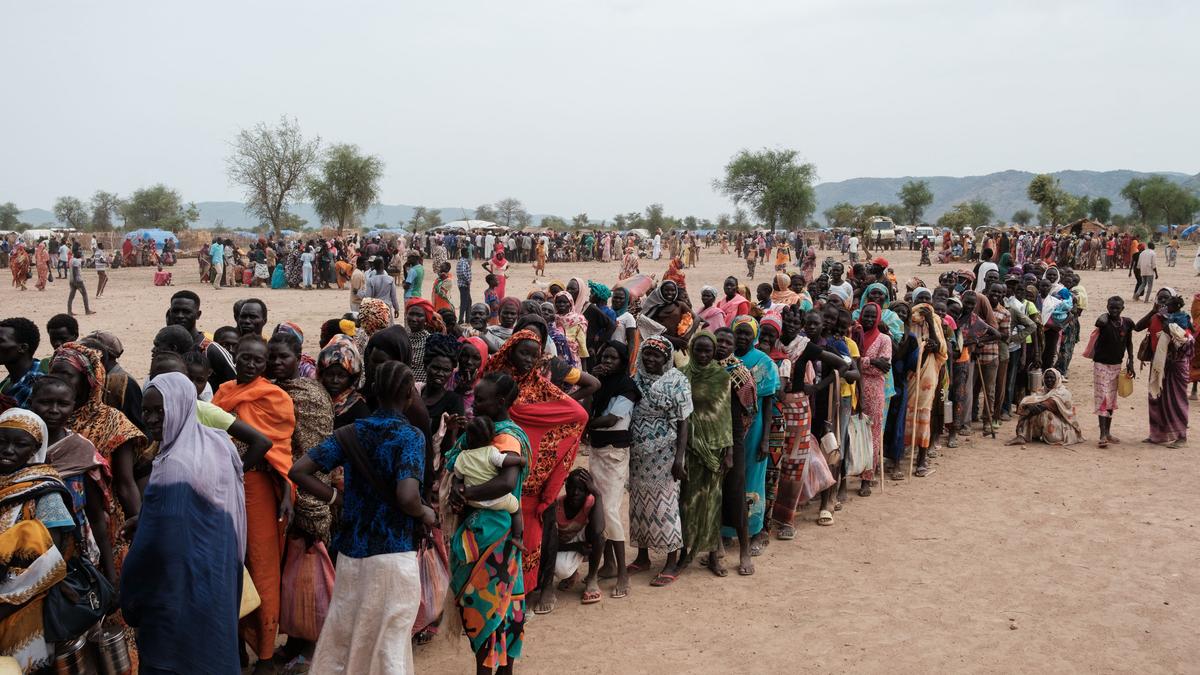
  • Over half of Sudanese face ‘acute food insecurity’: U.N.-backed report World
  • “Have A Desire To Participate In Elections From Andhra Pradesh”: Jaya Prada Nation
  • UK’s Princess Anne In Hospital With ‘Minor Injuries And Concussion’: Palace World
  • Shahjahan Sheikh’s CBI Custody Extended By 4 Days In Attack-On-Officers Case Nation
  • Asian Games 2023: Boxer Lovlina Borgohain Settles For Silver, Parveen Hooda Signs Off With Bronze Sports
  • England vs Australia Live Score Updates 1st T20I Sports
  • Helicopter Crashes Into Roof Of Australian Hotel, Hundreds Evacuated World
  • “Why Others Get More Games To Fail, I Get One?”: R Ashwin’s Explosive Remark Ahead Of 100th Test Sports

Whales near Antarctica face dire competitor for krill: industrial fishing

Posted on September 12, 2024 By admin


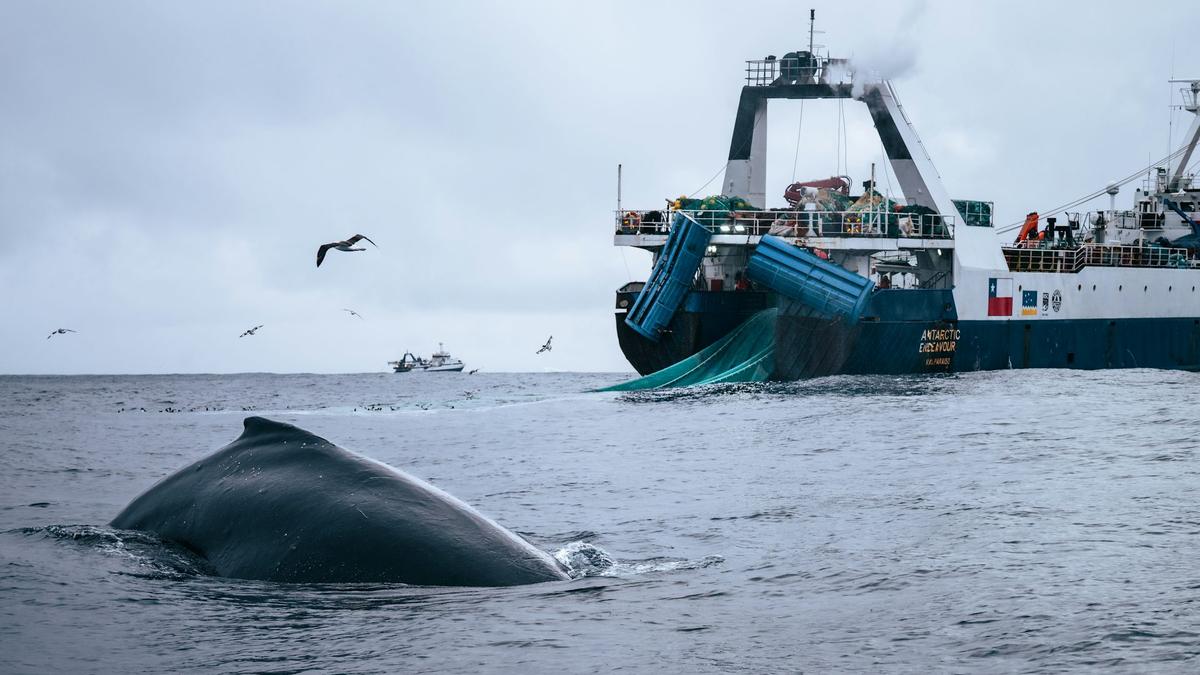
A humpback whale surfaces near two trawlers. All are pursuing Antarctic krill.
| Photo Credit: Youenn Kerdavid/Sea Shepherd Global (CC BY-ND)

The Southern Ocean encircling Antarctica is the world’s largest feeding ground for baleen whales – species like humpbacks that filter tiny organisms from seawater for food. In the 20th century, whalers killed roughly 2 million large whales in the Southern Ocean. Some populations, like the Antarctic blue whale, were reduced by more than 99% and have been struggling to recover, even though most nations ended commercial whaling in the mid-1980s.

Today a new threat is emerging: industrial fishing for Antarctic krill – tiny swimming crustaceans, roughly 6 cm long. In a newly published study, colleagues and I found that competition with this burgeoning fishery may impede whales’ recovery.

I first learned about this issue in early 2022, when a colleague working aboard a cruise ship told me that he had seen approximately 1,000 fin whales feeding on krill near the South Orkney Islands, just north of Antarctica. This was probably the largest aggregation of baleen whales seen since the 1930s, at the peak of industrial whaling.

My friend also reported that four enormous fishing boats were weaving among the huge group of whales, with large nets deployed. Like the whales, they were fishing for Antarctic krill.

Because the Southern Ocean is so remote, few people realised that krill fishing was competing directly with whales. Together with colleagues from Stanford and the University of Washington, we wrote about this observation in 2023 to draw attention to the potential threat to recovering populations.

We were soon contacted by Sea Shepard Global, a non-profit organisation that works to protect marine wildlife and had been monitoring this situation for several years. They reported that direct overlap between foraging whales and active fishing operations was common.

Now, krill fishing is on the verge of expanding. Along the Antarctic Peninsula, the fishing industry has proposed increasing the catch limit fourfold, from 155,000 tons to 668,101 tons annually.

Nearly all of this catch is used to make two products: fish meal for aquaculture, and omega-3 dietary supplements. Most of the fish meal feeds farmed salmon, which develop their familiar pink colour from consuming the food.

Meanwhile, whales are competing with fishing boats for the animals’ sole food supply. Whales feed for roughly 100 days out of each year; depending on the species, an adult whale may consume one to six tons of krill in a day.

Most baleen whales use a strategy called lunge feeding: They swim rapidly toward a swarm of krill, opening their enormous mouths at the exact right moment. Then they close their jaws and force the seawater out through the bristly baleen plates in their mouths, filtering the krill from the water.

This behaviour consumes a lot of energy, so the whales target large, dense swarms of krill – and so do fishing boats. From 2021 through 2023, four humpback whales died after becoming entangled in krill fishing nets.

The Commission for the Conservation of Antarctic Marine Living Resources, an international organization that manages use of the Southern Ocean, is required to ensure that whales and other krill-dependent populations are not harmed due to fishing. However, the commission operates by consensus, so if one member state opposes an action, nothing changes.

Member states have stalled proposals to create marine protected areas in the Southern Ocean and regulate krill fishing more tightly. A coalition is pressing for stricter limits, but Russia and China have resisted. Our work shows that if Antarctic krill fishing expands without strict guardrails to protect wildlife, baleen whales’ fragile comeback could be halted or even reversed.

Matthew Savoca is a research scientist, Stanford University. This article is republished from The Conversation.

The Conversation

Published – September 12, 2024 03:25 pm IST


Source link

Science

Post navigation

Previous Post: How A New Approach Is Needed Now To Fight Terrorism
Next Post: “Business Of India Bashing…”: Sunil Gavaskar Slams Michael Vaughan’s ‘Sachin Tendulkar-Joe Root’ Take

Related Posts

  • The Science Quiz | Exploring superfoods and beyond Science
  • India selects two astronaut-designates for upcoming Axiom-4 mission to International Space Station Science
  • A wild orangutan used a medicinal plant to treat a wound, scientists say Science
  • Muscle, wood, coal, oil: what earlier energy transitions tell us about renewables Science
  • 150% customs duty on lab chemicals alarms scientists Science
  • What makes the brain the most complicated object in the universe Science

More Related Articles

How does using the AC affect a car’s mileage while driving? Science
New mpox clade Ib disproportionately affects children Science
Negotiating a life with amyotrophic lateral sclerosis Science
H5N1 outbreak: route of mammalian transmission among cattle unclear Science
Communication a vital skill in today’s era of AI: Vishwanathan Anand Science
India may have had 11.9 lakh excess deaths due to pandemic in 2020: study Science
SiteLock

Archives

  • September 2024
  • August 2024
  • July 2024
  • June 2024
  • May 2024
  • April 2024
  • March 2024
  • February 2024
  • January 2024
  • December 2023
  • November 2023
  • October 2023
  • September 2023
  • August 2023
  • July 2023
  • June 2023
  • May 2023
  • April 2023
  • March 2023
  • February 2023
  • January 2023
  • December 2022
  • November 2022
  • October 2022
  • September 2022
  • August 2022
  • July 2022
  • June 2022
  • May 2022

Categories

  • Business
  • Nation
  • Science
  • Sports
  • World

Recent Posts

  • Trilobite fossils from upstate New York reveal extra set of legs
  • “Time To Overhaul AIFF”: India Great’s ‘Decline’ Remark In Explosive Rant
  • 9-Year-Old Girl Student Dies Of Cardiac Arrest While Playing In Lucknow School
  • U.S. calls on India, other countries to also ban RT, Russian media organisations
  • “Played With Me In IPL…”: Shocked India Star On Being Sledged By Joe Root

Recent Comments

  1. TpeEoPQa on UP Teacher Who Asked Students To Slap Muslim Classmate
  2. xULDsgPuBe on UP Teacher Who Asked Students To Slap Muslim Classmate
  3. KyJtkhneiLmcq on UP Teacher Who Asked Students To Slap Muslim Classmate
  4. mOyehudovB on UP Teacher Who Asked Students To Slap Muslim Classmate
  5. GFBvgSrWPcsp on UP Teacher Who Asked Students To Slap Muslim Classmate
  • How Rise In Ocean Temperatures Is Threatening Marine Life World
  • Babar Azam-Iftikhar Ahmed Register Third-Highest Partnership In ODI Asia Cup History Sports
  • CEO dissatisfied with gaps in arrangements for conduct of elections Nation
  • New science research board ‘takes effect’, Science Minister Science
  • Chennai Lions vs Athlead Goa Challengers, Ultimate Table Tennis 2024: Live Score Updates Sports
  • Explained | Israel’s limited military operation in Rafah World
  • NDTV Tops Reuters Institute Survey On India News Sources, 4th Time In Row Nation
  • “Pakistan Stars Accepted US $2500 For…”: Board To Take Strong Action Against ‘Indisciplined, Careless’ Stars Sports

Editor-in-Chief:
Mohammad Ariff,
MSW, MAJMC, BSW, DTL, CTS, CNM, CCR, CAL, RSL, ASOC.
editor@artifex.news

Associate Editors:
1. Zenellis R. Tuba,
zenelis@artifex.news
2. Haris Daniyel
daniyel@artifex.news

Photograher:
Rohan Das
rohan@artifex.news

Artifex.News offers Online Paid Internships to college students from India and Abroad. Interns will get a PRESS CARD and other online offers.
Send your CV (Subjectline: Paid Internship) to internship@artifex.news

Links:
Associate Journalism
About Us
Privacy Policy

News Links:
Breaking News
World
Nation
Sports
Business
Entertainment
Lifestyle

Registered Office:
72/A, Elliot Road, Kolkata - 700016
Tel: 033-22277777, 033-22172217
Email: office@artifex.news

Editorial Office / News Desk:
No. 13, Mezzanine Floor, Esplanade Metro Rail Station,
12 J. L. Nehru Road, Kolkata - 700069.
(Entry from Gate No. 5)
Tel: 033-46011099, 033-46046046
Email: editor@artifex.news

Copyright © 2023 Artifex.News Newsportal designed by Artifex Infotech.