

Skip to content
  • Facebook
  • X
  • Linkedin
  • WhatsApp
  • YouTube
  • Associate Journalism
  • About Us
  • Privacy Policy
  • 033-46046046
  • editor@artifex.news
Artifex.News

Artifex.News

Stay Connected. Stay Informed.

  • Breaking News
  • World
  • Nation
  • Sports
  • Business
  • Science
  • Entertainment
  • Lifestyle
  • Toggle search form
  • Access Denied Sports
  • India-US Strategic Partnership Scaled New Heights: PM Modi
    India-US Strategic Partnership Scaled New Heights: PM Modi Nation
  • Access Denied World
  • “Brian Lara Would Be Happy”: Ex-KKR Captain’s Honest Take On Sunil Narine’s Knock vs DC
    “Brian Lara Would Be Happy”: Ex-KKR Captain’s Honest Take On Sunil Narine’s Knock vs DC Sports
  • China Removes Li Shangfu As Defence Minister From State Council Report
    China Removes Li Shangfu As Defence Minister From State Council Report World
  • Declared Dead, Rajasthan Man Breathes Moments Before Final Rites
    Declared Dead, Rajasthan Man Breathes Moments Before Final Rites Nation
  • Access Denied Sports
  • Access Denied Sports
What is vertical fiscal imbalance?

What is vertical fiscal imbalance?

Posted on September 6, 2024 By admin


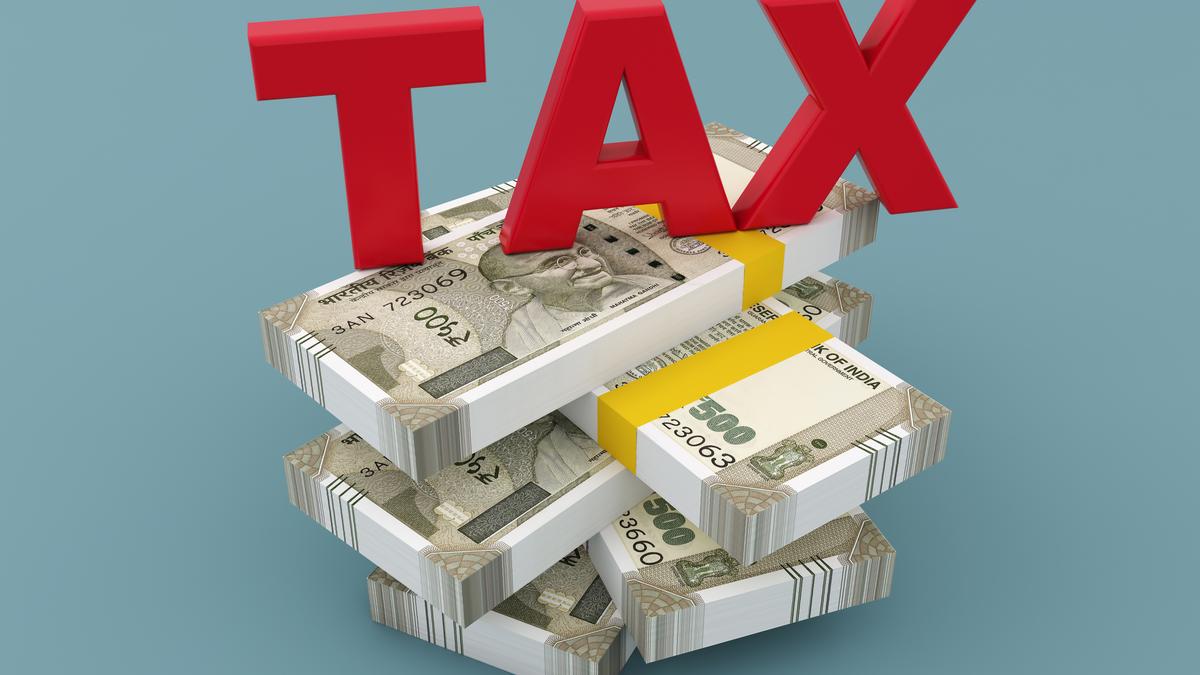
For representative purposes.
| Photo Credit: iStockphoto

The financial relationship between the Union government and the States in India is asymmetrical, as in many other countries with a federal constitutional framework. As the 15th Finance Commission noted, States incur 61% of the revenue expenditure but collect only 38% of the revenue receipts. In short, the ability of the States to incur expenditures is dependent on transfers from the Union government. Consequently, there is the problem of Vertical Fiscal Imbalance (VFI) in Indian fiscal federalism where expenditure decentralisation overwhelms the revenue raising powers of the States.

Why should VFI be reduced?

Constitutionally, the financial duties of the Union government and the States are divided. On the revenue front, to maximise the efficiency of tax collection, the Personal Income Tax, the Corporation Tax and a part of indirect taxes are best collected by the Union government. But on the expenditure front, to maximise the efficiency of spending, publicly provided goods and services are best supplied by the tier of the government closest to its users. It is in this context that the extent of VFI merits attention.

The 15th Finance Commission had noted that India has had a larger, and rising, vertical imbalance than most other federations. These imbalances were further magnified during periods of crises, such as the COVID-19 pandemic, which drove a large wedge between one’s own revenues and expenditure responsibilities at the sub-national level.

The problem of VFI falls under the purview of the Finance Commission, and it deals with broadly two questions. The first question is how to distribute the taxes collected by the Union government to the States as a whole. These transfers are made as a prescribed share of the “Net Proceeds” (Gross Tax Revenue of the Union less surcharges, cesses and costs of collection). The second question is how to distribute taxes across States. The matter of VFI arises as part of the first question.

Apart from devolving taxes, the Finance Commissions also recommend grants to States in need of assistance under Article 275 of the Constitution. But these are generally for short periods and for specific purposes. There are also transfers to the States that fall outside the Finance Commission’s ambit. For example, the Union government spends substantial amounts — under Article 282 of the Constitution — on subjects falling in the State and Concurrent lists through centrally sponsored schemes and central sector schemes. But such grants are tied transfers that include conditionalities. In sum, the devolution of taxes from the net proceeds is the only transfer to the States that is untied or unconditional.

Calculating VFI in India

Here we try to estimate the VFI in India after the devolution of taxes to the States. We measure VFI at the level of “all States”, and not separately for each State. For this, we use a globally accepted method. We first estimate a ratio where the numerator is the sum of the Own Revenue Receipts (ORR) and the tax devolution from the Union government for all States. The denominator is the Own Revenue Expenditure (ORE) for all States. If this ratio is less than 1, it implies that the sum of own revenue receipts and tax devolution of the States is inadequate to meet the ORE of the States. If we subtract this ratio from 1, we get the deficit in receipts. It is this deficit that we use as a proxy for VFI after devolution.
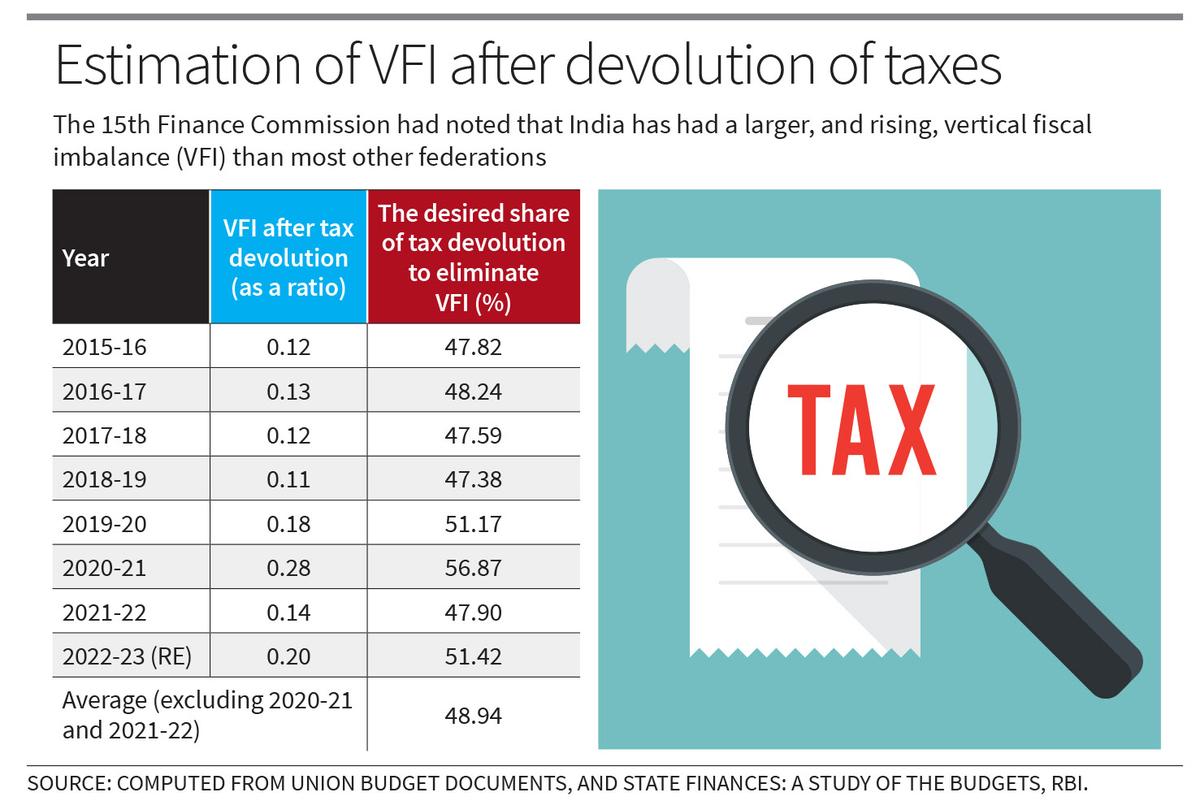
We can then ask the simple question: how much should tax devolution rise over and above that recommended by the past Finance Commissions to equalise the ratio to 1? Equating the ratio to 1 would eliminate VFI. In the attached table, we show that the average share of net proceeds devolved to the States between 2015-16 and 2022-23 should have been 48.94% to eliminate the VFI. But the shares of tax devolution recommended by the 14th and 15th Finance Commissions were only 42% and 41%, respectively, of the net proceeds.

Raising tax devolution

Many States have raised the demand that the share of tax devolution from the net proceeds must be fixed at 50% by the 16th Finance Commission. They add force to this demand by pointing to the exclusion from the net proceeds of the substantial amounts of cesses and surcharges, which truncates the net proceeds within the gross tax revenue.

Our analysis in this article lends empirical support to this demand. Here, we have assumed the present levels of expenditures of the States as a given. At the aggregate level, these actually incurred expenditures have not only conformed to but also underutilised the borrowing limits specified in the fiscal responsibility legalisations. Even then, we find that the share of net proceeds devolved to the States must rise to about 49% to eliminate VFI. Such an increase in devolution would place more untied resources in the hands of the States to spend on their citizens. It would also ensure that States’ expenditures better respond to jurisdictional needs and priorities, and that the efficiency of expenditures is enhanced. Overall, it will be a move towards a healthy system of cooperative fiscal federalism.

R. Mohan is former Indian Revenue Service officer. R. Ramakumar is Professor, Tata Institute of Social Sciences, Mumbai.

Published – September 06, 2024 08:30 am IST


Source link

Business

Post navigation

Previous Post: Cristiano Ronaldo Gets Emotional On Scoring Historic 900th Career Goal. Watch
Next Post: Madhya Pradesh Official Objects To Loud DJ Music, Beaten With Sticks: Cops

Related Posts

  • Govt extends duty-free imports of Urad till March 2026
    Govt extends duty-free imports of Urad till March 2026 Business
  • Rate cut hopes: at least one new MPC member a dove
    Rate cut hopes: at least one new MPC member a dove Business
  • Singapore Hosted Over 1.2 Million Visitors From India In 2025: STB Business
  • Finance Ministry notifies constitution of GST Appellate Tribunals
    Finance Ministry notifies constitution of GST Appellate Tribunals Business
  • SpiceJet’s Singh vies with Sky One in bidding for Go First
    SpiceJet’s Singh vies with Sky One in bidding for Go First Business
  • Access Denied Business

More Related Articles

Access Denied Business
IMF maintains 2024 global growth forecast, warns of inflation risk IMF maintains 2024 global growth forecast, warns of inflation risk Business
Markets drop in early trade dragged by Infosys, Axis Bank Markets drop in early trade dragged by Infosys, Axis Bank Business
Financial inclusion index rises with growth across all segments: RBI Financial inclusion index rises with growth across all segments: RBI Business
Access Denied Business
Cabinet to soon approve ₹37,500 crore incentive scheme to promote coal gasification projects Cabinet to soon approve ₹37,500 crore incentive scheme to promote coal gasification projects Business
SiteLock

Archives

  • May 2026
  • April 2026
  • March 2026
  • February 2026
  • January 2026
  • December 2025
  • November 2025
  • October 2025
  • September 2025
  • August 2025
  • July 2025
  • June 2025
  • May 2025
  • April 2025
  • March 2025
  • February 2025
  • January 2025
  • December 2024
  • November 2024
  • October 2024
  • September 2024
  • August 2024
  • July 2024
  • June 2024
  • May 2024
  • April 2024
  • March 2024
  • February 2024
  • January 2024
  • December 2023
  • November 2023
  • October 2023
  • September 2023
  • August 2023
  • July 2023
  • June 2023
  • May 2023
  • April 2023
  • March 2023
  • February 2023
  • January 2023
  • December 2022
  • November 2022
  • October 2022
  • September 2022
  • August 2022
  • July 2022
  • June 2022
  • May 2022

Categories

  • Business
  • Nation
  • Science
  • Sports
  • World

Recent Posts

  • Nicobarese oppose proposal for three wildlife sanctuaries
  • Visakhapatnam Collector calls for inter-departmental synergy to boost investments
  • Kohli’s masterful knock powers Royal Challengers to the top
  • Senior IPS officer Asra Garg posted IGP Intelligence
  • Vijay Narayan earns rare distinction of being Advocate General under two different governments

Recent Comments

  1. StevenLek on UP Teacher Who Asked Students To Slap Muslim Classmate
  2. Leonardren on UP Teacher Who Asked Students To Slap Muslim Classmate
  3. NathanQuins on UP Teacher Who Asked Students To Slap Muslim Classmate
  4. Davidgof on UP Teacher Who Asked Students To Slap Muslim Classmate
  5. NathanJobre on UP Teacher Who Asked Students To Slap Muslim Classmate
  • Odisha Teen Dies After Consuming Poison, Family Alleges Harassment By School
    Odisha Teen Dies After Consuming Poison, Family Alleges Harassment By School Nation
  • Access Denied Sports
  • Access Denied Sports
  • Joe Kent | The rebel within
    Joe Kent | The rebel within World
  • Access Denied Business
  • Indian-Origin Singaporean Jailed For Coughing At Others While He Had Covid
    Indian-Origin Singaporean Jailed For Coughing At Others While He Had Covid Nation
  • Access Denied Sports
  • Access Denied
    Access Denied Nation

Editor-in-Chief:
Mohammad Ariff,
MSW, MAJMC, BSW, DTL, CTS, CNM, CCR, CAL, RSL, ASOC.
editor@artifex.news

Associate Editors:
1. Zenellis R. Tuba,
zenelis@artifex.news
2. Haris Daniyel
daniyel@artifex.news

Photograher:
Rohan Das
rohan@artifex.news

Artifex.News offers Online Paid Internships to college students from India and Abroad. Interns will get a PRESS CARD and other online offers.
Send your CV (Subjectline: Paid Internship) to internship@artifex.news

Links:
Associate Journalism
About Us
Privacy Policy

News Links:
Breaking News
World
Nation
Sports
Business
Entertainment
Lifestyle

Registered Office:
72/A, Elliot Road, Kolkata - 700016
Tel: 033-22277777, 033-22172217
Email: office@artifex.news

Editorial Office / News Desk:
No. 13, Mezzanine Floor, Esplanade Metro Rail Station,
12 J. L. Nehru Road, Kolkata - 700069.
(Entry from Gate No. 5)
Tel: 033-46011099, 033-46046046
Email: editor@artifex.news

Copyright © 2023 Artifex.News Newsportal designed by Artifex Infotech.