




Skip to content
  • Facebook
  • X
  • Linkedin
  • WhatsApp
  • Associate Journalism
  • About Us
  • Privacy Policy
  • 033-46046046
  • editor@artifex.news
Artifex.News

Artifex.News

Stay Connected. Stay Informed.

  • Breaking News
  • World
  • Nation
  • Sports
  • Business
  • Science
  • Entertainment
  • Lifestyle
  • Toggle search form
  • Sydney McLaughlin-Levrone Sets 400m Hurdles World Record To Seal Olympic Berth Sports
  • Markets Open At Record High Business
  • Germany vs Hungary Live Streaming Euro 2024 Live Telecast: When And Where To Watch Sports
  • At Israel Music Fest, Hamas Gunman Fires At Toilets To Leave None Alive World
  • Gunman Arrested After Taking Passengers Hostage On Bus In Rio de Janeiro In Brazil: Cops World
  • How Odd Grace Marks Method Raised Red Flags In NEET-UG Nation
  • North Korea Says It Conducted “Tactical Nuclear Strike Drill” World
  • From Rinku’s Snub To Hardik’s Selection: Top Points Made By Rohit Sharma, Ajit Agarkar In Presser Sports

IIT Bombay researchers show one way how animals find their way home

Posted on August 28, 2024 By admin


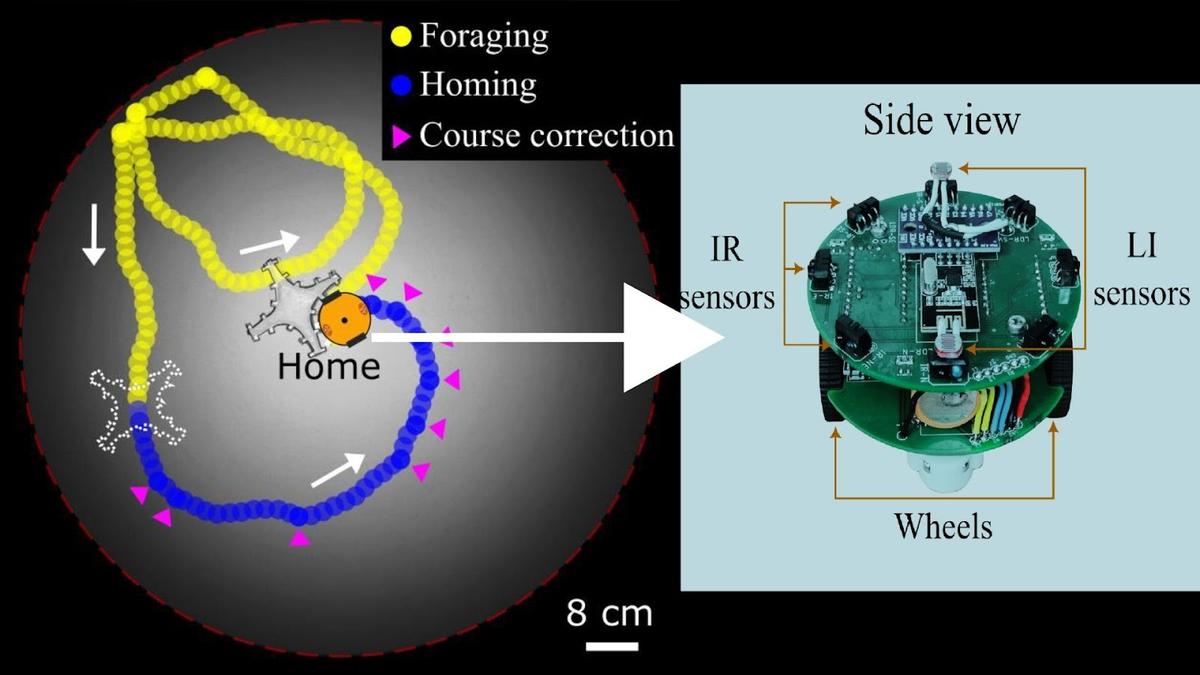
Path taken by the homing robot and a magnified view of the robot.
| Photo Credit: Special Arrangement

Researchers at IIT Bombay are using robots to understand how animals find their way back home from unfamiliar places, a skill called homing.

Nitin Kumar, assistant professor at the Department of Physics at IIT Bombay, explained, “The primary goal of our research group is to understand the physics of active and living systems. We achieve this by performing experiments on centimetre-sized self-propelled programmable robots. In simple words, we model these robots to mimic the dynamics of living organisms, both at the individual and collective levels.”

Homing is crucial for many life-forms, from birds flying thousands of kilometres during migration to ants finding their way back to their colonies after foraging. Humans have even harnessed this ability to train homing pigeons to deliver messages over long distances.

Dr. Kumar’s team has now developed a robot that mimics foraging and homing behaviour. This robot is designed to move on its own and use light as a guide to return home. In a new study, they have reported some principles of homing based on their studies with the robot.

The foraging robot is programmed to move semi-randomly, like how animals might wander when looking for food. This type of movement is called active brownian (AB) motion. The robot’s direction changes frequently due to rotational diffusion, a mechanism that introduces a certain level of randomness to its path. When the robot needs to return home, it shifts to a different mode that doesn’t include randomness inputs.

The researchers shone a beam of light on the robot; the light’s intensity changed gradually. The robot was programmed to follow this gradient light to find its way back, mimicking the way some animals use the Sun or other environmental light sources to find their way.

“The homing motion is similar to the AB model, except the robot undergoes frequent course corrections whenever it deviates significantly from its intended homing direction, as expected in actual living organisms” Dr. Kumar said.

In their study, the team determined the time the robot took to return home after being forced to deviate more and more from its homing path. They observed that the reorientation rate — the frequency with which the robot adjusted its direction to return home — was related to the degree of randomness in its path. They reported an optimal reorientation rate for a particular value of randomness; beyond this rate, the frequency of reorientations negated the effects of randomness and ensured the robot got home.

According to the researchers, this suggests animals may have evolved to reorient themselves at an optimal rate to efficiently find their way home, regardless of the noise or unpredictability in their environment.

“The observation of a finite upper limit on return times indicates that the homing motion is inherently efficient,” Dr. Kumar said. Our results demonstrated that if animals are always aware of the direction of their home and always correct their course whenever they deviate from the intended direction, they will surely get home within a finite time.”

To validate their findings, the researchers built a theoretical model that would predict how long a robot would take to reach home depending on its behaviour. The model was able to successfully explain the robot’s behaviour and also captured specific features of its homing path, Dr. Kumar said.

The model highlights the importance of reorientation as a strategy, showing that frequent course corrections are vital for efficient navigation, he added.

The team also ran computer simulations in which the robot’s movement mimicked certain animals. They matched the experimental results, reinforcing the idea that randomness and reorientation worked hand-in-hand to optimise homing. “When we applied this model to the trajectories of a real biological system of a flock of homing pigeons, it showed a good agreement with our theory, validating our hypothesis of enhanced efficiency due to frequent course corrections,” Dr. Kumar said.

This said, light-based cues are one of many involved in real-world navigation; others include social interactions, changing landscapes, and other environmental factors. “In our future research, we aim to model these scenarios in our experiment by using a combination of spatiotemporal variations in light intensity and physical obstacles,” Dr. Kumar said.


Source link

Science Tags:animal behaviour studies, animal homing skill, how to animals findd their way to home when lost

Post navigation

Previous Post: Virat Kohli, Yashasvi Jaiswal Move Up In Test Rankings, Rohit Sharma Slips To…
Next Post: South Korean teen activist hopes for landmark court ruling on climate change

Related Posts

  • Catalytic boost for cheaper biodiesel production Science
  • The ‘genomic accordion’ mpox viruses use to evolve, infect humans Science
  • How do some cancer cells survive chemotherapy? Scientists find one way Science
  • Sun bears appear so human-like they are mistaken for people in suits – experts explain Science
  • India’s space startup calls off maiden rocket launch for a fourth time Science
  • New NOvA data deepens mystery of subatomic particle’s mass Science

More Related Articles

Archaeologists, Sanskrit scholars tie up to decipher Rigveda text Science
New mpox clade Ib disproportionately affects children Science
SpaceX a week away from first private spacewalk Science
Scientists genetically modify ‘sexual’ fruit fly to reproduce asexually Science
Climbers have turned Mount Everest into a high-altitude garbage dump Science
Scientists discover the anatomy behind the songs of baleen whales Science
SiteLock

Archives

  • August 2024
  • July 2024
  • June 2024
  • May 2024
  • April 2024
  • March 2024
  • February 2024
  • January 2024
  • December 2023
  • November 2023
  • October 2023
  • September 2023
  • August 2023
  • July 2023
  • June 2023
  • May 2023
  • April 2023
  • March 2023
  • February 2023
  • January 2023
  • December 2022
  • November 2022
  • October 2022
  • September 2022
  • August 2022
  • July 2022
  • June 2022
  • May 2022

Categories

  • Business
  • Nation
  • Science
  • Sports
  • World

Recent Posts

  • 47 Indians rescued from cyber scam centres in Laos
  • China’s factory PMI adds to stimulus case
  • M Mukesh Need Not Resign As MLA Amid MeToo Allegations: CPI(M)
  • Do some spiders exploit firefly’s flashing signals to lure more prey?
  • The chemical treasury in garlic

Recent Comments

  1. TpeEoPQa on UP Teacher Who Asked Students To Slap Muslim Classmate
  2. xULDsgPuBe on UP Teacher Who Asked Students To Slap Muslim Classmate
  3. KyJtkhneiLmcq on UP Teacher Who Asked Students To Slap Muslim Classmate
  4. mOyehudovB on UP Teacher Who Asked Students To Slap Muslim Classmate
  5. GFBvgSrWPcsp on UP Teacher Who Asked Students To Slap Muslim Classmate
  • Battle Of The Teens: Lamine Yamal And Kobbie Mainoo Clash In Spain vs England Euro 2024 Final Sports
  • Indo-Bangladesh To Remain Open For 24 Hours For Students, Stranded People To Enter India Nation
  • Persistent Robert Lewandowski Secures Barcelona Win Over Athletic Bilbao Sports
  • Afghanistan Schools Restart, Girls Still Barred From Secondary School World
  • “Sad” Arvind Kejriwal To Tihar Jail Officials Nation
  • With Special Message For Rohit Sharma, Rahul Dravid’s Final Head Coach Speech Guarantees Goosebumps. Watch Sports
  • Donald Trump Explains Wife Melania’s Absence From 2024 Presidential Campaign World
  • Congress Launches ‘Kharche Pe Charcha’ Campaign Ahead Of Haryana Polls Nation

Editor-in-Chief:
Mohammad Ariff,
MSW, MAJMC, BSW, DTL, CTS, CNM, CCR, CAL, RSL, ASOC.
editor@artifex.news

Associate Editors:
1. Zenellis R. Tuba,
zenelis@artifex.news
2. Haris Daniyel
daniyel@artifex.news

Photograher:
Rohan Das
rohan@artifex.news

Artifex.News offers Online Paid Internships to college students from India and Abroad. Interns will get a PRESS CARD and other online offers.
Send your CV (Subjectline: Paid Internship) to internship@artifex.news

Links:
Associate Journalism
About Us
Privacy Policy

News Links:
Breaking News
World
Nation
Sports
Business
Entertainment
Lifestyle

Registered Office:
72/A, Elliot Road, Kolkata - 700016
Tel: 033-22277777, 033-22172217
Email: office@artifex.news

Editorial Office / News Desk:
No. 13, Mezzanine Floor, Esplanade Metro Rail Station,
12 J. L. Nehru Road, Kolkata - 700069.
(Entry from Gate No. 5)
Tel: 033-46011099, 033-46046046
Email: editor@artifex.news

Copyright © 2023 Artifex.News Newsportal designed by Artifex Infotech.