





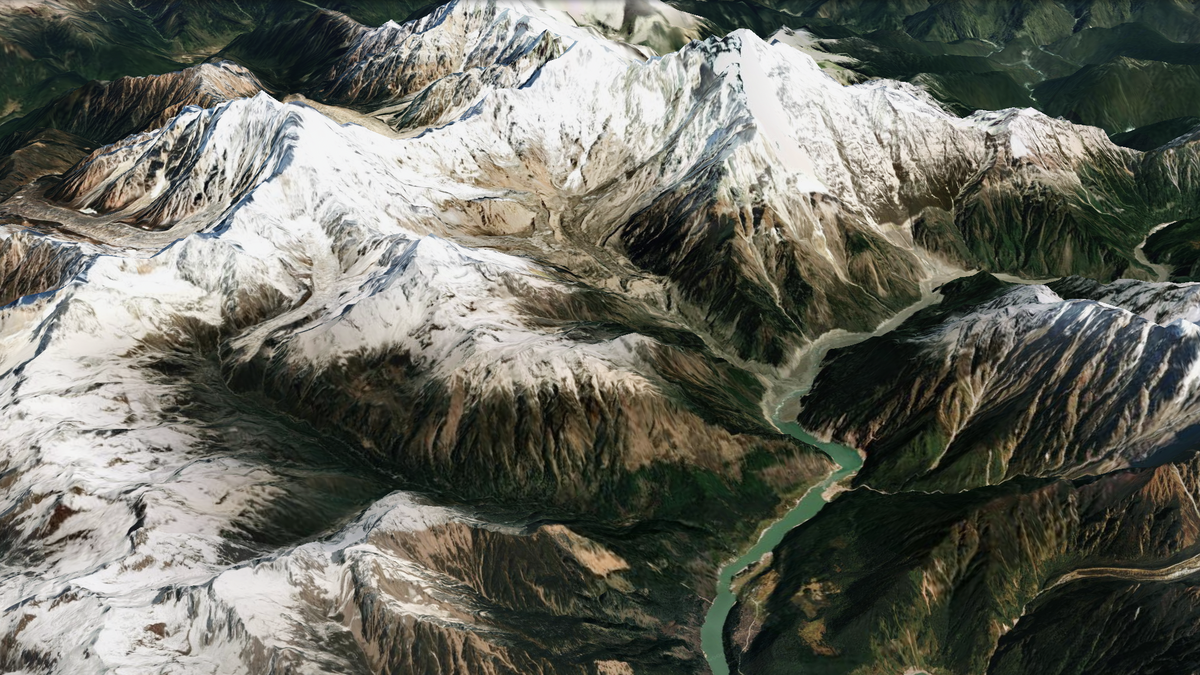
A bird’s eye view of the Sedongpu Gully in Tibetan China, visible just to the left of the Yarlung Tsangpo River at the centre of this image, December 30, 2020.
| Photo Credit: Google Earth
A new study on the high frequency of mass wasting events in the Sedongpu Gully of the Tibetan Plateau since 2017 and the rapid warming of the area, which rarely experienced temperatures beyond 0º C before 2012, could be bad signs for India, specifically the country’s Northeast.
A geological event, mass wasting is the gravity-influenced movement of rock and soil down a slope. A gully is a landform created by erosion from running water, mass movement or both.

The Sedongpu Gully, in the catchment of the Sedongpu glacier and its valley, is 11 km long and covers 66.8 sq. km. It drains into the Yarlung Zangbo, or the Tsangpo River, near where it takes a sharp turn — called the Great Bend — while flowing around Mt. Namcha Barwa (altitude 7,782 metres) and Mt. Gyala Peri (7,294 metres) to create a gorge 505 km long and 6,009 metres deep. This is one of the deepest gorges on the earth.
The Great Bend is close to Tibet’s border with Arunachal Pradesh, where the Tsangpo flows as the Siang River. In Assam further downstream, the Siang meets the Dibang and Lohit to form the Brahmaputra, which flows as the Jamuna in Bangladesh.
The study, authored by Weile Li and six others associated with China’s Chengdu University of Technology, was published on August 2 in the Journal of Rock Mechanics and Geotechnical Engineering.
According to their paper, more than 700 million cubic metres of debris have been mobilised in the Sedongpu gully catchment since 2017. The combination of long-term warming and intense local shaking due to earthquakes has greatly enhanced landslide activity in the area. The impact on humans has been low because it is so remote.
However, environment scientists in Assam said the study underlining landslides was ominous for areas hundreds of kilometres downstream. The threat has been accentuated by big dams such as the 510-MW Zangmu on the Tsangpo and India’s planned projects on the Siang.
River choking and flash floods
“China plans to set up a 60-gigawatt project on the Tsangpo, which will [have] thrice the capacity of the Three Gorges project on the Yangtze, the world’s largest hydropower plant,” said Partha Jyoti Das, the head of the Water, Climate, and Hazard Division of Aaranyak, a Guwahati-based biodiversity research organisation. “This region is characterised by enormous geophysical instability and experienced the 8.6-magnitude Assam-Tibet or Medog earthquake in 1950, one of the biggest of the 20th century. The 6.4-magnitude Nyingchi earthquake hit the same region in November 2017.”
“The Sedongpu study has serious implications for the Tsangpo-Siang-Brahmaputra-Jamuna, especially in India and Bangladesh. The most direct consequence could be the addition of major amounts of sediments to the course of the river, already one of the most sediment-laden rivers of the world,” he said.

The Brahmaputra carries more than 800 tonnes of sediment at Pandu in Guwahati, becoming more than a billion tonnes at Bahadurabad in Bangladesh. Dr. Das said increasing sedimentation may make the river more intensely braided in the Assam plains, which could lead to more bank erosion.
“The sedimentation can elevate the river beds more, accentuating flood hazards. Further, the channels of the river in Assam and Bangladesh may get choked with sand and silt in the lean season making navigation difficult and affecting livelihoods related to fishing,” he said.
The Sedongpu study examined the patterns of landslides in the gully catchment using satellite data from December 1969 to June 2023. From 149 satellite images, they identified 19 large mass-wasting events or event groups they divided into three sub-patterns: ice-rock avalanche (IRA), ice-moraine avalanche (IMA), and glacier debris flow (GDF). A moraine is a mass of rocks and sediment deposited by a glacier.
The debris from the IRAs temporarily blocked the Tsangpo and tributary Yigong. “The breaching of the blockages leads to catastrophic flash floods in the downstream areas such as the ones in Arunachal Pradesh’s East Siang and Assam’s Dhemaji district in 2000. These floods were triggered by the outburst of a dam created on the Yigong by the glaciated debris and rock materials generated during a huge landslide,” Dr. Das said.
Lull before hyperactivity
The Sedongpu study noted that the earliest mass wasting event in the area occurred from 1974 to 1975 and satellite images thereafter indicated no catastrophic events until 1987. Two IMAs happened from 1998 to 2000 and the gully remained quiet again from 2001 to 2017.
“The gully entered a very active period [in] 2017 with a large IRA from October 20-27 temporarily blocking the Yarlung Tsangpo,” the paper said, underlining the Nyingchi earthquake — its epicentre was 8 km from the gully’s edge — that disrupted the stability of the rocks and glaciers.
Three successive GDFs followed from November to December 2017 and two catastrophic IRAs occurred “unexpectedly” in 2018 to completely block the Tsangpo and form another gully more than 300 metres deep. “After these events, the Sedongpu gully entered an intense erosion period… Overall, among the 19 events, 13 were concentrated after 2017, accounting for 68.4% of the total,” the paper said.

The geoscientists said the bedrock of the Sedongpu basin consists mostly of Proterozoic marble and the conditions indicate its land surface temperature ranges from -5º to -15º C, rarely exceeding 0º C before 2012. Data from the nearby weather stations at Bomi and Linzhi revealed that the annual temperature in this area increased at rates of 0.34º to 0.36º C during 1981-2018, which is higher than the global average.
“It is high time we undertook similar studies to monitor the status and trends of geophysical events leading to landslides, rockfalls, and other erosional processes that could affect the geomorphic and hydrological regime of the Brahmaputra and its tributaries apart from attending to sediment management,” Dr. Das said.
rahul.karmakar@thehindu.co.in