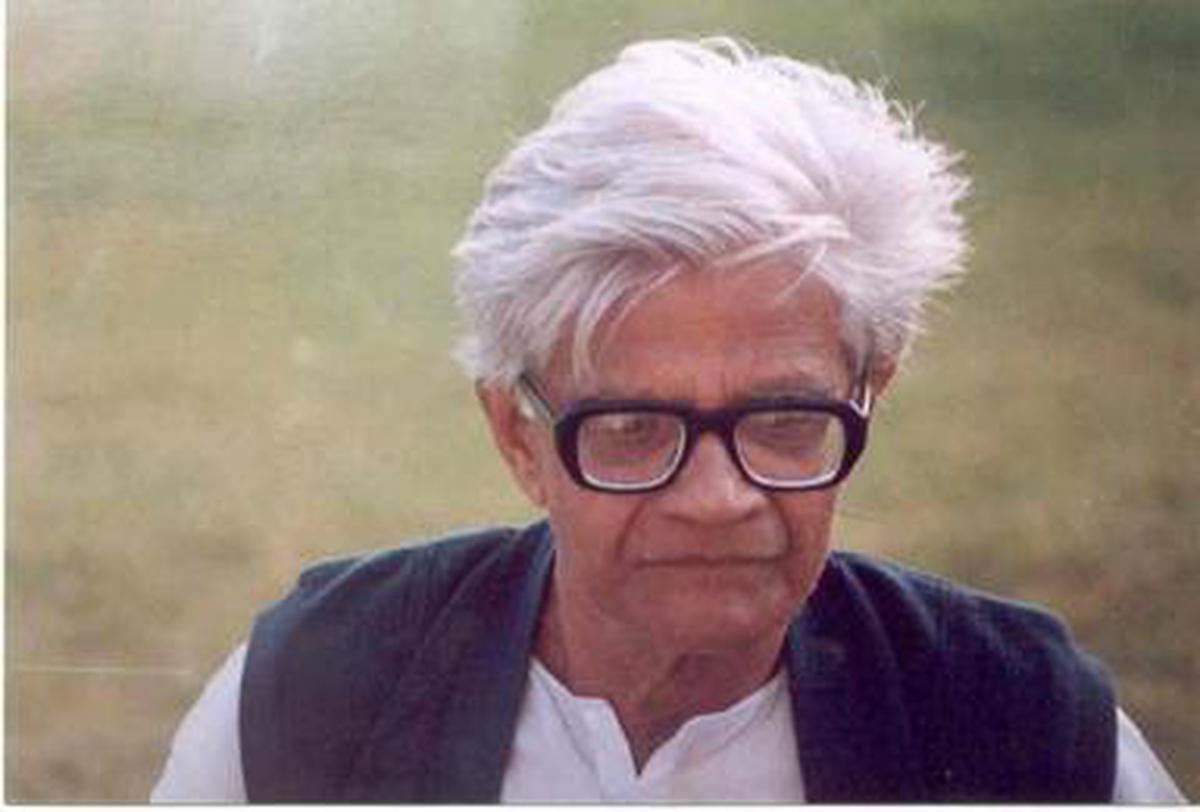



K.M. Ajith’s first research paper, co-authored with his supervisor in 2005, was about mathematical physics they had worked out in quantum field theory. The U.K. journal to which the paper was submitted had no hesitation in accepting the quality of the research work, yet the review was quite scathing.
“The reviewer pointed out grammatical errors, including for punctuation marks. And asked us to re-write from scratch,” says Mr. Ajith, who is now a professor at the National Institute of Technology, Karnataka.
The authors may have known quantum mechanics but not how to write succinctly. They asked for help from friends who were also pursuing research but whose English was better. Part of the difficulty was in rewriting the technical terms. Yet they managed to avoid jargon as much as possible to make it to the journal.
Mr. Ajith studied in a Malayalam medium school, and his exposure to English was minimal at that time. Twenty years into research and publishing, Mr. Ajith now speaks about why budding researchers should be good writers too.
India comes third after China and the U.S. in the number of research papers published, says a paper titled, Academic Writing in India: A Research Scholar’s View. But in the same paper, the authors also say the rejection rate of Indian papers is high, not so much due to poor research but more so due to weak language and grammar.
In a 2019 public notice, UGC said that writing programmes should be organised in research institutions to overcome this skill deficiency.
Somadatta Karak, head of science communication and public outreach at the Centre for Cellular and Molecular Biology, says, despite the courses, Indian students struggle with writing. She is concerned about the intensity and reach of the writing workshops and frameworks.
“When I go to tier 2 cities and take workshops on science communication, students there have not even heard or thought about all of these,” says Ms. Karak.
According to Kanika Singh, who directs the writing program at Ashoka University, the higher education system in India has no separate emphasis on writing. “If writing is institutionalised as part of your curriculum and you write in different ways daily, then your science research thesis will become better,” says Ms. Singh.
Eldho Mathews, programme officer (Internationalisation of Higher Education), The Kerala State Higher Education Council, says even students who join top-tier research institutions are trained in a way that gives little importance to writing.
“At the level of screening [for admissions to research institutions], it is important to evaluate the level of language skills. By incorporating this factor into testing systems, the government and institutions can effectively motivate students to develop their writing skills early on,” he said.
Why writing should be taught as core skill
Asha Channakar, a researcher at the Institute for Stem Cell Science and Regenerative Medicine (InStem), Bengaluru, had a similar experience like Mr. Ajith with her first paper. “The first time I wrote, it took a lot of time to understand how to write.”
Ms. Channakar says that when she started to write, she read a lot of papers, and tried to connect the writing and presentation with what she wanted to convey. This was while she was a project assistant at the National Brain Research Centre in 2019. Later, she took research writing classes at the National Centre for Biological Sciences as part of her PhD at InStem.
“They taught how to write a scientific manuscript, and there was also an assignment to write for the non-scientific community,” says Ms. Channakar. She has now grown to become the first author of a paper published recently at InStem.
Ranjana Sarma, who has a PhD in Biochemistry from Montana State University, says, “Our researchers struggle with the flow of ideas more than the language.”
Unlike Mr. Ajith and Ms. Channakar, Ms. Sarma got the benefit of the U.S. research ecosystem. When she first wrote a review paper, the feedback was, “Ranjana doesn’t know English.”
“Coming from India, this was a huge ego-crusher,” says Ms. Sarma, who consistently scored high in English back home.
In 2004, she was put into a course offered by Penn State University to learn not only writing but also how to present and peer review. In the U.S., she learned that writing should be simple and easy to read with short sentences. The writing classes Ms. Sarma took influenced her not only to write but also to think and how to pay attention to what she reads.
“Language does look like a challenge for most researchers, as they write in a heavy, academic style. Despite English being the language of science in India, most researchers find it difficult to express themselves in plain, simple English,” says Subhra Priyadarshini, Chief Editor of Global Supported Projects, Nature Portfolio.
Can AI help?
Of late, students use software like Grammarly to correct language and grammar. Although Mr. Ajith appreciates such software, he also says that the tools will not help students to do the critical thinking while writing. “Grammarly is not writing a paper for you; all it does is to check the grammar of what you have already written,” says Anannya Dasgupta, Associate Professor of literature and arts at Krea University, Andhra Pradesh.
Ms. Dasgupta, who is now the director of the Centre for Writing and Pedagogy at Krea University, started her writing stint as a course coordinator while pursuing her PhD at Rutgers University, the U.S. According to Ms. Dasgupta, to improve the quality of writing, more people should be trained to teach writing.
Teaching writing also involves teaching how to think through the questions and how to build an argument, says Pooja Sagar, who teaches the Writing for Research and Analysis at the Indian Institute for Human Settlements (I.I.H.S.), Bengaluru.
Can AI help? Almost all the established researchers said it could help to an extent. But at the level of research papers, a lot of critical thinking is required that AI can’t deliver. They also cautioned about AI providing false information.