



In August 2024, Bangladesh witnessed one of the most significant political upheavals in its recent history.
Also Read: Bangladesh jailbreaks a worry for India: think tank
What began as a protest against a controversial quota system in government jobs evolved into a nationwide movement that ultimately led to the ouster of Prime Minister Sheikh Hasina, Bangladesh’s longest serving political leader (from 1996-2001 and 2009-2024). The irony is that both the government and the students were initially aligned in their desire for quota reform, with the government preparing to appeal against the court order that led to the restoration of the quota system. The inevitable question then is what could have gone so wrong that the world’s longest serving female head of government was ousted within a week?
This movement was primarily led by students not affiliated with any political party, making it a genuinely organic uprising. The spark that ignited the protests came on June 5, when the High Court re-established a job quota reserving 30% of civil service posts for the children and grandchildren of freedom fighters of Bangladesh’s liberation war. This reignited a long-standing debate about the fairness of the quota system in government employment.
Also Read: Our intelligence failed to predict Bangladesh crisis, say experts
Initially, protests were peaceful and as the movement gained momentum, by July 7, students had escalated their actions, staging blockades and demanding rescinding of the quota. On July 10, a student’s blockade severely affected Dhaka’s transport system.
As the movement grew, so did the tension between the protesters and authorities. On July 14, a controversial statement by Prime Minister Hasina, referring to protesters as the “children of Razakars” (collaborators of Pakistani forces during the 1971 war), inflamed the situation. Ms. Hasina’s aggressive stance and derogatory comments aggravated the protesters, and the government had to shut down the internet to disrupt communication among protesters.
The last nail in the coffin was unleashing the Bangladesh Chhatra League, the much despised student wing of the ruling Awami League, who attacked protesters, which rapidly escalated and galvanised the movement as protests spread nationwide, with students from schools, colleges, and private universities joining. Major highways and railway lines were blocked, bringing much of the country to a standstill.
The government announced indefinite closure of all educational institutes. The situation reached a critical point on July 18 when approximately 20 students were killed amid clashes between the protesters and police. Thus, negotiations between the government and protest leaders began on July 19. However, these talks were marred by allegations of government coercion and the disappearance of key coordinators.
The beginning of the end
On July 21, the Supreme Court reduced the quota percentage from 30% to 7%. This was seen as a potential breakthrough, but it failed to quell the unrest due to the arrests of student protest coordinators. The movement persisted, with protesters resuming large-scale demonstrations on July 29 after the government ignored an ultimatum to release their leaders.
On August 2, the situation escalated with renewed clashes between protesters and police. The movement reached its climax on August 3 when the students movement announced their single key demand — the resignation of Sheikh Hasina. They called for a non-cooperation movement from August 4, effectively marking the end of the quota protests and the beginning of a broader anti-government movement. Violence shook the nation, with the death toll climbing to a nearly 100 people — the highest and deadliest death toll for a single-day protest in the nation’s history.
Public anger mounted, and on August 5 the “March to Dhaka” brought hundreds of thousands to the streets in Dhaka and other surrounding towns. It was at this point that law enforcers realised the situation was beyond control and advised Ms. Hasina to step down. She reportedly refused and urged for more forceful measures to subdue the crowd. In a crucial turn of events, the army refused to comply. Faced with a refusal from the military and a massive public uprising, Ms. Hasina finally fled the country. A revolution spearheaded by students succeeded in toppling an increasingly authoritarian regime that had been in power for 15 years.
The opposition and India’s position
Throughout this period, protests were marked by a complex interplay of various actors. Students formed the core of the movement, but with the loss of innocent lives, it increasingly became a mass popular movement joined by parents, teachers, lawyers, cultural activists, artists, professionals and civil society members. The international community also took notice, with organisations like UNICEF expressing concern over the deaths of at least 32 children during the crackdown. The protests highlighted deep-seated issues in Bangladesh’s political and social fabric, including concerns about authoritarian rule, lack of participative democracy, nepotism, corruption, and suppression of dissent.

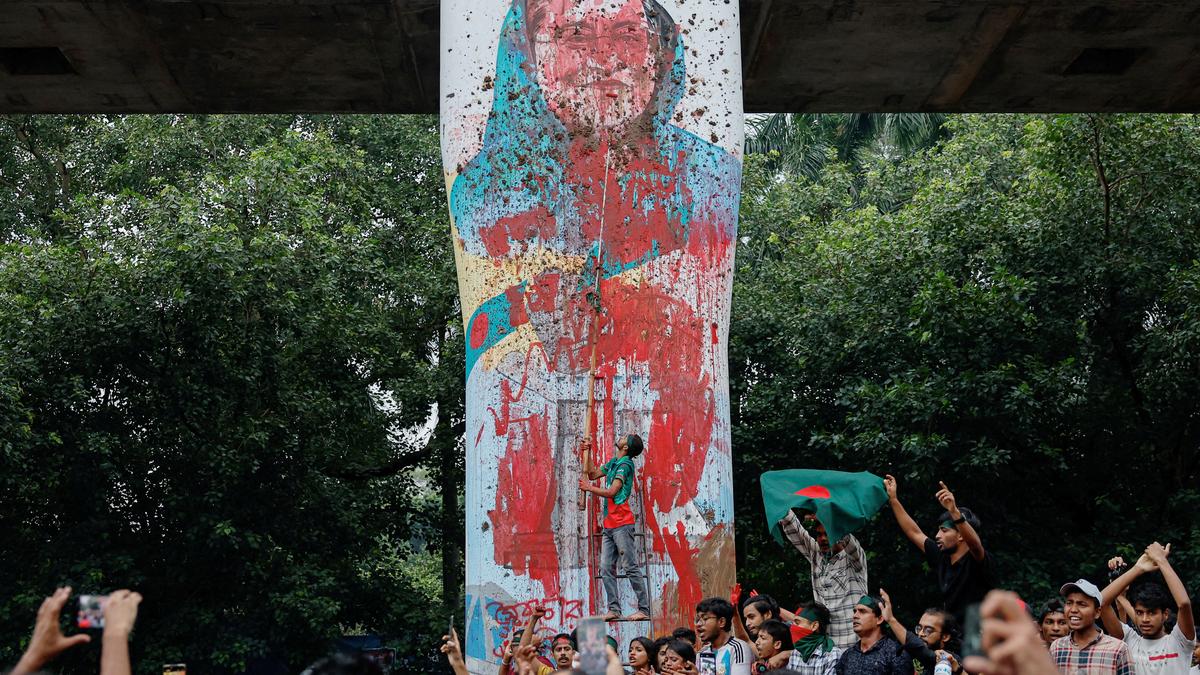
In the aftermath of Ms. Hasina’s departure, there was an outpouring of pent-up anger towards anything associated with her and the Awami League. This included desecration of statues and murals of Sheikh Mujibur Rahman, father of Sheikh Hasina who led Bangladesh’s war of liberation. Even if there is some element of truth in Awami League’s claim that the student movement was exploited by opposition parties, led by the Bangladesh Nationalist Party (BNP) and the right wing Jamaat-e-Islami, it does not take away from the fact that anger and discontent had been fuelling below the surface for a long time due to Ms. Hasina’s repressive style of governance wherein she suppressed opposition and presided over three controversial, non-participative elections in 2014, 2018, and 2024. If the opposition took advantage, hiding behind the cloak of the student movement, and unleashed unacceptable violence resulting in the loss and damage of public property and killing of law enforcers, Awami League can’t avoid responsibility by letting a one-point quota reform movement spiral out of control because of the sheer arrogance and high handedness it displayed from the very beginning.
The Indian government’s response, articulated by Foreign Minister S. Jaishankar on August 6, was notable for its omission of human rights violations and killings that had occurred. It appeared to downplay the democratic nature of the movement, instead framing it in a way that aligned with the Awami League’s narrative of external instigation. This approach has been criticised for failing to recognise the genuine grievances and widespread public discontent that fuelled the protests. India’s policy of turning a blind eye to Ms. Hasina’s exercise of hard power, often justified by some of the commendable economic progress and relative stability achieved during her rule, did not go well in Bangladesh. Most Bangladeshis view India’s relations as being aligned with one particular party and one person as opposed to the people of Bangladesh. This presents a challenge for India’s diplomacy and the need for having a more nuanced understanding of Bangladesh’s socio-political landscape.
As aptly stated by Shivshankar Menon, India’s former National Security Adviser and Foreign Secretary, “Primarily, it was a people’s movement. It was a revolution on the streets, and we should recognise it as such rather than looking for foreign influences or purely political explanations.” Additionally, the role of a section of the Indian media did not go well in Bangladesh where exaggerations and at times outright fake news, as verified by credible sources like BBC, about the persecution of Hindu minorities generated anger and resentment in Bangladesh when policies such as the Citizenship (Amendment) Act, 2019 and the persecution of Muslims in India in the last decade are fresh in their minds. While there may have been instances of attacks on minorities, what was notable is the open public vigil by students, activists, and even opposition parties against attack on minorities, particularly Hindus, with helplines and phone numbers given out for seeking support should any such attack take place. Professor Muhammad Yunus visited the Dhakeshwari National Temple, exchanged greetings with leaders of the Hindu community, and assured them of their safety and security.
What next?
As the movement transitioned from quota reform protests to a broader call for political change, Bangladesh is entering unchartered territory. Depending on how things unfold in the coming months as the interim government takes the reign of power, South Asia’s rising star is facing one of its biggest challenges on the path to achieving a pluralistic society based on democratic principles, rule of law, good governance, inclusive growth, and human rights. The events of 2024 would have far-reaching implications for the country’s political landscape, governance structures, and social dynamics.
Also Read: Nearly 650 people killed in recent spate of violence in Bangladesh: UN report
Given the open enmity Ms. Hasina displayed against the interim government leader Prof. Yunus, including the alleged corruption charges brought about by her government against the Nobel laureate, which he termed as politically motivated, the challenge for Prof. Yunus would be to rise to the occasion and hold a free, fair, and participative election in contrast to what the Awami League did for 15 years.
For India, the takeaway is the importance of engaging with the broader population rather than relying solely on relationships with one individual or party. Embracing the truth helps in the long run as opposed to either being in a state of denial or continuing the justification of misperceptions. After all, Bangladeshis know their country better than outsiders, including their friends and neighbours.
Syed Munir Khasru is chairman of the Institute for Policy, Advocacy and Governance, an international think tank.